Outside spending propelled Ted Budd to Congress. Trump has him close to a Senate seat.
READ MORE
The Charlotte Observer Voter Guide 2022
Information on where to vote, the candidates, how to vote and more.
Expand All
The Republican nomination for U.S. Senate is Rep. Ted Budd’s to lose.
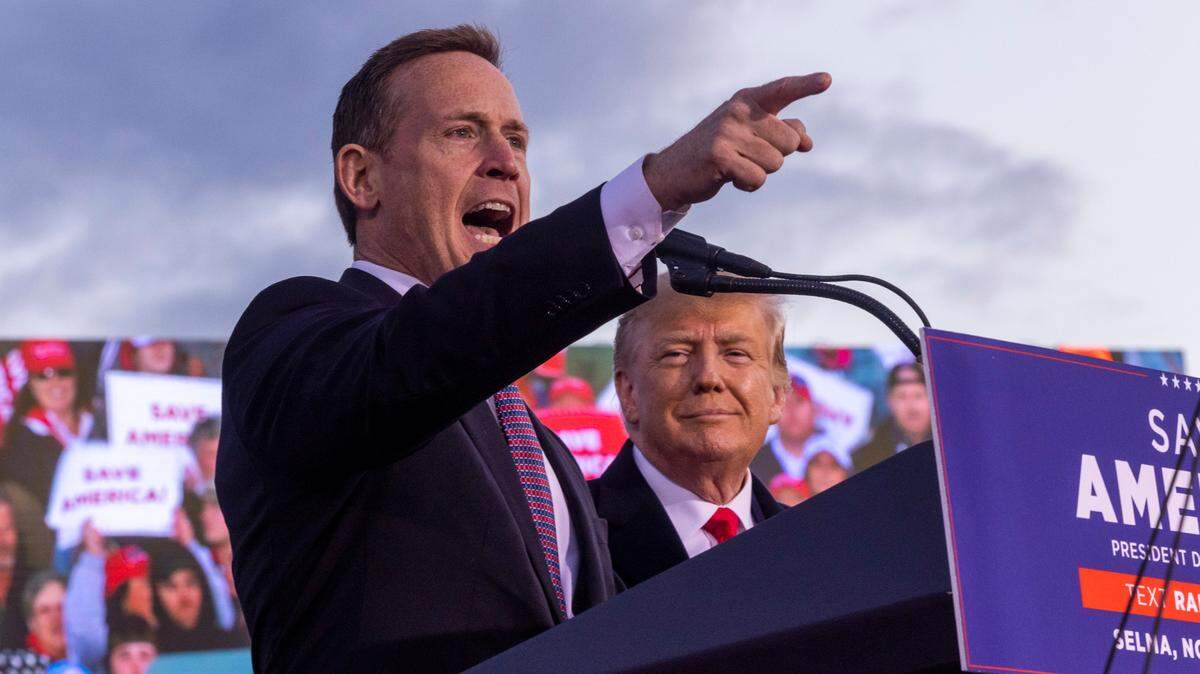
The Davie County native is leading by double digits in recent polls ahead of his opponents, former Gov. Pat McCrory, former U.S. Rep. Mark Walker and political newcomer Marjorie Eastman. He’s skipping debates, betting that he doesn’t need them to win the GOP primary election. Instead, he’s likely benefiting from the millions of dollars that a conservative group is spending on his campaign plus his endorsement by former President Donald Trump, who remains popular among Republicans.
Last April, Budd traveled to Trump’s home of Mar-a-Lago to discuss a possible run for Senate. Five days later he announced.
Walker had already been campaigning for months, and McCrory had statewide name recognition. Winning did not seem to be an easy feat for Budd.
But everything changed on June 6, when Trump pulled Budd aside at the Republican state convention in Greenville and told him that in a few minutes he would take the stage and give him his endorsement.
“He said, ‘Ted, I’m endorsing you because you’ve never wavered on your America First principles,’” Budd recalled to McClatchy this month. “My style is different. I tell people it is very North Carolinian, but he knows that I have not wavered on the principles that have made this country great and can make it great again.”
Carter Wrenn, a longtime Republican operative, said Trump’s backing “probably helped Budd, but it wasn’t a decisive factor in the primary. I think the reason you see Budd moving up — some of it’s Trump’s endorsement – but more of it is Club For Growth.”
Budd wasn’t well-known outside his district. But that’s all changing now that the Club for Growth plans to spend $14 million backing him.
“These are astronomical numbers the Club For Growth is putting behind Ted Budd,” said Chris Cooper, a political science professor at Western Carolina University. “It appears to be working.”
Family business
Budd, 50, grew up on a 300-acre cattle and commercial chicken farm in Davie County. The farm served as a Tyson Chicken egg hatching operation between 1981 and 2001.
Budd, as he grew up, worked alongside his family on the farm. He cleaned out the chicken houses and the toilets, mowed the grass, put out the pine straw, loaded and unloaded trucks, drove the forklift and the tractor and worked the cattle.
Meanwhile, his father, Richard Budd, was rebuilding a struggling janitorial supply company he bought out of Winston-Salem in 1963. He turned that company into The Budd Group, a janitorial, maintenance and landscaping company that now employs thousands across the Southeast.
“You just get to see what an entrepreneur does,” Budd said, of watching his dad work on the farm and build his company. ”Late nights, early mornings and just the grind that makes you love the American dream. I’m so proud of what he has done and wanted to make things better for other people.”
In campaign disclosures, Budd reported assets worth between roughly $3 million and $10 million owned by himself and his wife and children, including those tied to family businesses.
Todd Kiger, Ted Budd’s friend since their sophomore year of high school in 1988, said Budd’s father is a man of integrity and a good businessman and that’s reflected in his son.
“Ted Budd is the kind of guy where his handshake has meaning and value,” Kiger said, adding that his parents instilled that in him. “I’ve always been impressed with their values.”
The family business has made an appearance in the primary campaign. The Washington Post reported that a seed company led in part by Budd’s family declared bankruptcy and failed to make millions of dollars in payments to farmers — but did repay a loan, with interest, that had been signed by Budd and 10 others. A dispute with the farmers led to a lawsuit and then a settlement. Budd’s campaign said he had never been involved with the company, AgriBioTech, where he was a shareholder but not an officer.
College, family and the farm
College took Budd to Appalachian State University. It was there that he traveled in 1991 on a mission trip to what was then the Soviet Union and met his wife, Amy Kate.
Together, the couple has raised and homeschooled three children. Their youngest is about to graduate high school.
Budd earned master’s degrees in business administration and theology.
In 2010, Budd opened ProShots, a gun store and range in Rural Hall. He’s an ardent supporter of the Second Amendment, which gives U.S. citizens the right to bear arms.
Budd said his backstory allows him to relate to his constituents and stand out from his opponents.
“I would not bill myself as a farmer but somebody who lives on a family farm,” Budd said. “My neighbors work way too hard to call themselves farmers and I’m not going to steal anything — I would not take any credit from them.”
Help in an election
In 2016, a federal court ruled that two congressional districts had been racially gerrymandered and ordered lawmakers to redraw the districts immediately. The new maps created an open seat that encompassed Davie County.
Budd said he had been concerned about the direction of the country for a while. He joined 16 other Republicans hoping to get the GOP nomination to represent the area in Congress — including four legislators.
The Club for Growth, an influential conservative political action committee, took an interest in Budd and both endorsed him and pumped $500,000 into television spots supporting him.
The group labeled Budd a “pro-growth outsider.”
Budd said the group backs him because he supports low taxes, economic growth and small government.
“And those were my principles long before I ever heard of Club for Growth,” Budd said. “And they’ll be my principles long after I’m out of politics, and I think people appreciate that.”
Turnout was low — less than 8%. Budd got 20% of the vote, far more than his opponents. He went on to win the general election.
Congress: Fighting for the party by fighting against it
Once in Washington, Budd chose a home and office based on what would allow him the most time to work. The office was near the House floor. His bedroom: a Murphy bed in the office, instead of renting a nearby residence.
“It just keeps life simple up there and keeps me focused on what I’m here to do,” Budd said.
Budd said he was surprised by how slow things move.
“It requires a relentless pursuit of your goals,” Budd said. “You have to win and you have to keep winning and you need to know the system that you’re in, in Washington, but you can’t be of it.”
Budd said he tries to always remember who sent him there and why.
And he said he sometimes has to fight back against his party and its leaders when their goals don’t align with the needs of his constituents.
He said in May 2017, he and Trump butted heads over the proposed American Health Care Act.
“I thought it would not do what we had promised voters,” Budd said, “that was to give them more choice, higher quality health care, end Obamacare and drive down costs and I did not think it would do that.”
Budd said he felt tremendous pressure and he remembered Trump threatening then-Rep. Mark Meadows of North Carolina, and saying, ‘Mark, I’m going to take you out.’
Budd, a member of the House Freedom Caucus that Meadows co-founded, said they kept fighting back and it paid off.
“We were in a different place politically than he was,” Budd said, “but he figured out we were the ones telling him the truth and he learned who he could trust and he chose some allies out of that even when we were originally against him.”
Meadows went on to become Trump’s chief of staff.
Priorities as a senator
Budd said as a senator he will focus on the military because of its presence in the state, and take care of the state’s veterans.
Budd said he wants to address critical race theory, divisive social issues and illegal immigration.
“We’re a generous country,” Budd said. “We want to continue to bring the best and the brightest here and continue our international generosity but at the same time we can’t look the other way when it comes to illegal immigration and the crime that results from that.”
Budd included fentanyl deaths and human trafficking in those crimes.
Budd also said he’s concerned about government spending and fiscal irresponsibility that has led to “unprecedented inflation,” including increased food and fuel prices that affect everyone.
“We haven’t seen inflation like this in 41 years and a lot of that is the fiscal policies of the Biden administration,” Budd said.
Budd said he’s also concerned about election integrity. Courts need to honor North Carolina voters’ decision to instate voter ID laws, he said.
Backing Trump in failed re-election
Budd is one of 147 members of Congress who voted to overturn Biden’s election as president.
He promised to make sure the “mess” that happened in 2020 doesn’t happen again.
“North Carolina was one of the better states,” Budd said. “Remember, Trump won in 2016 and 2020. The vote totals did not change in the middle of the night as we saw in six or seven other states.”
Budd’s statement is based on false claims Republicans have made since the 2020 election arguing that election workers stopped counting ballots overnight until enough Democratic votes could be found to give Biden a win.
Reuters, The Associated Press and PolitiFact have all fact-checked these claims and found they lack context and are unfounded. After the precinct ballots had been counted, election workers began counting mail-in ballots that largely leaned to the left.
North Carolina was originally grouped into these claims, but is used in arguments less after Trump won the state.
Campaigning instead of debating
Eastman, McCrory and Walker have taken issue with Budd for missing televised debates.
“Leaders show up. So the fact that Budd’s not here says a lot,” Eastman said during a Spectrum debate Wednesday.
Budd said he’s more interested in visiting voters.
“When you get to the smaller counties ... they just appreciate you coming and they told me over and over, ‘I’ve just never seen any other candidates in this race here,’” Budd said. “I think that makes more of an impression than standing in a TV studio that may or may not be seen.”
Budd’s campaign said he has traveled to around 80 of 100 counties and plans to hit all of them before the primary on May 17.
BEHIND THE STORY
MOREWho is running for US Senate in 2022?
U.S. Sen. Richard Burr, a Republican, is not running for a fourth term in 2022. North Carolina’s primary is May 17, 2022.
Who’s in?
Republicans (in order they will appear on the primary ballot): Marjorie K. Eastman, David Flaherty, Benjamin E. Griffiths, Kenneth Harper, Jr., Pat McCrory, Charles Kenneth Moss, Lichia Sibhatu, Debora Tshiovo, Mark Walker, Jen Banwart, Ms. Lee A. Brian, Leonard L. Bryant, Ted Budd, Drew Bulecza
Democrats (in order they will appear on the primary ballot): James L. Carr, Jr., Robert Colon, Alyssia Rose-Katherine Hammond, Constance (Lov) Johnson, Tobias LaGrone, B. K. Maginnis, Rett Newton, Marcus W. Williams, Greg Antoine, Cheri Beasley, Chrelle Booker
Libertarian: Shannon Bray
Independents (must gather signatures to qualify for November ballot): Kimrey Rhinehardt, Adrien Meadows
This story was originally published April 24, 2022 at 6:00 AM.

.jpg)
.JPG)