NC Supreme Court candidate wants Democrat disqualified from considering election challenge
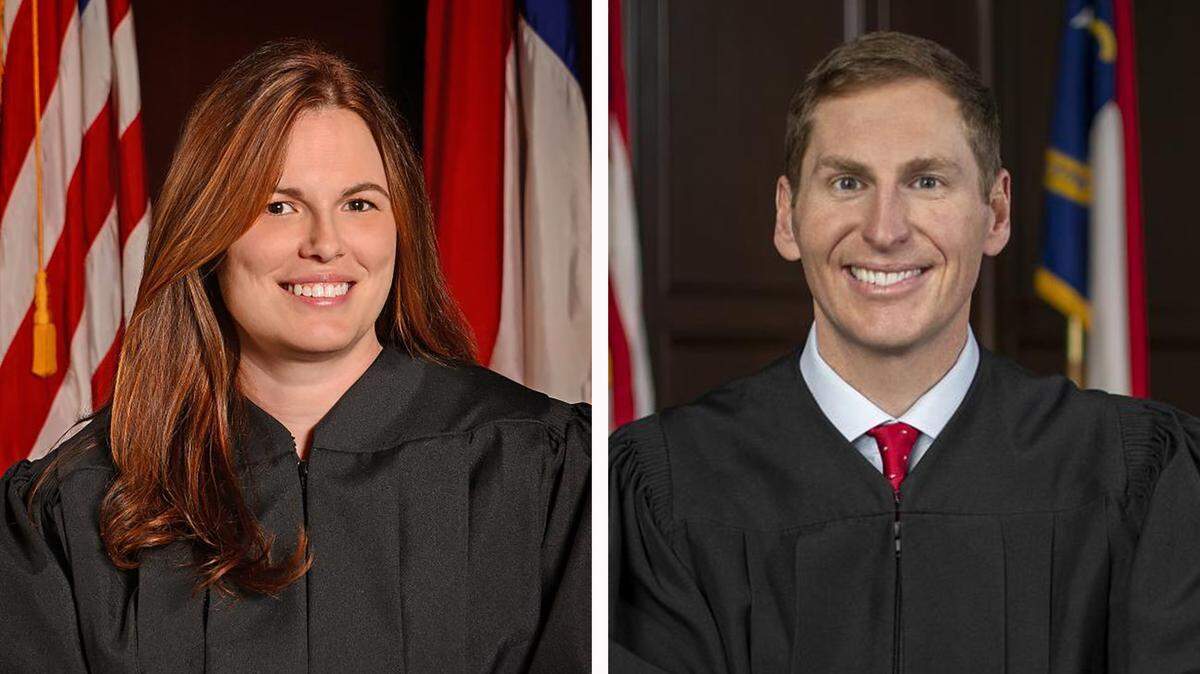
While the North Carolina State Board of Elections voted to certify most election results on Tuesday, the race for a seat on the state Supreme Court remains uncertain as a recount, lawsuit and ballot protests play out.
Republican Jefferson Griffin continues to trail incumbent Democrat Allison Riggs as most counties finish their recounts, but he has challenged the validity of over 60,000 votes in the race — more than enough to flip the race in his favor.
Riggs has called these protests “a tired page from the playbook of previous failed candidates” and said Tuesday that her own parents were among the voters whose ballots were challenged.
Just before the State Board of Elections was set to consider a preliminary step in handling the protests on Tuesday, Griffin requested that a member of the board, Siobhan Millen, recuse herself since her husband, Press Millen, has previously served as Riggs’ attorney.
“A reasonable observer would question the objectivity of Ms. Millen, who is the wife of the long-standing leader of Justice (Riggs’) legal team,” Griffin’s attorneys argued. “... Mr. Millen’s representation of Justice Riggs — and the Millen family’s financial connection to the Riggs matter before the NSCBE — requires the disqualification of Ms. Millen from considering the election protests.“
Speaking to The News & Observer, Press Millen said he has not represented Riggs in any matter before the State Board of Elections and only worked with her on pre-election matters pertaining to campaign advertising issues.
Griffin’s recusal request notes that Millen is a partner at the same law firm, Womble Bond Dickinson, as the lawyers who are representing Riggs before the board.
“The firm creates an ethical screen to ensure that I’m screened off from contact with the lawyers working on that matter,” Millen said. “All the firm’s files and other related materials are inaccessible to me — and this is standard law firm practice.”
A lawyer for the state board said Griffin’s motion was filed 15 minutes before the board began its meeting, in which it was supposed to consider subpoena requests related to Griffin’s protests.
The board postponed consideration of the recusal and subpoena requests until a later meeting.
The State Board of Elections is currently composed of three Democrats and two Republicans. If Millen, a Democrat, were to recuse herself, the board could potentially deadlock when considering Griffin’s protests.
Riggs’ parents challenged in election protests
Among the 60,000 ballots Griffin challenged across the state were those cast by Riggs’ own parents: Christine and Jack Riggs of Durham County.
“I was shocked to see my parents’ names on there,” Riggs told The N&O. “Given that they are lawful, eligible voters — retirees who just want to enjoy retirement and their family and have been attacked in this way.”
Griffin’s protests includes Riggs’ parents on a list of voters that he alleges have incomplete information included in their voter registration and are therefore ineligible to vote.
His argument mirrors one put forth by the Republican National Committee in a lawsuit filed this summer that sought to purge 225,000 voters from the state’s rolls.
A federal judge appointed by former President Donald Trump rejected part of the RNC’s argument, though the case is ongoing.
Riggs said her father registered lawfully to vote using his military ID and proof of residency.
“My parents were worried that their vote wasn’t going to count and their daughter is a Supreme Court justice — so imagine someone who doesn’t have access to that kind of support,” she said. “I had to reassure them that their vote was absolutely lawful. They did not do anything wrong. They do not deserve being treated like this.”
A contentious race
Griffin and Riggs’ race has become one of the most contentious and enduring contests from this year’s elections.
Riggs, who worked as a civil rights lawyer for over a decade before being appointed to the high court, received criticism from Republicans for her campaign ads in support of abortion rights.
In one ad, she suggested that Griffin could vote to uphold future abortion bans.
Republican lawmakers filed a confidential ethics complaint against Riggs, claiming that her ads improperly signaled how she might rule on a case that could come before her on the court.
Griffin referenced the complaint in an attack ad, claiming that Riggs was “under investigation by the Judicial Standards Commission.”
Riggs’ attorney then sent Griffin’s campaign a cease-and-desist letter about the ad, reminding them that the commission’s investigations and complaints are confidential and that using them to attack Riggs “would constitute an egregious violation of the commission’s rules in an effort to turn the commission’s deliberations into fodder for political attacks.”
The saga did not end on Election Day.
While Griffin initially led Riggs by about 10,000 votes on Election Night, the race swung in her favor after outstanding absentee and provisional ballots were counted — putting her 722 votes ahead.
Before requesting a recount, Griffin sued the State Board of Elections, arguing that it wasn’t providing him data quickly enough for him to meet the deadline to file election protests.
A hearing has not been set in that case.
Republicans were unhappy with the late change in the election results — with Senate leader Phil Berger calling it “another episode of ‘count until somebody you want to win wins.’”
The executive director of the State Board of Elections, Karen Brinson Bell, said Berger’s statement was false and warned that it could lead to threats or violence against election workers.
Bipartisan county boards of elections are required to count provisional ballots in the post-election period, known as the “canvass.” This process usually takes 10 days.
However, Republicans also proposed changes to election law last week that would shorten the period for counting provisional ballots in the future. The bill, which also strips power from incoming Democratic leaders, passed roughly along party lines.
If enacted, it would require counties to finish counting all provisional ballots on the third day after Election Day — a process that took nearly two weeks this year.
Gov. Roy Cooper vetoed the legislation, but Republicans currently hold a supermajority in the General Assembly capable of overriding his veto.
Counties are scheduled to finish the recount in the state Supreme Court race by Wednesday.
In the Spotlight designates ongoing topics of high interest that are driven by The News & Observer’s focus on accountability reporting.
This story was originally published November 26, 2024 at 3:48 PM.