NC elections board approves new rule making it easier to disqualify ballots
AI-generated summary reviewed by our newsroom.
- NC elections board approved a new voter ID rule making disqualification easier.
- Board adopted the rules in a 3-2 vote and they await Rules Review Commission review.
- New rule lets county boards discard ballots by majority vote if ID explanations fail.
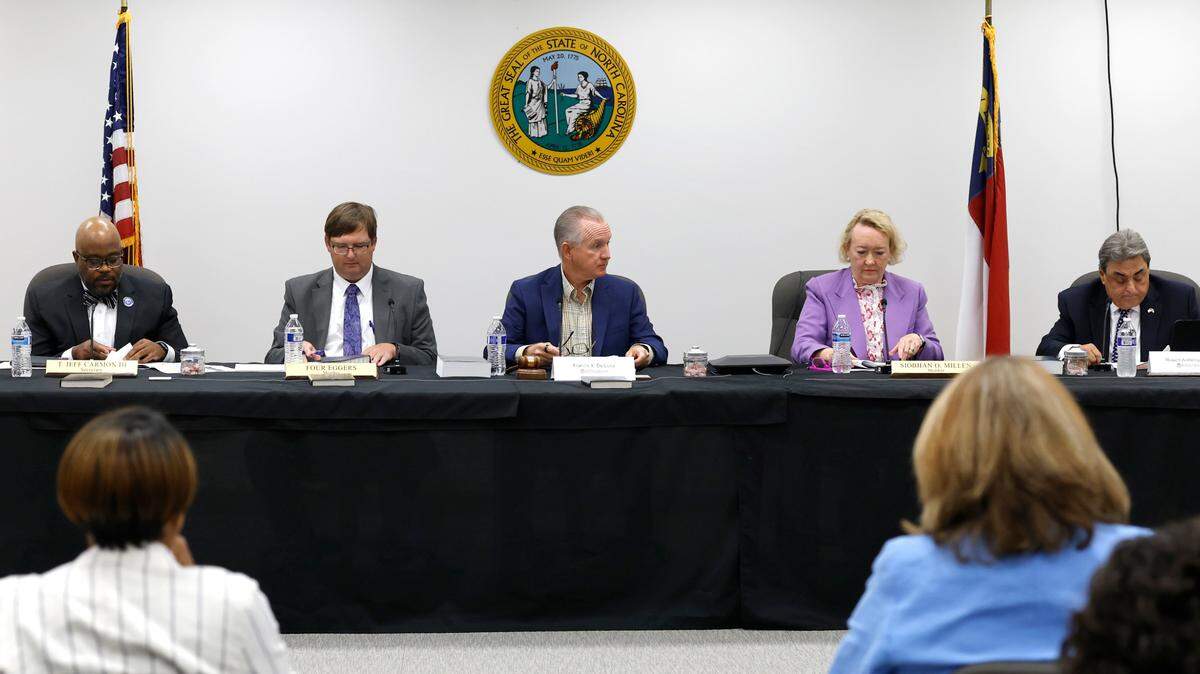
The North Carolina State Board of Elections on Thursday approved a series of new voting rules, one of which will make it easier for officials to disqualify ballots from voters who don’t provide identification.
The rules, adopted in a 3-2 vote by the board’s Republican majority, will be in effect for the November midterms and beyond if approved by the state’s Rules Review Commission.
The new voter ID rule would allow county election officials to disqualify ballots by a majority vote if they don’t believe a voter’s reason for failing to provide identification. Currently, this requires a unanimous vote of a county elections board, all of which are composed of three Republicans and two Democrats.
“That is going to make these photo ID debates at the county level into a very partisan vote, and I think that’s highly disruptive to voters’ trust in elections,” said Siobhan Millen, a Democratic member of the state board. “I think we’re opening ourselves up to potential problems.”
Stacy “Four” Eggers, a Republican member of the board, said he didn’t believe the unanimity requirement complied with state law, which does not specify a vote threshold for discarding a ballot for this reason.
The rule would require the board to issue a written decision “based only on facts and not speculation” explaining its reasoning. The board would also be required to give the affected voter notice and an opportunity to address the board and defend their ballot.
The other rules passed Thursday would slightly amend the recount process and ban the use of amplified sound near polling places.
Democratic board member Jeff Carmon objected to the sound rule, saying the board was “discouraging people from being excited about voting.”
Eggers said his time working in county elections led him to believe the rule was necessary.
“There are times at which the chief judge is called upon to maintain order and decorum within a precinct, and this provides tools consistent with the statute for them to do so,” he said.
Member pushes to subpoena auditor official
Thursday’s meeting came on the heels of a flurry of stories about the influence of the Office of the State Auditor on early voting plans.
Earlier this week, the auditor’s election liaison, Dallas Woodhouse, resigned after several news outlets reported on texts he sent to county election officials counseling them against Sunday voting or on-campus voting sites.
Carmon began Thursday’s meeting by requesting that the board subpoena Woodhouse to question him about his involvement in election planning.
“These communications, for me, raise significant concerns regarding the appropriate boundaries between appointment authority and election administration, as well as the potential for improper influence over county board member decision-making,” he said. “Given the seriousness of these allegations and the public attention that they have generated, I believe we have an obligation to establish a complete and factual record.”
Eggers argued that such a request would not be in order because Woodhouse no longer works for the auditor’s office.
“If we start subpoenaing those who engage in First Amendment protected political speech to come in and discuss things with us and to address those, there’s really going to be no end to that,” he said.
In a statement to The News & Observer after Thursday’s meeting, Woodhouse defended his role in the auditor’s office.
“My mission was straightforward: help the Office of the State Auditor successfully carry out the responsibilities assigned to it by the General Assembly, support county boards during the transition, and work to ensure North Carolina’s election system continued to serve voters with integrity while expanding voting opportunities wherever possible,” he wrote.
He went on to say that after the 2026 voting plans were finalized, he believed they would show that “North Carolina expanded early voting opportunities through additional locations, expanded hours, and increased opportunities for voters to cast their ballots. I am proud to have contributed to that effort alongside dedicated county election officials, the State Board of Elections, and my colleagues in the Office of the State Auditor.”
This story was originally published July 16, 2026 at 11:35 AM.