Sleepy village that survived 1918 pandemic is for sale in NC — post office and all
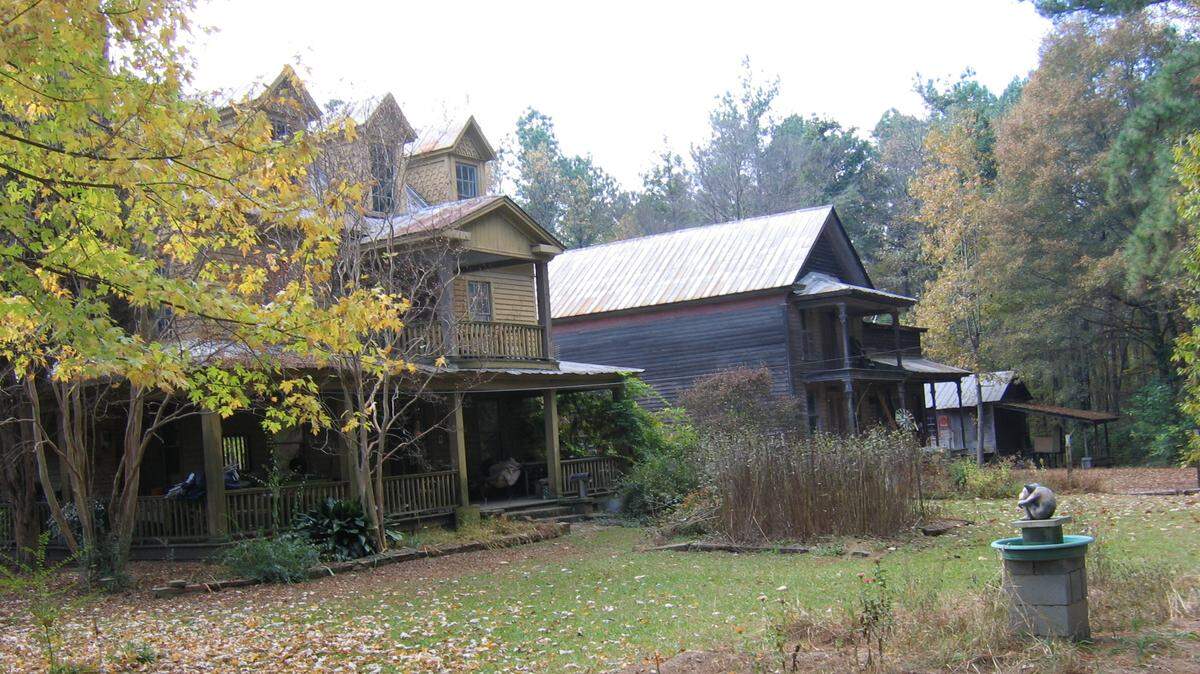
Less than 100 yards from Old U.S. 1 Highway at the end of a dead-end road sits Merry Oaks — or what’s left of it, anyway.
A boarding house, general store, train depot and post office line the railroad tracks that used to cart all manner of goods, peddlers, kinfolk and quacks into a bustling little village about 30 minutes southwest of Raleigh, according to historical record and the current owners.
Merry Oaks survived the Civil War and the Spanish Flu in 1918 before new development and the invention of the automobile made it all but obsolete, an oft-forgotten piece of history nestled in a grove of oaks.
Now, in the midst of a second global pandemic, it’s for sale.
The $349,000 listing includes a boarding house with seven bedrooms and one bathroom, according to its real estate listing on Zillow. The general store is outfitted as an artist studio with a bathroom, and the train depot has a living space, bathroom and kitchen.
The buildings, which take up two parcels and close to three and a half acres, were built around 1840, according to the Zillow listing. As a “historic gem in the rough,” the listing suggests Merry Oaks would be best viewed “with an eye to restoration and renovation.”
Ron Jones, one of the property’s current owners, said it “will take an adventurous soul.”
“It is a very unique place with lots of history,” he told McClatchy News in an email.
Jones, a storyteller based in Durham, and Spencer Lyerly have owned Merry Oaks for 12 years. It was left to them in 2008 after the death of the previous owner, Anne Hill.
An artist and “extremely self sufficient woman,” Hill bought the property in 1970 and converted the store into an art studio and the train depot into a cottage for her elderly mother, Jones said.
“She made the house livable to ‘her tastes’ and reigned as hostess supreme until she passed away in 2008,” he told McClatchy.
In the years since, Jones and Lyerly have done their best to carry on Hill’s tradition of hosting “raucous and creative gatherings” of friends, families and newcomers, according to Jones’s website.
They weren’t the first occupants of Merry Oaks to do so.
In the 1970s, a graduate student named Barbara Wallace at the University of North Carolina at Chapel Hill compiled a three-part series on the history of Merry Oaks. By her account — which Jones echoed — the village got its name from jovial farmers who raced horses on the weekends under the large oak trees that lined the road leading into town, likely “scandalizing the more sedate citizens,” she wrote.
“I think the merry came for their have a good time and a drink or two,” Jones told McClatchy.
At its onset in the early to mid-1800s, he said Merry Oaks was comprised of a “boarding house/hotel” run by a family from nearby Pittsboro, the Yates Thomas General Store, a U.S. Postal Office, a train depot, a blacksmith, a bank, a shoe shop, a school known as the Merry Oaks Academy and a feed and farm store.
Merry Oaks was mostly a farming community, according to Wallace’s historical account. The families were large to help look after the land, and drinking and dancing were banned.
The nearest doctor lived in Moncure about 5 miles away, Wallace wrote. Though sometimes late to deliver babies, he “pulled Merry Oaks through with very few deaths” during the Spanish Flu in 1918 — “even though he only gave his patients the same little black pills he gave for everything else,” she said.
But the start of World War I brought drastic change to what “was once a bustling center of education and culture,” according to Wallace.
Merry Oaks Academy closed in 1921 after a new school opened in Moncure and enrollment dropped at the village academy. The bank failed in 1920, and many young people who didn’t want to farm left to find work in other towns and cities. The stores closed and visitors coming by train were few and far between with the growing popularity of cars and trucks.
“As the leading citizens drifted away, the town soon became inactive in civic affairs,” Wallace wrote. “Soon there was no mayor, no magistrate, no policeman.”
By the 1950s, according to her research, the U.S. Post Office opted to consolidate offices in more rural towns — leaving Merry Oaks without even an address.
“There are wonderful stories and every once and a while folks call or email us asking if they can come by and visit the place, some were born there or lived in the area years ago,” Jones said of the town’s history.
Now, “many folks don’t know it exists at all,” he said.
This story was originally published July 29, 2020 at 5:53 PM.