After 17 years, Brood X cicadas will re-emerge in part of North Carolina. Here’s where
Parts of the Midwest and East Coast are in for an onslaught of cicadas come spring, the likes of which haven’t been seen in over a decade.
Encased in a hard outer shell with paper-thin wings in hues of red, orange and black, the periodical cicada — as it’s called — only emerges once every 13 or 17 years. This group, known as Brood X, hasn’t been seen since 2004.
Brood X is one of the largest broods of 17-year cicadas by geographical range, according to researchers at the University of Connecticut.
The largest concentrations are likely to emerge in and around Washington, D.C., including parts of Virginia, Delaware and Maryland, The Washington Post reported. But another eight states scattered across the Midwest and into the Southeast could also see — and hear — some action.
They include Pennsylvania, Ohio, Indiana, Illinois, Kentucky, Tennessee, Georgia and — of course — North Carolina, according to the University of Connecticut’s tracking data.
Only two areas in North Carolina reported seeing any cicadas from Brood X back in 2004 — the City of Morganton in the foothills and the Town of Murphy tucked in the western-most corner of the state, the tracking website Cicada Mania found.
In 2021, the list of possible counties where the brood might emerge includes Cherokee, Surry and Wilkes.
Cherokee is the western-most county in North Carolina and encompasses part of the Qualla Boundary, the reservation that belongs to the Eastern Band of Cherokee Indians. Surry and Wilkes are neighboring counties near the Virginia border that are also in Western North Carolina.
Most people in the Carolinas are used to annual cicadas, which show up every year at the end of summer and range in color from dark green to black with green wing veins, according to the experts at N.C. State University.
They’re also slightly larger than periodical cicadas.
Annual and periodical cicadas have similar life cycles that begin with the females laying eggs in slits they carve into twigs, branches and trunks. Adult cicadas die after mating, The Post reported, and the eggs hatch six to seven weeks later.
From there, the so-called nymphs “fall to the ground and dig down to a nice tree root,” according to The Post.
Depending on the species, they’ll emerge one, 13 or 17 years later, clawing their way to the surface to shed their outermost skin, find a mate and repeat the process. The cacophony of buzzing that accompanies their arrival is the males’ mating song.
Periodical cicadas are early risers that typically arrive in the first few weeks of May but can show up in March if the ground temperature warms to 64 degrees, The Post reported.
Their singing is also extremely loud and “may be heard from miles away,” partly because of the sheer size of the brood — which is “much larger” than that of annual cicadas, N.C. State says.
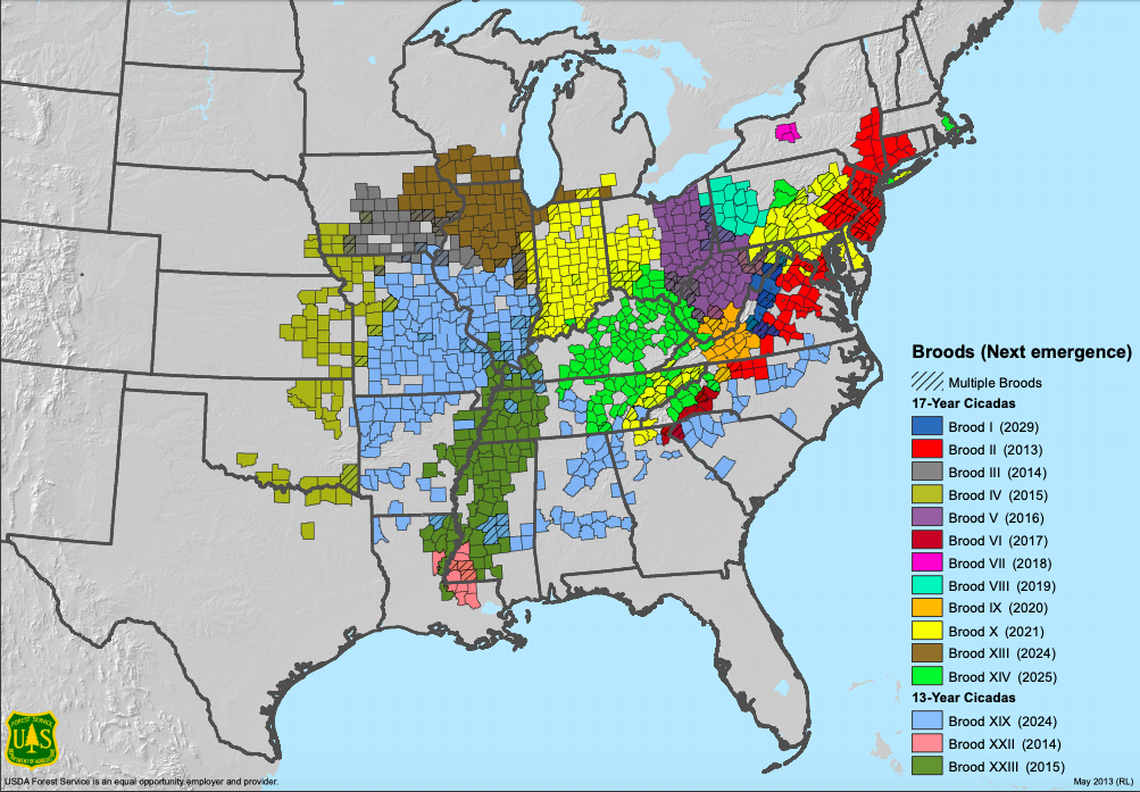
Brood X is one of a dozen 17-year cicadas currently active in the U.S., according to the U.S. Forest Service. There’s also at least three 13-year broods.
Five of those broods surface in different parts of North Carolina depending on the year.
In 2020 it was Brood IX, which spanned six North Carolina counties — including Surry and Wilkes, McClatchy News previously reported.
Other broods occasionally get confused and surface ahead of time, like Brood XIX, 13-year periodical cicadas that weren’t due until 2024 but unexpectedly popped up in Alabama, Georgia, South Carolina and central North Carolina in May last year.
This story was originally published March 9, 2021 at 5:05 PM with the headline "After 17 years, Brood X cicadas will re-emerge in part of North Carolina. Here’s where."