
A rare endangered whale spotted off NC will likely die from fishing gear entanglement
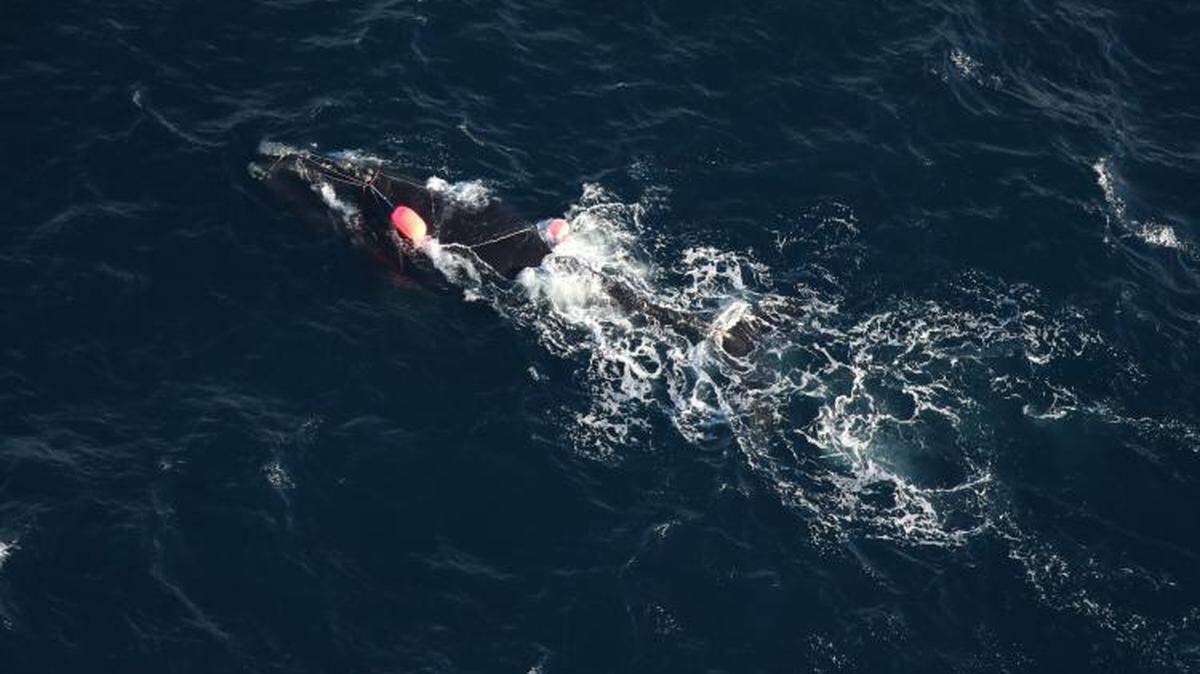
An endangered North Atlantic right whale spotted entangled in fishing gear off the Outer Banks is likely to die, federal officials said Friday.
The 3-year-old male, identified as right whale #5132, had several lines wrapped around his head and mouth, with a pair of buoys attached. An aerial survey team from the Clearwater Marine Aquarium Research Institute spotted the whale Monday, about 60 miles off the Outer Banks.
This marks the third time in a week that a North Atlantic right whale has been spotted entangled in fishing gear, with the two others spotted off the Massachusetts coast. The National Oceanic and Atmospheric Administration’s Fisheries division determined that one of the whales spotted off Massachusetts is likely to die of its injuries, like the one in North Carolina.
“Entanglement is devastating,” Nora Ives, a marine scientist for environmental nonprofit Oceana, said in an interview.
There are about 370 North Atlantic right whales alive.
The top of NOAA’s web page for the species offers a stark warning: “Endangered North Atlantic right whales are approaching extinction.”
In 2017, NOAA declared an unusual mortality event for the species based on the impact human activities were having on it. Since then, 41 whales have been found dead; 39 injured enough that it is believed they would die; and 71 non-lethally injured or ill.
Entanglement is the leading cause of deaths or injury for North Atlantic Right Whales. Since the unusual mortality event was declared there have been 10 whales killed from entanglement, another 35 injured enough that scientists believed they would die and 54 more who suffered non-lethal injuries.
By comparison, vessel strike is the second-highest cause of death or injury, with North Atlantic right whales particularly susceptible because they are dark in color and do not have dorsal fins. Boats and ships have killed or likely fatally wounded 18 whales since 2017, injuring seven more.
As right whales move through the ocean, Ives said, they encounter fishing lines linking buoys to crab pots and lobster pots.
“Right whales have to navigate around these vertical lines and they become entangled sometimes. When they do, they may try to free themselves or even as they keep swimming the lines wrap themselves tighter and tighter,” Ives said, adding that as they tighten the lines can hinder breathing, eating and swimming.
As a solution, Oceana is touting technology that uses “pop-up” fishing gear when whales are known or suspected to be in the area. Such gear sends the buoy and the line to the bottom along with the pot, with the fisherman sending a signal that releases the buoy when they are ready to collect it.
The technology was tested earlier this year by 19 fishermen catching Dungeness crabs in waters between 60 and 360 feet deep off the California coast. According to Oceana, they caught $1.6 million worth of crabs using the gear.
By stashing the line with the trap, Ives said, “You’ve eliminated that vertical line in the water and eliminated that risk of entanglement.”
Before Monday, whale #5132 was last spotted off the Canadian coast, in the Bay of Fundy, in October. At that time, he was not suffering from entanglement.
NOAA officials said a team that responds to try to untangle whales from fishing gear is on alert, but that it isn’t safe to help the whale right now because of weather conditions in the area.
“We will further document the entanglement and determine if entanglement responses are possible if the whale is resighted,” NOAA said on its right whale web page.
This story was produced with financial support from the Hartfield Foundation and Green South Foundation, in partnership with Journalism Funding Partners, as part of an independent journalism fellowship program. The N&O maintains full editorial control of the work. If you would like to help support local journalism, please consider signing up for a digital subscription, which you can do here.
This story was originally published December 20, 2024 at 3:10 PM.