1,000 square feet of paradise: On OBX, some dream homes are castles made of sand
AI-generated summary reviewed by our newsroom.
- 2025 storms toppled 15 Buxton homes and one in Rodanthe, raising relocation questions.
- Policy debates resume on long-term habitation, rebuilding and coastal retreat options.
- Small vintage cottages endure storms but face rising risk from 2025 season.
The Callahan Cottage was hammered together in the neighborhood off Old Lighthouse Road in Buxton in 1976, long before the arrival of the showy seven-bedroom places with cathedral ceilings, granite countertops and high-gloss reclaimed-pine floors.
It was what Outer Bankers used to call a “beach box” — single story with three bedrooms, two baths, a living room and porch.
In Lat and Debby Williams’ eyes, it was 1,000 square feet of paradise.
The couple bought the house from Debby’s parents — the Callahans — who had owned it since 1981 and had hosted countless family beach vacations there. The Williamses retired in 2017, moved into the cottage full time from Charlotte, and made sure family members knew it was still open to ocean breezes and long visits.
Such a solid house, the Callahan Cottage was built on stilts on Cottage Avenue, a street that runs perpendicular to the shoreline just south of where N.C. 12 cuts hard to the west at the village of Buxton. The home sat three lots and two big sand dunes back from the ocean then, close enough to smell the salt air but far enough that visitors packed extra snacks when they headed to the beach in the morning.
In its lifetime, the Callahan Cottage and its neighbors had withstood more than 100 tropical storms and hurricanes, and who knows how many nor’easters. It had lost a weathered cedar shake here, a roof shingle there. But it never trembled.
Then came the 2025 storm season, which in a matter of weeks took down 15 houses in Buxton and one in Rodanthe. It had the Williamses scrambling to try to stop their beloved home from falling into the sea and caused so much trouble that people started asking — again — how long permanent settlements will be able to cling to the North Carolina Outer Banks.
An unusual hurricane season
It’s been an unusual hurricane season, relatively busy as the National Oceanic and Atmospheric Administration and others predicted, but with a few days to go, not one hurricane has made landfall on the U.S. coast this year.
And yet, Lat Williams says, “It was just relentless. One big storm after another.”
For the Outer Banks, it started with Hurricane Erin, which formed as a tropical storm on Aug. 11. Its eye never came closer than 200 miles off the coast, but after intensifying from Category 1 to Category 5 in just 18 hours, the massive storm generated 50-foot waves near its center. Though it weakened before passing North Carolina, it sent waves up to 20 feet tall breaking against Outer Banks beaches for six days.
Erin was followed in September by Humberto, which developed into another Category 5 storm before weakening and then merging with Hurricane Imelda. October brought a pair of nor’easters.
Lat and Debby Williams had ridden out storms in the cottage, but when someone offered to let them stay in an apartment at their church during Erin, they packed enough for a few nights and went.
On the fourth day of the storm, Lat Williams said, the waves took down the second dune that had shielded Callahan Cottage from the sea. It also exposed the septic tank, rendering the cottage unusable.
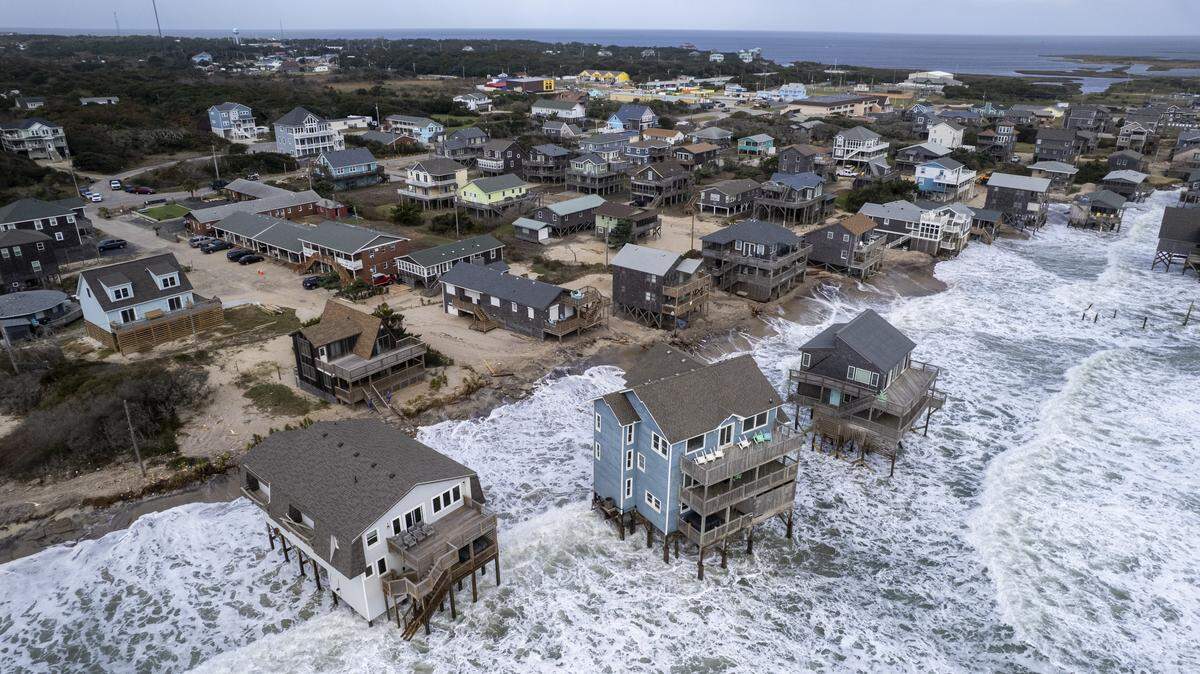
First, Williams said, he planned to relocate the tank to the other side of the house and even got a permit. But before he could have the work done, the first nor’easter came through and pushed the ocean under the house and into that side of the yard, too, rendering the permit moot.
The first house to fall in Buxton went down on Sept. 16. Two weeks later, five more cottages in the neighborhood tumbled into the ocean, all within 45 minutes, according to the National Park Service, which manages the beaches of the Cape Hatteras National Seashore, including on Hatteras Island. Another collapsed that night.
Three more houses went down in Buxton and one in Rodanthe, a village 20 miles from Buxton toward the northern end of the island, between Oct. 1 and Oct. 18. On Oct. 28, five more homes in Buxton succumbed to the sea.
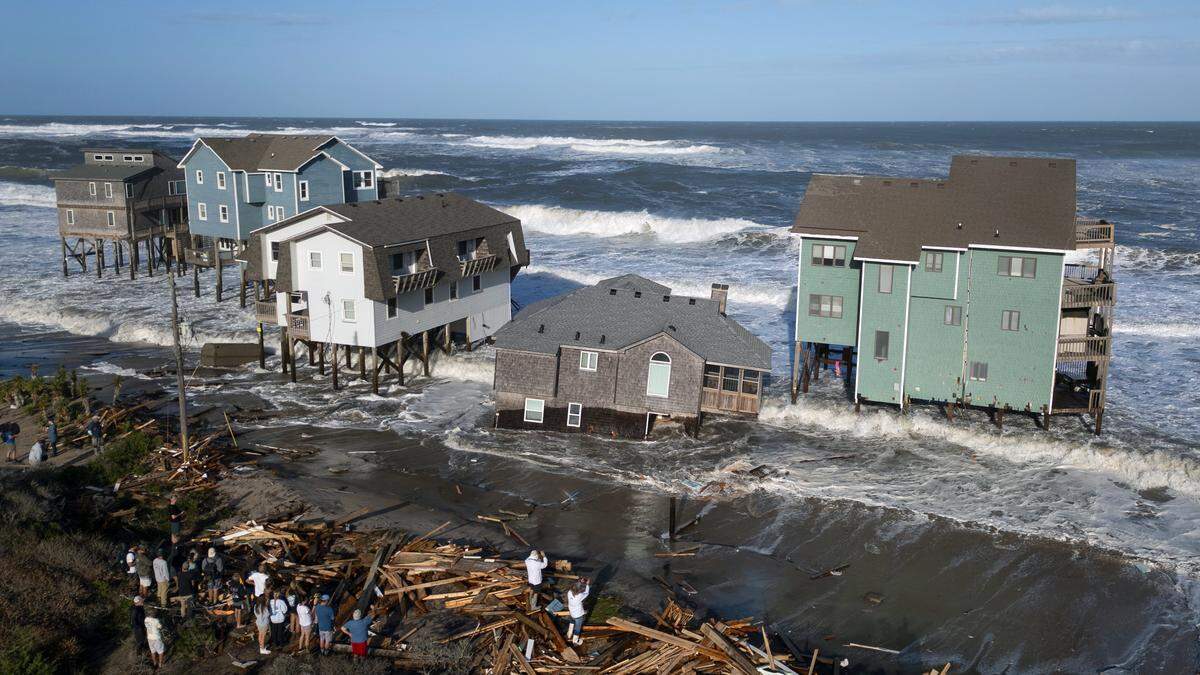
That’s a total loss of 16 houses over about six weeks, in addition to the 11 homes that fell or had to be torn down in Rodanthe between 2020 and 2024.
County inspectors have deemed dozens more houses in the two villages uninhabitable because of problems caused by erosion, meaning it could be a tense winter for homeowners as seasonal nor’easters roll through.
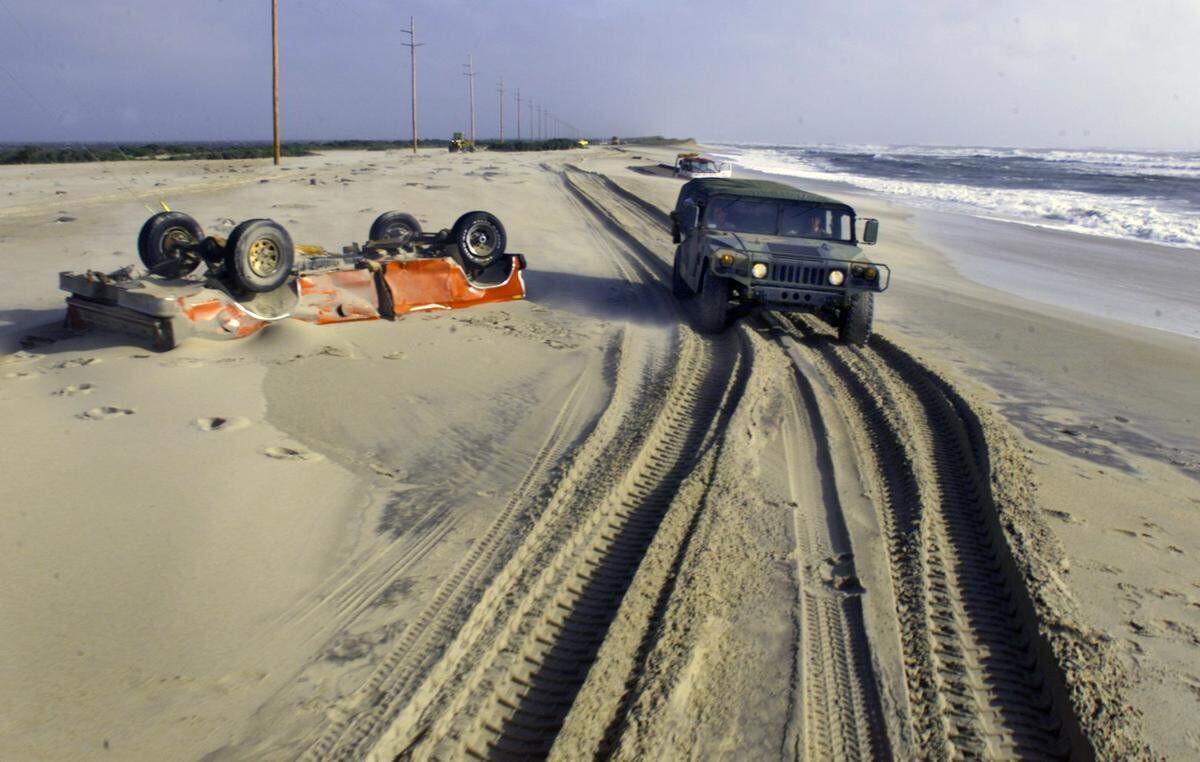
N.C. Highway 12, which threads the Outer Banks together and brings supplies, residents and visitors onto the islands, also has taken a beating this year. State transportation workers have had to close the two-lane route repeatedly for days at a time to clear sand and water from the pavement and check for fractures.
When N.C. 12 shuts down, the only way onto or off of the barrier islands is by boat or aircraft.
Erosion has rapidly worsened
Coastal geologists say the Outer Banks, the string of barrier islands stretching 175 miles from the Virginia border to Ocracoke, have been eroding since at least the 1800s. Some of that is the result of the islands’ natural tendency to shift as the ocean washes over the land, depositing sand and causing the islands to migrate toward the mainland.
Sea-level rise is exacerbating erosion on the Outer Banks, NASA says. the result of climate change that has melted glaciers and ice sheets and warmed the oceans, causing thermal expansion.
From 1993 through 2024, global sea level rose 4 inches.
A. Brad Murray, a geomorphologist at Duke’s Nicholas School of the Environment, says sea-level rise is more pronounced along the Outer Banks partly because of decades of work to reduce short-term erosion, such as building higher dunes to hold back the ocean.
If the ocean can’t wash across the island, depositing sand across its length and breadth, the island essentially sinks relative to sea level, Murray said.
“Every time Highway 12 gets buried, totally understandably we rebuild that dune and try to prevent the next overwash event as best we can,” he said. “But the better we are at preventing what people view as coastal hazards, the faster the barrier landscape disappears over the long term.”
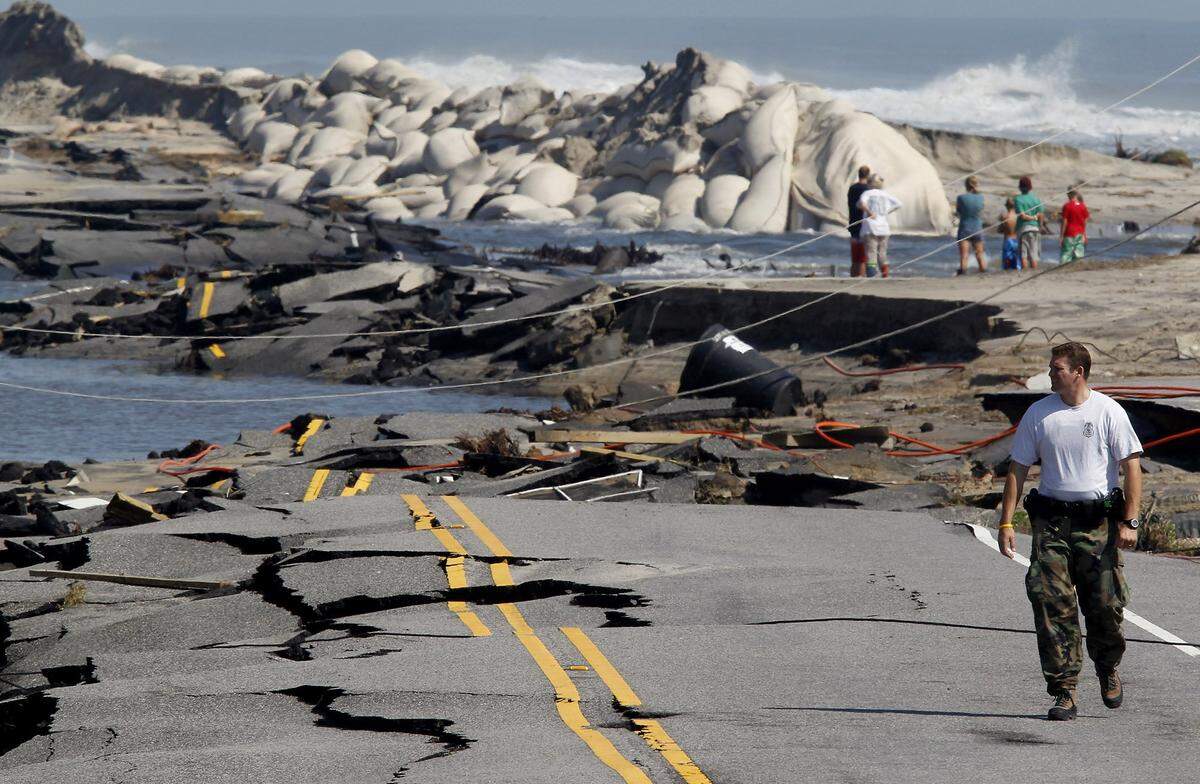
State and local officials have identified at least seven “hot spots” on Hatteras and Ocracoke islands, low-lying places where high surf from storms can send ocean waves under buildings and across roads. In some hot spots, even a heavy rain can be enough to make N.C. 12 temporarily impassable.
And it’s getting worse.
By 2050, sea level on the Outer Banks is expected to rise by 15 to 22 inches above the 1993 to 2024 levels, which is more than the projected global average, according to the Environmental Protection Agency. As it does, the agency says, flooding will happen more often and be more severe, even in the absence of storms.
Meanwhile, tropical systems have been growing more intense over the past 30 years as oceans continue to warm, partly the result of human activity, including the burning of fossil fuels.
Already, Rodanthe loses at least 10 feet of horizontal beach each year, partly because the island bows toward the ocean where the village sits, exposing it to more wave action. Two sets of shoals just offshore likely increase the problem.
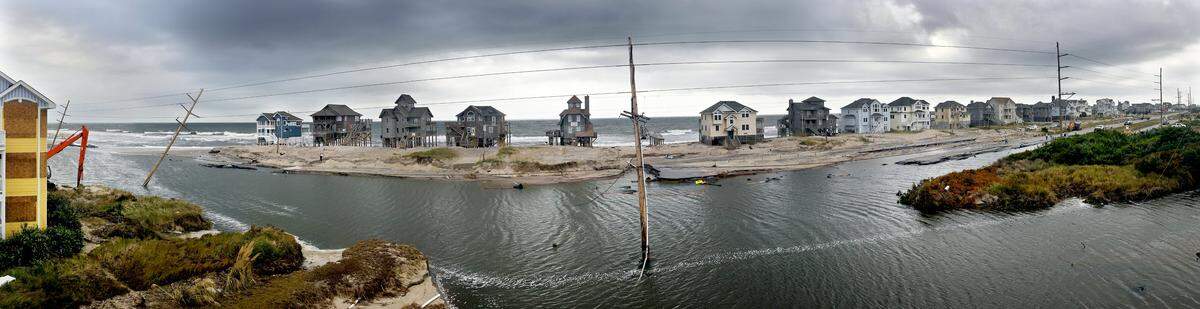
Buxton, just above where Cape Hatteras pokes into the ocean like a boot spur, has similarly high erosion rates.
Heather Gray Jeannette, a Buxton native and a founder of the Buxton Civic Association, is one of many local residents who believe erosion on the village’s oceanfront accelerated after the federal government stopped maintaining a set of three jetties, or groins, that extended from the shoreline.
The jetties were built in the 1970s to try to slow erosion near the site of the former Naval Facility Cape Hatteras, a Cold War submarine-monitoring site, as well as the historic Cape Hatteras Lighthouse.
The Naval Base was closed and the property handed over to the U.S. Coast Guard in the early 1980s. The lighthouse was rolled more than a half-mile inland in 1999 to save it from the ocean’s reach.
Sometime after that, the government quit repairing the steel jetties with rebar and concrete, and the structures began to disintegrate, developing gaps that work like siphons for sand, pulling it to the south, away from Buxton.
“All these people built homes out here assuming those jetties would be maintained,” Jeannette said. When residents asked for help restoring the jetties, they and Dare County officials ran up against North Carolina’s longstanding prohibition against permanent structures, including jetties, on the beach.
“We feel very handcuffed by the state,” Jeannette said. “We just haven’t been able to try to protect ourselves.”
The General Assembly voted in 2011 to make some exceptions to the rule, the N.C. Coastal Federation says. Dare County Manager Bobby Outten says the county is seeking permission and a contract to repair the jetty that’s in the best shape, but that work isn’t likely to begin before next spring.
The county also plans a beach nourishment project at Buxton next spring, Outten says, which will widen the beach with pumped sand. That and the jetty repair will run about $45 million, Outten said, to be paid with money the county has been saving from occupancy taxes.
Dare County doesn’t have the funds right now for beach nourishment at Rodanthe, Outten says.
Pumping sand onto shore to widen the beach is costly and a temporary solution that lasts only until the right type and intensity storm washes the sand away.
Looking farther into the future
Geologists, engineers and planning officials have been looking for years for more long-term solutions to preserve the Outer Banks’ more than 50,000 residents, island businesses and the infrastructure that supports them and the 5 million visitors who come to the Outer Banks each year. Tourists help make Dare County one of few in North Carolina that pays more money in taxes than it receives in state funding, local leaders say.
Many of those who have watched the widely circulated videos showing houses crumbling into the surf and scattering debris down the beach have commented on social media that it’s folly to build on barrier islands. It would be smarter, they say, to deliberately retreat from the beach, as the late Duke University geology professor Orrin Pilkey advised, than to wait until nature forces that choice by drowning the islands.
“But we’re here now,” said Outten, the Dare County manager. “How would you feel if the government came along and said, ‘You have to leave your neighborhood, we’re not going to maintain the roads and infrastructure anymore’?”
A task force that studied long-range options for N.C. 12 concluded in 2023 that building new bridges around the hot spots on the highway would be the most sustainable way to maintain the road and, by extension, the communities connected by it. Bridges would stop the cycle of clearing the sand and water from the pavement every time it storms. But as sea level continues to rise, the number of hot spots needing bridge bypasses will, too.
The Trump administration has been working to cut the Federal Emergency Management Agency’s Hazard Mitigation Program, which has been used successfully in areas away from the coast to buy homes that are statistically likely to keep flooding. The program was used to buy and tear down hundreds of houses in North Carolina after Hurricane Floyd in 1999 caused catastrophic flooding. The land was turned into green space.
Along the coast, the best hope some homeowners might have for cutting their losses on a home threatened by ocean flooding is the National Flood Insurance Program. As of now, the NFIP has a claim limit of $250,000 for a house and $100,000 for its contents, and policies pay only after the ocean knocks the house down.
A move to restore a provision to allow NFIP insurance to pay to tear down or move a beachfront home in imminent danger of collapse has been introduced in Congress.
The Callahan Cottage couldn’t wait for that.
When the houses around it began to fall, their pilings and beams and other structural elements became floating battering rams that bashed into the Callahan Cottage’s supports.
After one particularly bruising high tide, Williams said “about a third of the house had no support at all.”
Williams found a work crew willing to wade into the surf to sister in pilings and add cross-bracing to hold the cottage together while he figured out if it could be moved. With storms coming in rapid succession, he knew the house could fall at almost any time.
He found a lot five or six blocks away and closed on it at the end of October.
“If we can’t move the house, we can switch to a new build,” he said, though Debby had insisted it wouldn’t be the same.
Each time the beleaguered cottage survived another high tide, Williams grew more hopeful. He lined up a moving company, but had to postpone because weather conditions grew too rough again. They set another schedule, and that, too, had to be put off.
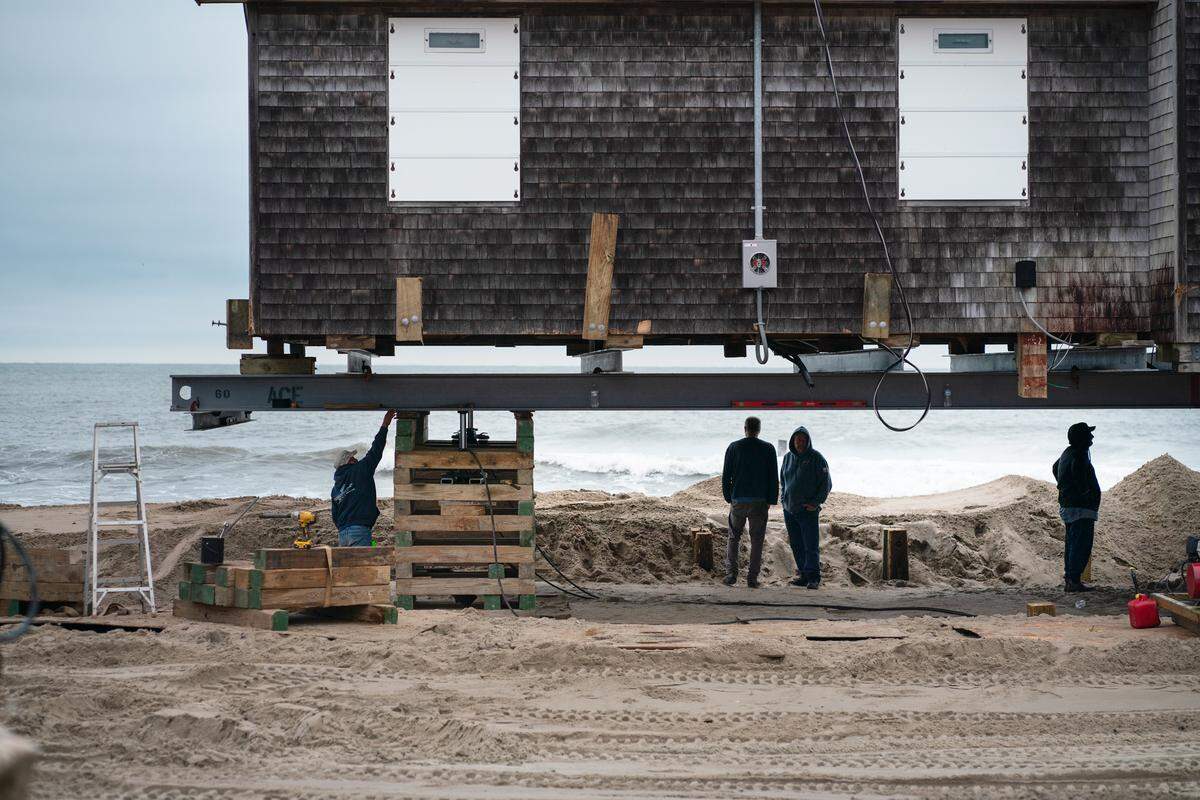
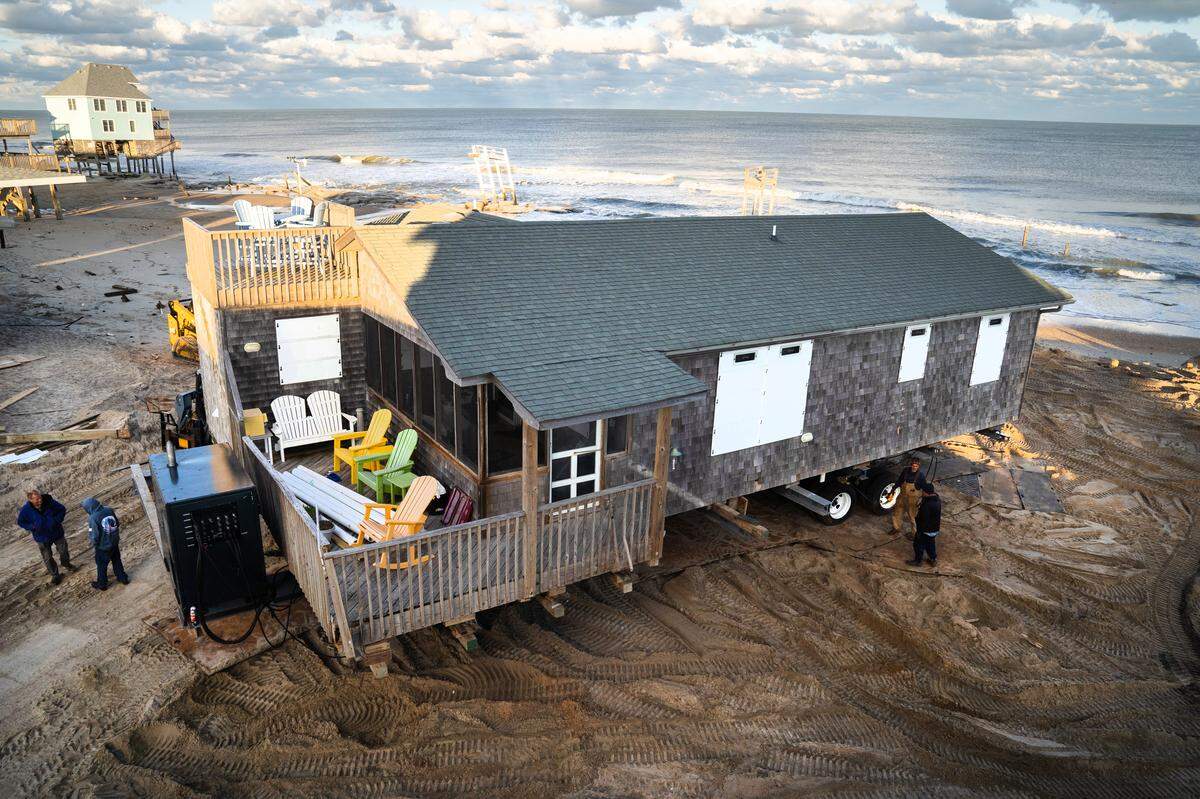
Finally, during a break in the weather on Nov. 9, the moving crew swooped in at low tide, raised the house enough to pull the pilings out from under it and lowered it onto a tractor-trailer flatbed, pink, green and white Adirondack chairs still sitting on the deck.
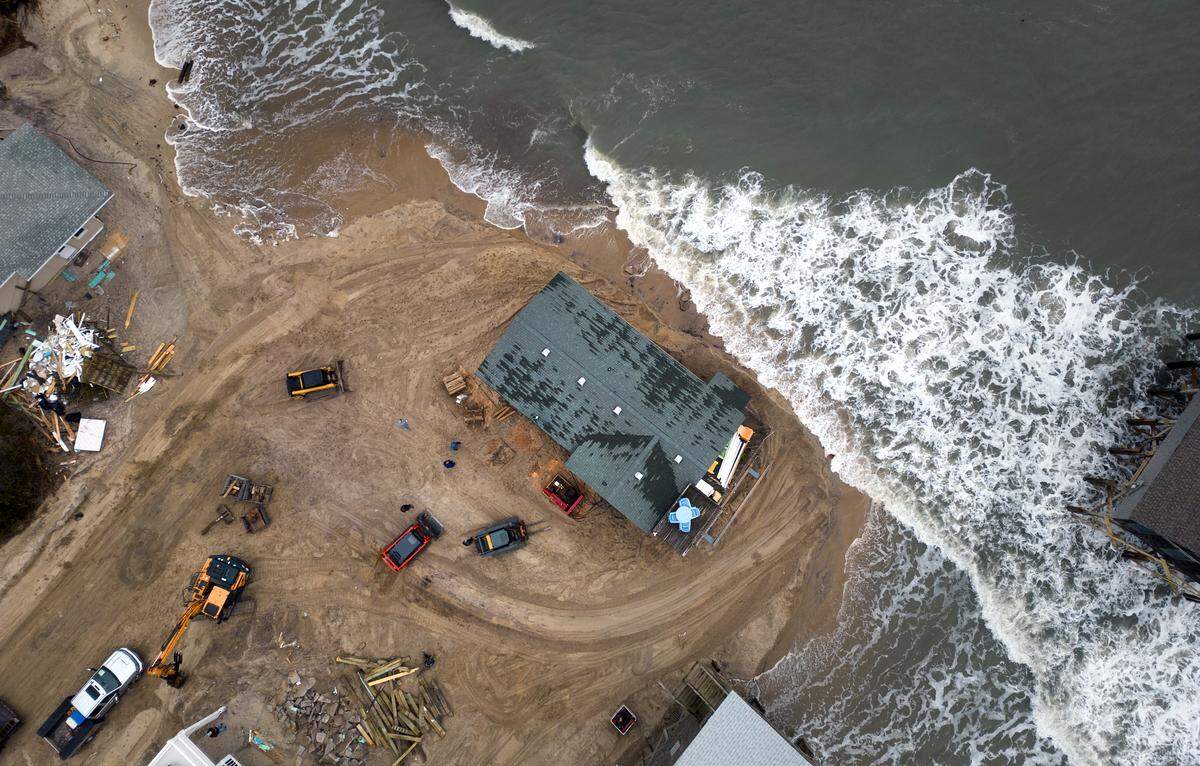
With a bobcat constantly working to hold back the surf by pushing sand between the water and the house, the crew pulled the cottage up the beach just far enough to get it out of the ocean’s reach.
A few days later, the house took a $55,000 ride the rest of the way to its new site, where it was set on cribbing about 15 feet up in the air to await the installation of new pilings.
“That was a great feeling,” Williams said. “Huge relief.”
At its new address, the Callahan Cottage likely won’t offer an ocean view. From its crow’s nest style upper deck, visitors will get a good view of the pines that now surround it.
“I’m looking forward to sitting up there,” Williams said. “It’ll be a new kind of beauty.”
This story is available free to all readers thanks to financial support from the Hartfield Foundation and Green South Foundation, in partnership with Journalism Funding Partners, as part of an independent journalism fellowship program. The N&O maintains full editorial control of the work. If you would like to help support local journalism, please consider a digital subscription, which you can get here.
This story was originally published November 26, 2025 at 5:30 AM.