North Carolina’s new budget paves the way for wildlife crossings statewide
AI-generated summary reviewed by our newsroom.
- North Carolina’s new budget allocates a recurring $10.2 million every two years.
- The funding follows a $25 million federal grant for fencing and underpasses on U.S. 64.
- Safe Passage coalition data convinced N.C. DOT to pilot underpasses, fencing and benches.
North Carolina’s new state budget includes a recurring $10.2 million for wildlife crossings and habitat connectivity, paving the way for animal-friendly overpasses and underpasses, particularly in the state’s western mountains.
The move caps a decade-long campaign by a coalition to win support for wildlife crossings, making North Carolina a national leader in road ecology and public safety, said Ben Prater, Southeast Program Director at Defenders of Wildlife.
“This is a big deal, and it sends a really strong signal that it’s possible,” Prater said. “North Carolina is leading by example through this historic $10.2 million investment to reduce the impacts of roads on iconic and imperiled wildlife alike — from the black bear to the endangered red wolf.”
The investment follows a $25 million federal grant to build fencing and wildlife underpasses on U.S. 64 in the Alligator River National Wildlife Refuge to protect the critically endangered red wolf and other animals.
With $10.2 million now recurring in the state budget every two years, North Carolina will have money to match other federal grants.
Economic and safety considerations
Nationally, wildlife-vehicle collisions cost $8 billion a year and kill hundreds of people. In North Carolina, these incidents disrupt commerce and supply chains and endanger motorists, says Jeff Hunter, the National Park Conservation Association’s Southern Appalachian Director.
“One of the things the DOT is always concerned about is if they have to close a road for a while, if traffic slows, that costs a lot of money,” Hunter said. “It’s more than wildlife; it’s more than driver safety. Our economies are so tied to this interstate transportation system, and when it doesn’t run efficiently, everyone pays.”
Prater stressed how the economic and motorist-safety aspects make wildlife crossings a bipartisan issue.
“Of all the things I’ve worked on in conservation over my 20-plus-year career, it was … so reassuring to be working on an issue that really was universally valued and appreciated,” Prater said. “This is an issue that I think had a universal resonance for people.”
A long road to funding
The idea for wildlife crossings in Western North Carolina began more than 20 years ago, after the reintroduction of elk to Great Smoky Mountains National Park.
Officials then sought to expand elk habitat to nearby Pisgah National Forest, but the two areas were separated by Interstate 40 in the Pigeon River Gorge, a vital wildlife corridor for elk, black bears, bobcats and other wildlife.
“When you couple high biodiversity with growing and magnifying threats, you get a problem,” Prater said. “No area was more emblematic of that challenge than what we were seeing along the Pigeon River Gorge corridor of Interstate 40.”
An array of people began working to find solutions, leading to the creation of the Safe Passage coalition, an alliance of nearly 20 federal, state, tribal and nonprofit groups. Their vision: reconnect fragmented habitats, reduce wildlife-vehicle collisions and foster a future in which species can move safely across highways.
The coalition spent years orchestrating research on vehicle-animal collisions using camera traps, GPS collars on elk, and roadkill monitoring to pinpoint the most dangerous crossings.
Their data convinced the N.C. Department of Transportation to test wildlife-friendly designs, such as underpasses, fencing and benches for animal crossing, strategies now slated for expansion statewide.
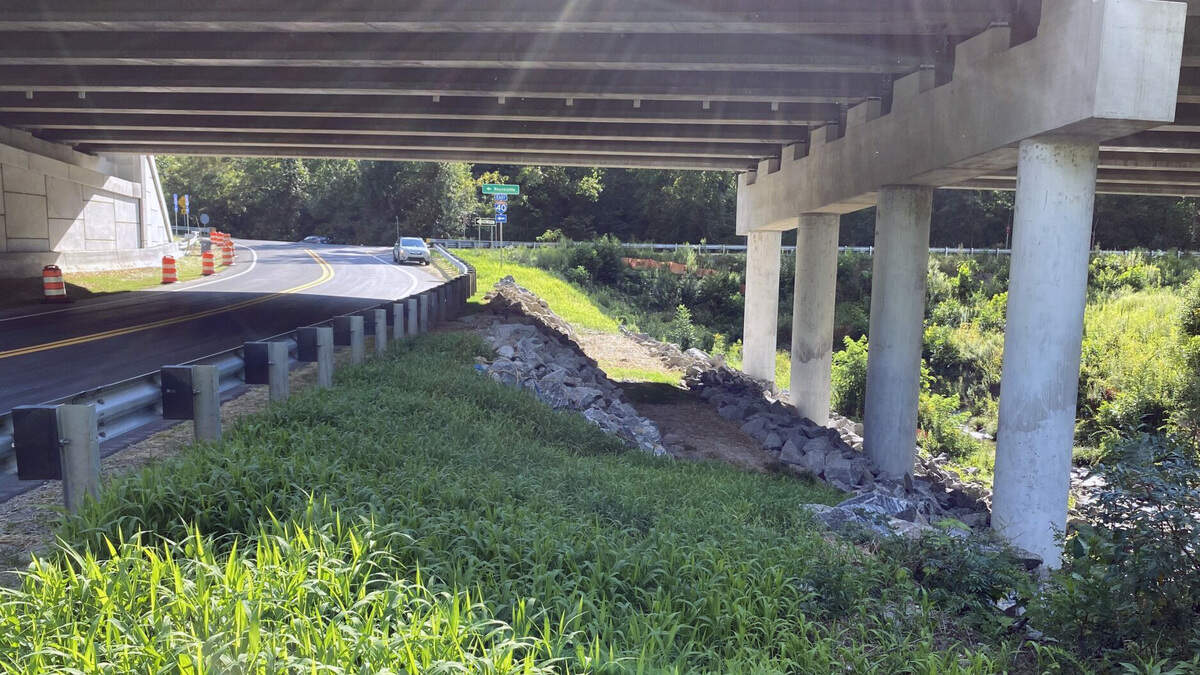
The coalition’s perseverance paid off in 2023 when lawmakers approved an initial $2 million, enough for a limited number of projects.
“The $2 million … was helpful, but that wouldn’t even pay for, you know, five miles of wildlife fencing on both sides of the highway,” Hunter said. “It’s not enough money, but it was a good start.”
Pulling on heartstrings
Hunter’s journey to protect wildlife began as a volunteer to save a local forest in New York. During the breeding season, frogs and salamanders travel to breeding pools, often crossing roads.
“You get an ill‑timed rainfall in an area with a big population of salamanders or frogs, and it can be just a bloodbath, I mean, just things smashed everywhere,” Hunter said. “I worked in a data center for Verizon, paid well, very boring, very mundane. That was an outlet for me, and that has direct application to the way that I do this work.”
Hunter stressed that the emotions he experienced in New York are shared by motorists nationwide who harm wildlife.
“You know, when you go by, and you see a deer smashed on the road… it’s such a disheartening sight,” Hunter said. “People come here to see the bears alive, not smashed on the side of the road, and it just happens way too frequently.”
Looking forward
Home to an exceptionally high number of species found nowhere else, North Carolina’s financial commitment to wildlife and human safety could have national impacts.
“This sets the stage for other states to put their money where their mouth is,” said Nikki Robinson, the North Carolina project manager at Wildlands Network. “What began as a vision to reconnect one of North Carolina’s most important wildlife corridors has resulted in a historic, statewide effort.”
While the timeline for construction is unclear, North Carolina’s mountain highways are likely to see some of the first new overpasses and underpasses.
“There’s a shared legacy here,” Hunter said. “If I see a crossing go up with this funding, I’ll be swelled with pride — but there are dozens of my partners who I know would feel the same way.”
For more on the Safe Passage coalition and upcoming projects, visit SmokiesSafePassage.org.