A hard freeze is coming to Raleigh & central NC. When it’s expected, how to prepare
A cold front moving in this weekend is expected to bring well below-average temperatures into the start of Christmas week, forecasters say.
How cold will it be this weekend?
The National Weather Service said a cold front moved into North Carolina on Friday, bringing some scattered rain Friday evening, followed quickly by a rush of cold air that will hang around through Monday.
On Saturday the high temperature was only expected to reach about 48 degrees. Saturday marks the Winter Solstice, the beginning of winter, and it will feel like it — chilly with a north wind of 6 to 10 mph with gusts up to 18 mph.
Saturday night, lows across Central and Eastern North Carolina are expected to reach down to 23 degrees — as much as 12 degrees below average for December — as Arctic air builds into the region, the Weather Service says. Some areas could see lows in the high teens.
Winds will calm considerably Saturday night.
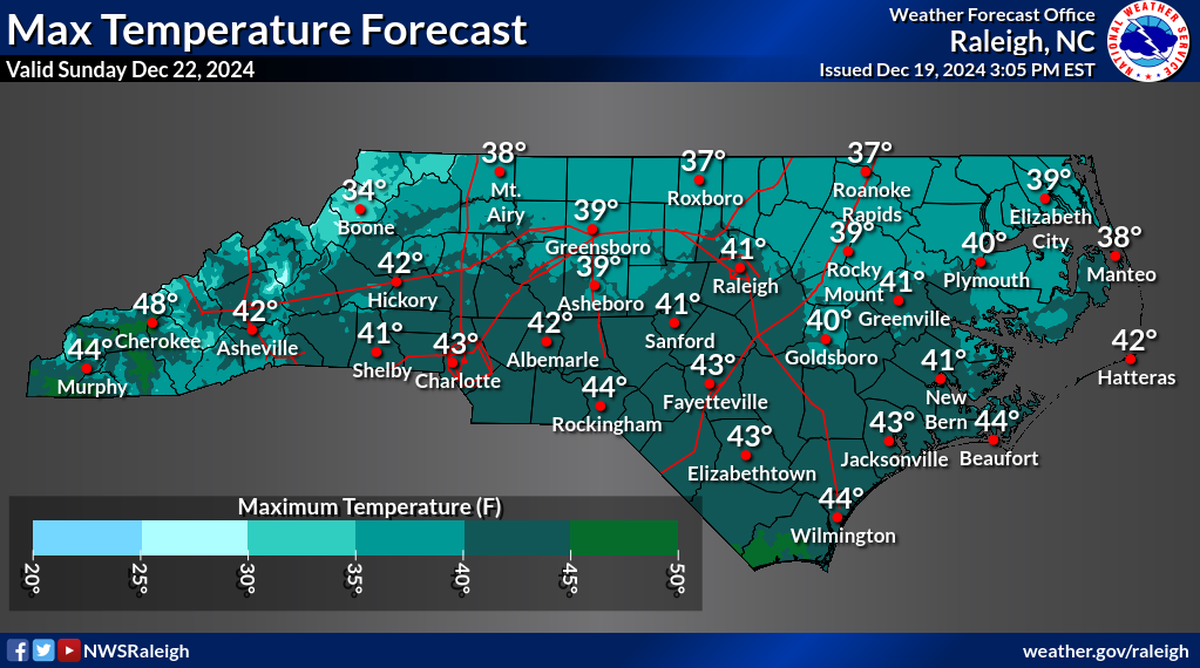
Even colder on Sunday
Sunday will be the coldest day of the period, forecasters say, with highs across the region in the upper 30s to low 40s during the day, with an expected low of 19 early Sunday morning. Those temperatures are 12 to 18 degrees below average, the Weather Service says.
Monday is expected to be sunny and still cold, with a high near 41 degrees and a low Monday night around 23 degrees.
Temperatures will approach more normal highs of around 50 degrees on Tuesday and Wednesday. Rain is possible on Wednesday, Christmas Day.
Is there a hard freeze warning?
The Weather Service issues freeze warnings when there are crops in the field that could be damaged by frosty temperatures.
If you have potted plants outside, now would be a good time to bring them in.
Cats and dogs are subject to hypothermia and frostbite just like humans, and should be brought inside during excessive cold, the American Veterinary Medical Association says.
If it’s not possible to bring them in, provide solid shelter against the wind with thick, warm, dry bedding and make sure the animals have access to water that isn’t frozen.
How cold does it have to be for your pipes to freeze?
Pipes can freeze at temperatures below 32 degrees, but most insulated pipes start to freeze at temperatures below 20 degrees, according to Angi, a website that provides information on home improvement projects. If a cold snap lasts for more than four to six hours, your pipes could burst.
Exterior pipes are most susceptible to cold temperatures and can freeze after a few hours in temperatures around 20 degrees, but pipes inside your home could take up to six hours to freeze at 20 degrees.
Charlotte Observer reporter Evan Moore contributed to this story.
This story was originally published December 20, 2024 at 6:00 AM.