Could this NC winter storm cause rolling blackouts like the Christmas storm of ‘22?
AI-generated summary reviewed by our newsroom.
- Duke Energy upgraded modeling, software and plant protocols to limit rolling blackouts.
- Officials warn ice and prolonged cold can still overwhelm supply and damage lines.
- Clean-energy groups press for more wind, solar and battery storage to bolster grid.
A winter storm bringing snow and ice across much of the nation’s midsection over the weekend could cause significant power outages in North Carolina, but Duke Energy says it doesn’t foresee a repeat of the Christmas 2022 event that caused rolling blackouts across the state.
Those blackouts had the utility explaining to regulators a series of cascading problems that plunged nearly a half-million of its customers in the western, Piedmont and Triangle areas of the state into hours of cold and dark starting Christmas Eve. Many had no warning.
It was the first time Duke had ever used the tactic of deliberately cutting power to customers in an effort to preserve the grid, and it didn’t work as planned.
Jeff Brooks, a Duke spokesman in Raleigh, says the company made immediate changes and has continued to work on the systems that performed poorly as the 2022 storm rolled through.
What caused the power blackouts in NC at Christmas 2022?
A multi-day winter storm that affected a wide area of the country arrived in North Carolina on the night of Dec. 23, 2022, bringing wind gusts of more than 27 mph in Raleigh and dropping temperatures to the single digits in much of the state, according to the Old Farmer’s Almanac.
When the cold temperatures hit, power demand increased more than Duke Energy had anticipated, creating a strain on the supply system. Then, instrumentation at two coal-powered plants in Person County and a natural gas-powered plant in Rockingham County froze, forcing those facilities to drop production, The News & Observer reported.
Duke had planned to buy extra power from neighboring utilities and independent producers, but they too were overwhelmed by a surge in demand, so they didn’t have power to spare.
Scheduled maintenance that had taken some plants offline further reduced production capacity, Duke said at the time.
To make matters worse, the company expected to only cut power to any customer for 15 to 30 minutes before rolling to another customer, but the software designed to make those switches got overloaded, and some customers had no electricity for hours, meaning their houses were cold and their tempers were hot.
Is this the same scenario as the Christmas 2022 storm?
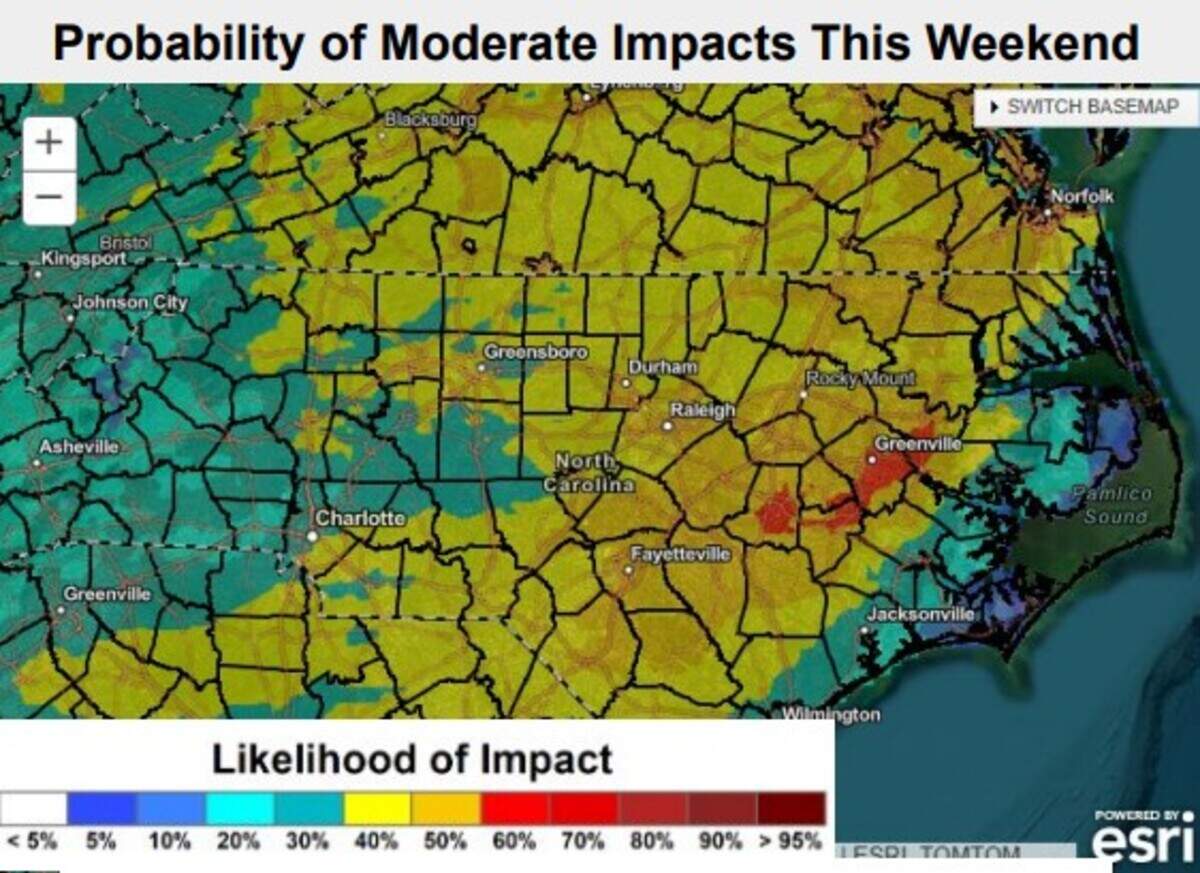
The systems that are forming into the storm expected to hit Saturday through Monday were still in flux on Thursday, but the National Weather Service was predicting that much of the state could see at least a thin coating of ice, followed by two or three days of very cold temperatures.
Single-digit lows are expected Monday night.
Winds will be gusty but not as strong as those that came with the 2022 storm.
But that combination – ice, which can bring down power lines, and extreme cold, which sends utility customers to bump up their thermostats — has had homeowners scouring big-box stores for generators and propane heaters as the storm approaches.
The spread of the storm system, reaching from the southern Rocky Mountains to the mid-Atlantic and New England, is uncomfortably similar to the one that hit in 2022.
Could NC have rolling blackouts during this winter storm?
Duke Energy says it began making improvements soon after the 2022 storm and has systems in place to prevent the need for rolling blackouts while also ensuring that if they’re needed, they aren’t as much of a disruption as the first time.
Those include:
- Improving the accuracy of modeling to more accurately estimate the amount of power that will be needed for winter weather events. In particular, Brooks said, the company now accounts for the surge that happens on winter mornings as families and businesses begin their days, turning up the heat and starting appliances and equipment.
The company also now takes climate projections into account as it makes long-term plans for equipment so it’s better positioned to meet surges in demand, Brooks said.
- Improving the software that keeps the blackouts rolling so that no customers are without power for longer than about 30 minutes.
- Conducting plant maintenance outside the times when demand could soar to ensure facilities aren’t offline when they’re needed most.
- Improving communications, letting customers know that a surge is expected and asking in advance for them to turn down thermostats to prevent excess demand. Brooks said Duke also now sends more frequent and accurate updates to customers whose power is out about the cause of the problem and when power is expected to be restored.
- Adding cold-weather protection to instrumentation that is exposed to the elements to try to prevent freeze-ups like the ones that happened in 2022.
Critics say Duke has not done all it can to safeguard the grid
Clean-energy advocates say Duke Energy’s plans to expand the use of natural gas and continue to use coal for power generation in North Carolina will do little to beef up the strength of the power grid.
In the company’s 2025 “carbon plan” update, Duke said it needs to build new gas and nuclear power plants and extend the life of aging coal-fired plants to meet an expected surge in demand over the next 15 years.
But clean-energy advocates say relying on fossil-fuel-burning, polluting technologies or trying to build unproven nuclear designs will reduce the reliability of the grid and increase costs for customers over the long haul.
Groups such as NC WARN and Vote Solar want Gov. Josh Stein and state regulators to push Duke more toward renewable energy sources such as wind and solar with batteries.
The company has said solar-generated power helped recover from the rolling blackouts in 2022 but that it wasn’t an immediate help because the problems started overnight on Christmas Eve, and without battery storage for solar power, the company had to wait for the sun to rise.
This story is available free to all readers thanks to financial support from the Hartfield Foundation and Green South Foundation, in partnership with Journalism Funding Partners, as part of an independent journalism fellowship program. The N&O maintains full editorial control of the work. If you would like to help support local journalism, please consider a digital subscription, which you can get here.
This story was originally published January 23, 2026 at 5:45 AM.