
A new fundraising complaint will test the GOP-led State Board of Elections | Opinion
AI-generated summary reviewed by our newsroom.
- Complaint alleges $338K fundraiser used straw donors to benefit GOP leaders.
- GOP-controlled election board faces test of impartiality in donor fraud probe.
- Secrecy law delays probe results, withholding key info from 2025 election voters.
Two GOP state leaders are at the center of a complaint filed with the State Board of Elections that alleges violations of campaign finance laws, including donations made in the name of people who deny they made a contribution. The use of “straw donors” who give more than $10,000 can be a felony.
Now we’ll see whether the board, whose control was shifted by a new state law from the governor to Republican State Auditor Dave Boliek, will aggressively investigate the complaint that could affect the campaign funds of two Republican leaders – House Speaker Destin Hall and Senate President Pro Tem Phil Berger.
Boliek has been very public about getting tough on waste and fraud in state and local agencies. But when the new law gave him power to appoint members of the State Board of Elections, his choices had a sharply partisan edge. He chose a former Republican state senator who led a gerrymandering effort and the former leader of the conservative Civitas Institute as part of the three-member Republican majority on the five-member board. The new majority then hired as the board’s executive director a lawyer who served as general counsel to Hall.
That’s not a lineup that inspires confidence that an investigation into how top Republicans received campaign donations will go forward without fear or favor. It would be good to hear Boliek provide assurance that this serious complaint will receive a thorough review and a timely resolution. His office did not immediately respond to a request for comment.
The complaint was filed by longtime campaign finance watchdog Bob Hall, the former executive director of Democracy North Carolina.
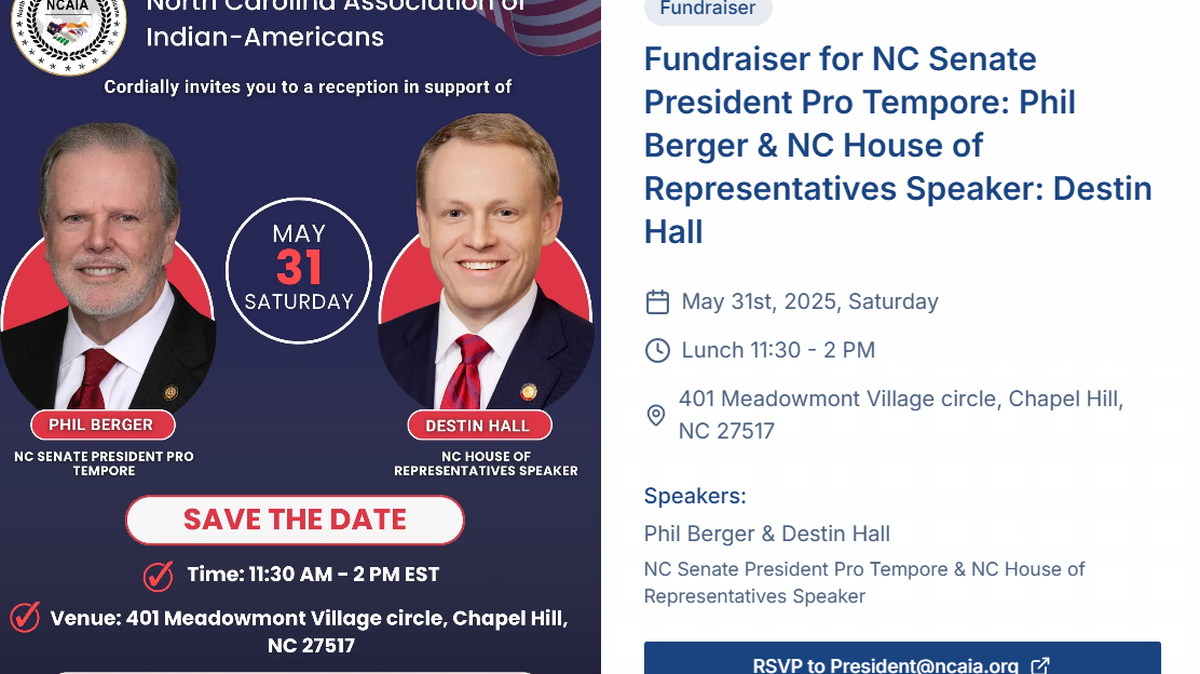
It focuses on a May 31 fundraiser hosted by the N.C. Association of Indian Americans (NCAIA) to benefit Speaker Hall and Berger. The event generated a huge amount of campaign donations – $338,000. The money was divided nearly equally between the two state lawmakers.
It was an extraordinary outpouring from the Indian American community. The complaint notes that the donors’ contributions “exceeds their total contributions of $260,000 over the past 25 years to all other state legislative, judicial and executive branch candidates.”
The complaint also notes that “nearly two-thirds of the Indian American donors had not given a recorded contribution to a state-level campaign before this event.”
Why are so many Indian Americans suddenly giving large sums to the House speaker and Senate leader? It may be because some in the community want the state to help pay for a new stadium on UNC-Chapel Hill’s North Campus that could accommodate cricket matches.
Vimal Kolappa, an Indian American hotel chain owner and a UNC-CH trustee, proposed the stadium idea to the university’s Board of Trustees two months after the fundraiser. Kolappa has been seeking $100 million from state lawmakers for the stadium.
“It looks like a transactional pay to play,” Bob Hall said. “The policy they want is a commodity to buy.”
There are all sorts of problems behind how Hall and Berger’s campaigns came to receive more than $165,000 each from the generosity of the Indian American donors.
The NCAIA’s nonprofit status is murky. It may lack the legal authority to raise funds for political campaigns. If the board finds that the organization acted outside of campaign finance laws, Berger and Speaker Hall may have to forfeit all or a portion of the donations to a state penalty fund.
The complaint’s most serious allegation is the discovery of what it said are “multiple examples of contributions attributed to donors listed on the candidates’ reports who deny they made the contribution or who don’t exist at the address given or who appear to be straw donors, i.e., names used by someone to illegally put money into the recipient’s campaign.”
What’s next? Unfortunately, the public won’t know for a while, maybe many months. A law passed in 2018 by the Republican-controlled legislature made board investigations secret. Even if violations are found, the findings have to be reviewed by the State Ethics Commission.
As a result, allegations of campaign finance law violations may not be resolved until well after the next election, depriving voters of information they should have.
Wake County District Attorney Lorrin Freeman could cut through the delay by investigating the alleged felony violations immediately. But she said on Thursday that she will wait for the board’s investigation to be complete so as not to duplicate its efforts.
Republican lawmakers and Republicans on the State Board of Elections focus on voter fraud. Now we’ll find out if they have the same interest in potential donor fraud.
Associate opinion editor Ned Barnett can be reached at 919-404-7583, or nbarnett@newsobserver.com