Campbell who? Small NC college is playing football in ACC country for national attention
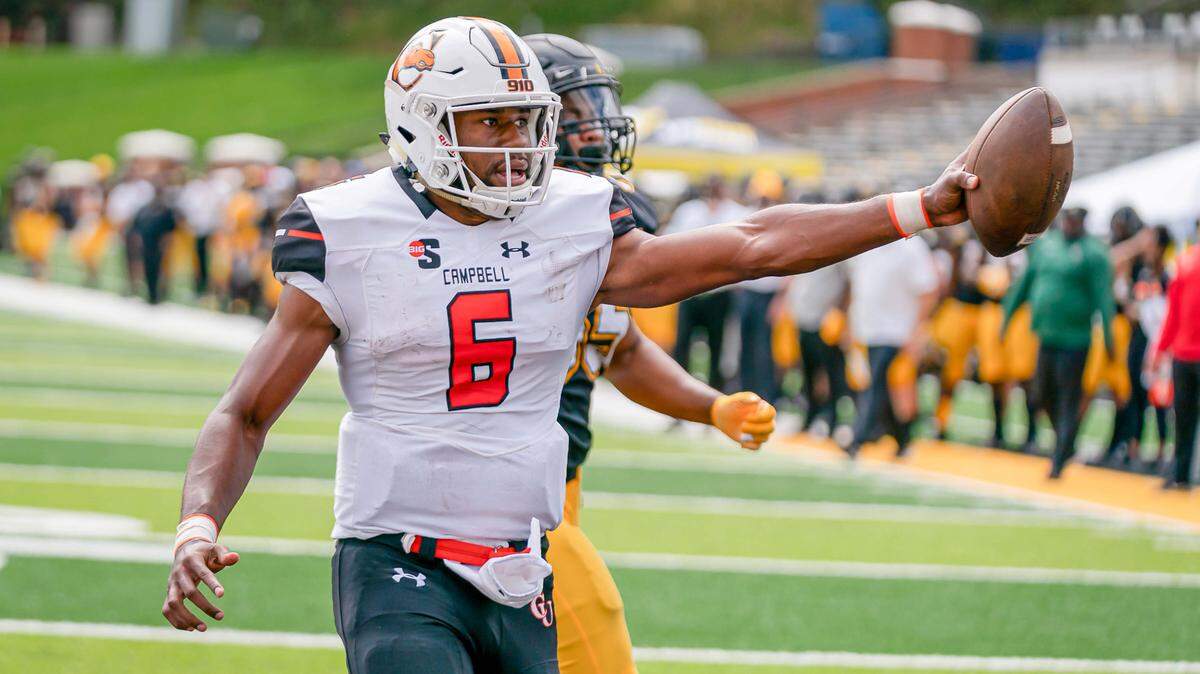
The most significant data point that emerged for Campbell during its football team’s season-opening defeat at Georgia Southern was not a result of anything that happened on the field. It was not any statistic or that the Camels, who were playing on television before a national audience, lost by only a point against a heavily favored opponent.
It was, instead, what registered on the university’s internet servers. Campbell University remains, as it has been throughout its history, a small Baptist school in the middle of fields and farmland in rural Harnett County. Its campus is only about 45 minutes south of Raleigh yet, surrounded by the serenity of open spaces, it feels farther removed.
The game at Georgia Southern, then, represented a rare opportunity. Campbell had never appeared in a nationally televised football game before that one, broadcast on ESPNU. The benefits soon became quantifiable. As soon as the game started, spectators watching at home, perhaps starved for football before major-conference teams began playing, reached for their phones or laptops.
They began searching for information about what, or who, or where Campbell was. They might have learned that Campbell is a member of the Big South Conference in the Football Championship Subdivision. Or that Campbell only became a scholarship football program in 2018. Or that Campbell is in a town called Buies Creek, population 3,000 — give or take a couple hundred.
A certain number of people who entered Campbell into Google then made their way to the university’s website. That’s what caught the attention of the university employees who track web analytics. They quickly took note of a surge of visitors to the webpage for the school’s admissions office, where traffic increased by 863%. The school’s main athletic department page on Facebook saw a similar spike. Meanwhile, Campbell’s official athletics website, gocamels.com, attracted more visitors than it ever had.
To explain why Campbell is doing what it’s doing — playing a four-game football season while the rest of the Big South takes the fall off — and doing it in a way that none of its peers are, people at the university share stories like the one about the increased exposure. There are 127 schools that play football at the FCS level. Of those, only 17, the Camels included, are playing any kind of football season amid the pandemic.
And of those 17, only one is playing a schedule comprised solely of road games against upper-division opponents from the Football Bowl Subdivision. Campbell is the one. After games, and defeats, against Georgia Southern, Coastal Carolina and Appalachian State, the Camels’ season ended with a 66-14 defeat on Friday night at Wake Forest.
That game, broadcast on the ACC Network, represents the third time in the past month that Campbell will play on national television. Undoubtedly, some people who tune in around the country will see the name of an unfamiliar school appear on their screens. The Googling will commence. The traffic on Campbell’s websites will increase.
“The exposure is something that we could not have imagined or prepared for considering everything that is going on right now,” Omar Banks, the Campbell athletic director, said. “But it is welcome because it introduces everybody to Campbell University.
“I said (before) if you peel back the name of the university, and you put the programs out there, I mean, we look a lot like Duke. We look a lot like Wake Forest. We’ve got a medical school. We’ve got a law school. We’ve got pharmacy, we’ve got business.
“We’ve got all these wonderful programs that people just really don’t know about.”
In recent years, athletics has become a more high-profile part of Campbell’s growth strategy. Many of the school’s sports facilities have been built or rebuilt within the past decade or so, and would not look out of place on campuses of universities with considerably more resources. The school’s basketball arena opened in 2008 and became a place to be while Chris Clemons became one of the most prolific scorers in college basketball history.
The baseball stadium, which in 2017 and ‘18 hosted a Houston Astros minor-league team before its relocation to Fayetteville, has undergone extensive renovations over the past 10 years and looks like a smaller, scaled-down version of any modern park found in the ACC.
Barker-Lane Stadium, home to the Campbell football team, also opened in 2008, the same year the school began playing football again after a 58-year hiatus. Since, the facility has grown relative to Campbell’s athletics ambition. In 2012, the university added lights to the stadium; in 2013 it completed an addition that expanded capacity by 3,000; in 2016 it welcomed a large video scoreboard; in 2018, it installed a new playing surface, with new logos painted onto it.
Mike Minter, who spent 10 seasons as an NFL safety with the Carolina Panthers, has been at Campbell long enough to experience most of these changes. As the Camels’ head football coach, he has played a leading role in implementing a lot of them. When he arrived at Campbell in 2013, he said, his goal was clear enough for the young, unestablished program that he was inheriting.
“When I took this job,” he said during a recent interview, “my vision for this program was to become an FCS powerhouse.”
At the time, it seemed like something of a fantasy. When it began playing football again in 2008, Campbell did not offer football scholarships. It joined the Pioneer Football League, which, like the Ivy League, consists of schools that do not award football scholarships. Unlike the Ivy League, though, the PFL only sponsors football. Its members include Davidson, Morehead State, Butler and Valparaiso, among others.
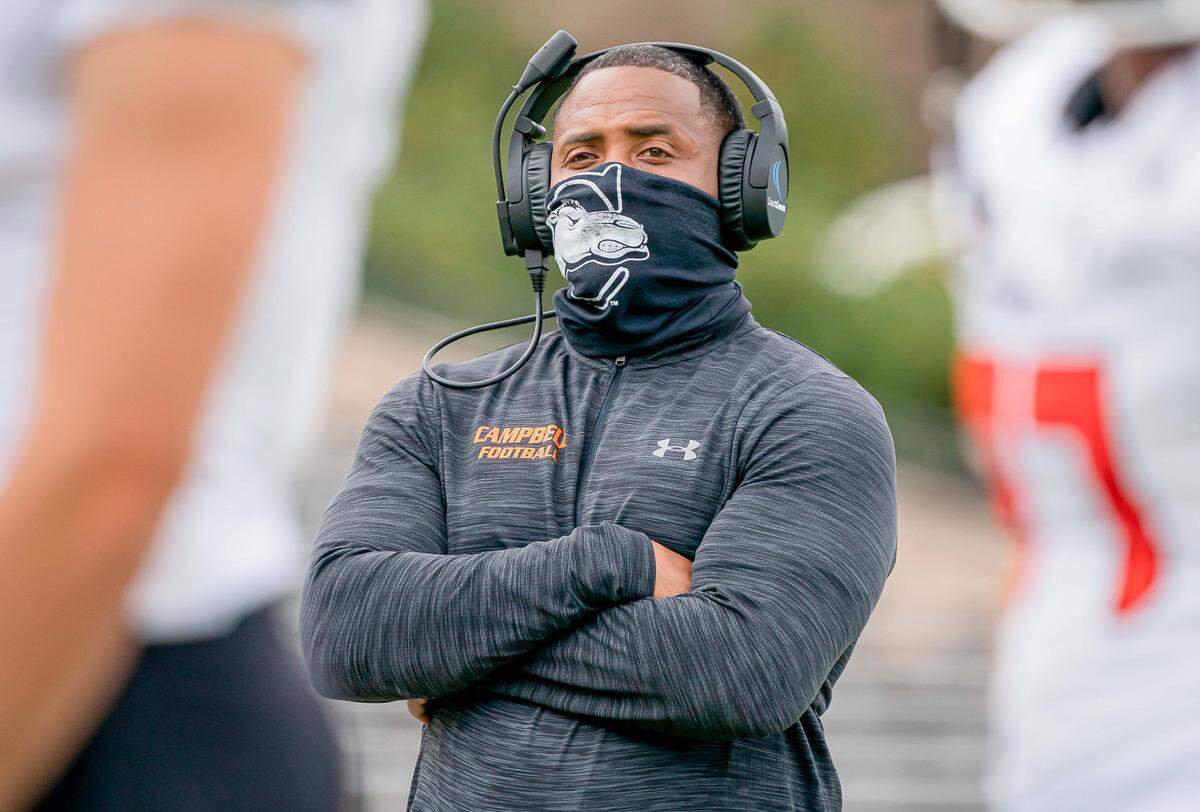
Before Campbell could attempt to make Minter’s vision a reality, it had to begin offering football scholarships. In late 2016, it announced that it would. Two years later, it transitioned to the Big South Conference, where the Camels are a member in all other sports. Their football program has been around for 12 years now, but in a lot of ways still feels new because of the relatively recent transition to the Big South, and offering scholarships.
The pandemic has only accelerated Campbell’s timeline. Before, it had planned on competing against an upper-division in-state school for the first time in 2022, against East Carolina. In 2023, the Camels were going to play an ACC school for the first time, at North Carolina. Those milestones became squeezed into consecutive weeks in this long, strange year. Last week, Campbell traveled to Appalachian State, where it suffered a 52-21 defeat.
And on Friday, in Winston-Salem, the Camels make their debut as an ACC opponent, three years ahead of schedule.
“This has sort of sped up the process,” Ricky Ray said with a laugh.
He’s Campbell’s Deputy Athletics Director, and among his many responsibilities is the football schedule. Non-conference college football schedules are usually made years in advance, sometimes with games planned a decade before they might actually happen. Ray had about four weeks to put together and finalize the Camels’ four-game schedule.
That they’d play any kind of season at all was in doubt for months. Early last spring, Minter said, he assumed what many others did, too: That one way or another life would eventually return to some kind of normalcy; that by the fall, his team’s season would go on as expected. Gradually, reality began to settle in.
By early August, a college football season of any kind, at any level, appeared in doubt. At the FCS level, especially, where schools’ athletics budgets are by several magnitudes smaller than the ones at their FBS counterparts, finances became an obstacle given the expense of regularly testing athletes for COVID-19.
There, Campbell caught a break, Minter and Banks said, because of its medical school. Through the school, the university received a grant that has covered some of the costs of testing football players for COVID-19. Those tests cost $125 each, Minter said, and they have been administered weekly — on top of any other testing requirements the Camels’ opponents have mandated.
Resources, or lack thereof, led a lot of FCS conferences and schools to not attempt to play a season. There were also logistical concerns, given the smaller rosters. FCS teams that award football scholarships are limited to 63 of them. FBS teams, meanwhile, have a scholarship limit of 85.
“Even if they have 20 guys out, they’re still good,” Minter said before Appalachian State had to sit 18 players for COVID-19 contact tracing last week. “Where if 20 guys are out on (our team), you don’t have a football team. So I think that’s the other piece that comes into deciding not to.
“And then the unknown. The unknown of the virus — is this stuff going to kill somebody. Is it not going to kill somebody? Do they have this heart condition that’s out there? How do you deal with that?”
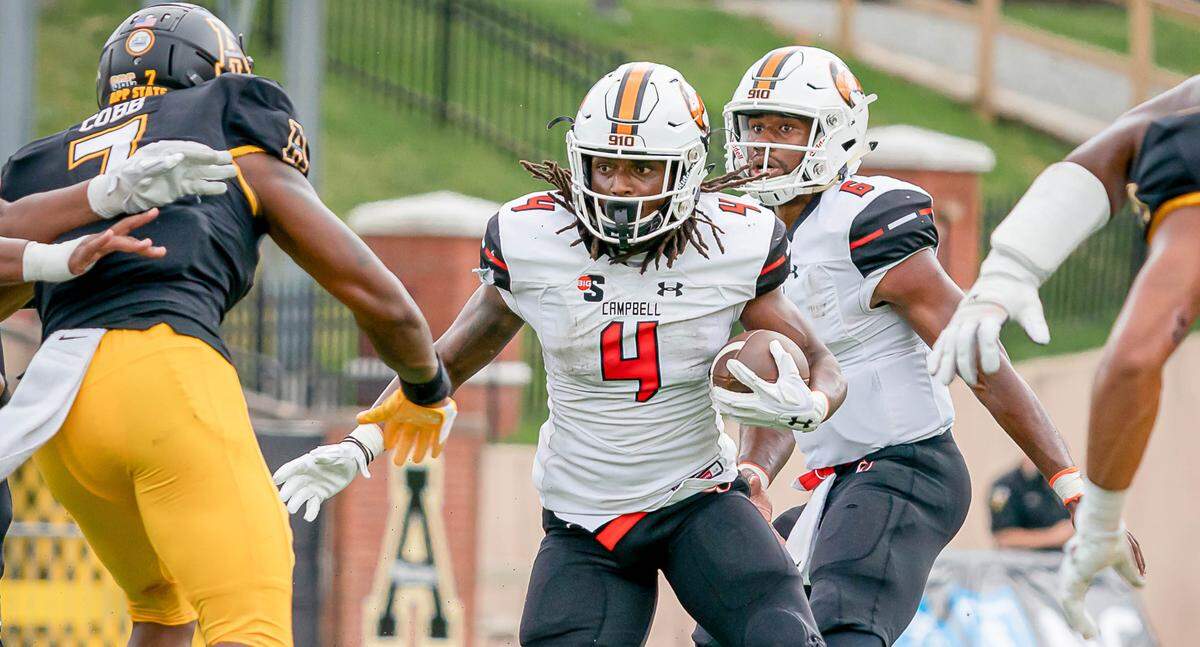
One after another, FCS conferences canceled their fall sports seasons in early August. The Big South became the 10th to do so Aug. 12. Its leadership at the time said they were hopeful that a spring season could be possible, while allowing its members to play up to four non-conference games this fall. Minter saw opportunity. He thought about Campbell’s proximity to FBS schools throughout the Carolinas and said to himself:
“Why not get four FBS games?”
“It would help us in recruiting,” he said. “Our footprint would grow. People would begin to want to know who Campbell is. We would get to show our product and our progress from (a) non-scholarship” program to now. He met with Ray, the associate athletic director, and said, “All right, Ricky, this is what we want. Go get it.”
Ray did. The first game of the season, at Georgia Southern, had already been scheduled.
That meant Ray needed to fill three openings. He spoke with about 25 schools, he said, and though Campbell received overtures to board planes to play against far-flung opponents, “it just seemed to make a lot more sense” to play against schools that were closer, Ray said. The games against Coastal Carolina, Appalachian State and Wake Forest all made for easy bus trips. All came with guarantee money, though not at the level that it would’ve been before the pandemic.
The Camels received $150,000 for their game at Appalachian State. According to The Fayetteville Observer, they were paid $325,000 for playing Georgia Southern and noted that Ray said, “we’re not getting half a million dollars to go to Wake Forest.” As a private institution, Campbell is not required to disclose contract information.
“You kind of understood that going in that it was going to be a reduced rate,” Ray said, but the payments from Campbell’s opponents have provided but only one financial benefit. “... The amount of social media and website traffic and new eyeballs on the place has just been phenomenal.”
While Ray worked on the schedule, Minter allowed his players to process the news that their season would be far different than one they’d expected. That instead of playing a full season, they could either play four games or none at all. Though the Big South expressed hope about a spring season, Minter, who played in college on Nebraska’s nationally dominant teams of the mid-1990s, did not think that was a good idea.
“I know how long it takes to heal up,” he said. “I’m not guessing. The time that we have off (in the winter and spring) is the time that we need off.”
In August, not long after the Big South’s announcement, but before Campbell finalized its own plans, Minter gathered his players. He told them about the vision for the schedule: Four games, all against FBS opponents. He described the opportunity that could await, both to play in nationally televised competitions, but also against teams that would offer formidable tests.
“I said, ‘let’s take a vote, guys,’ ” Minter recalled. “ ’This is up on you. If you want to do it, we’re doing it. If you guys are not going to do it, we will not do it. We are one team, one heartbeat in everything we do.’ ”
The players decided to proceed, despite the abbreviated season.
“Everybody still wanted to play,” said Darion Slade, a senior defensive back who is among the Camels’ most dependable contributors. Like many of his teammates, Slade attempted to prepare for this season during solo workouts in his hometown. When campus emptied last spring, because of the virus, he went back home to Winston-Salem. He tried to remain in shape by working out in a field, doing sprints and makeshift agility drills.
“Not the best of training,” he said. “But it was just something to keep me active.”
For Slade and his teammates, any kind of season has proven better than no season. Even one that has always appeared likely to end without a victory. After a 27-26 defeat against Georgia Southern, Campbell lost by about three touchdowns at Coastal Carolina, and by about four at Appalachian State. It was unlikely that its trip to Wake Forest would end in a more narrow defeat, and it didn’t. Winning, though, hasn’t necessarily been the objective for the Camels. At least not on this stage, and not yet.
“We want to play those types of teams,” said Slade, whose final college game, at Wake Forest, came in his hometown. “We want to measure our skill level — how we compete against those types of teams. ... We don’t shy away from any type of challenge, any type of competition. And of course it’s good exposure, as well.”
That’s the primary benefit. Last week, days before its game at Appalachian State, Campbell announced that it was ceasing in-person classes for two weeks due to a virus outbreak. The news briefly called into question whether the football game would go on as scheduled in Boone, where Appalachian State’s administration had announced a virus cluster of its own.
The game went on, though, in front of 30,000 empty seats at Kidd-Brewer Stadium, and under a sky full of gray, puffy clouds that hung low over the mountains. In the distance, leaves were just beginning to change color. It was a beautiful early fall day, perfect for a football game — and yet it felt odd, what with the absence of fans and a made-for-TV spectacle playing out on the field.
Outside the stadium gates, Mike and Dana Hayes formed a two-person Campbell cheering section. Mike wore a bright orange shirt, and greeted some of the Camels’ players when they walked off the field after pregame warm-ups and entered the visitors’ locker room across the street from the stadium. The Hayeses had driven four hours from their home in Dillon, S.C., to watch their son, Jackson, the Campbell long-snapper. They expressed gratitude for the Camels’ unique four-game season.
“It’s really good exposure for Campbell,” Mike Hayes said, standing near a black iron fence that allowed for a diagonal view of the field. “National exposure, with ESPNU against Georgia Southern, and then last week against Coastal on ESPN on a Friday night. Can’t beat it.”
“And to play as well as we did against Georgia Southern,” Dana Hayes said.
At App State, which has become an annual contender in the Sun Belt Conference and a program familiar with appearances in the Top 25, Campbell scored first, and held the lead late into the second quarter. The Mountaineers asserted themselves before halftime, and made the game a lopsided affair during a dominant third quarter. Still, the Camels walked off the field afterward with a sense of accomplishment. They’d led for most of the first half.
“As far as competing, we feel like we’re in the FBS,” Hajj-Malik Williams, the team’s sophomore quarterback, said afterward. Six years earlier, in 2014, Campbell had traveled to Boone and suffered a 66-0 defeat against the Mountaineers, who were then transitioning from the FCS to the FBS. Now, the Camels had held their own — at least for a half.
“Same type of App team,” Minter said on Saturday. “But we’re a different football team.”
Little by little, he has attempted to build something in Buies Creek. During an interview over Zoom last week, Minter spoke in his office with a couple of footballs on shelves in the background. One of the balls was from his first victory at Campbell; another from his first conference victory. Nearby, he kept a commemorative football that he received when the Panthers played in the Super Bowl in 2004 against the New England Patriots.
Minter made 14 tackles during Carolina’s 32-29 defeat.
“Every player that comes in and has aspirations to go to that league, I say hold this ball, and let me see how you hold it,” Minter said. “If you don’t hold it right, I know you ain’t for real ... They better hold it like it’s theirs — like, ‘It’s mine.’ ”
Campbell has not yet had a player matriculate to the NFL, though it seems only a matter of time before that changes. Part of the Camels’ growth in recent years, Minter said, has been convincing his players that they belong. The odds were not in their favor before any of their games this season, and yet Minter implored them to be relentless — to rise again after they’d inevitably fall.
“You’re not going to be able to convince somebody in two days that you’ve got to go beat Goliath,” Minter said. “Right? David was out there training for years before his fight with Goliath.”
In a lot of ways, then, this four-game season has served as a training ground for a small-school football program with bigger aspirations. While most of its peers have sat out the fall, either due to concerns about the virus or a lack of resources to handle it, or both, Campbell saw an opportunity. It has reinforced that, sometimes, and in some ways, a losing season can be a victory.
This story was originally published October 2, 2020 at 6:00 AM.