NIL. Branding. Social Media. How a top prep basketball player navigates college recruiting
READ MORE
Being Jarin Stevenson
The second part of an occasional series exploring what it’s like to be a top college basketball recruit in 2023.
Expand All
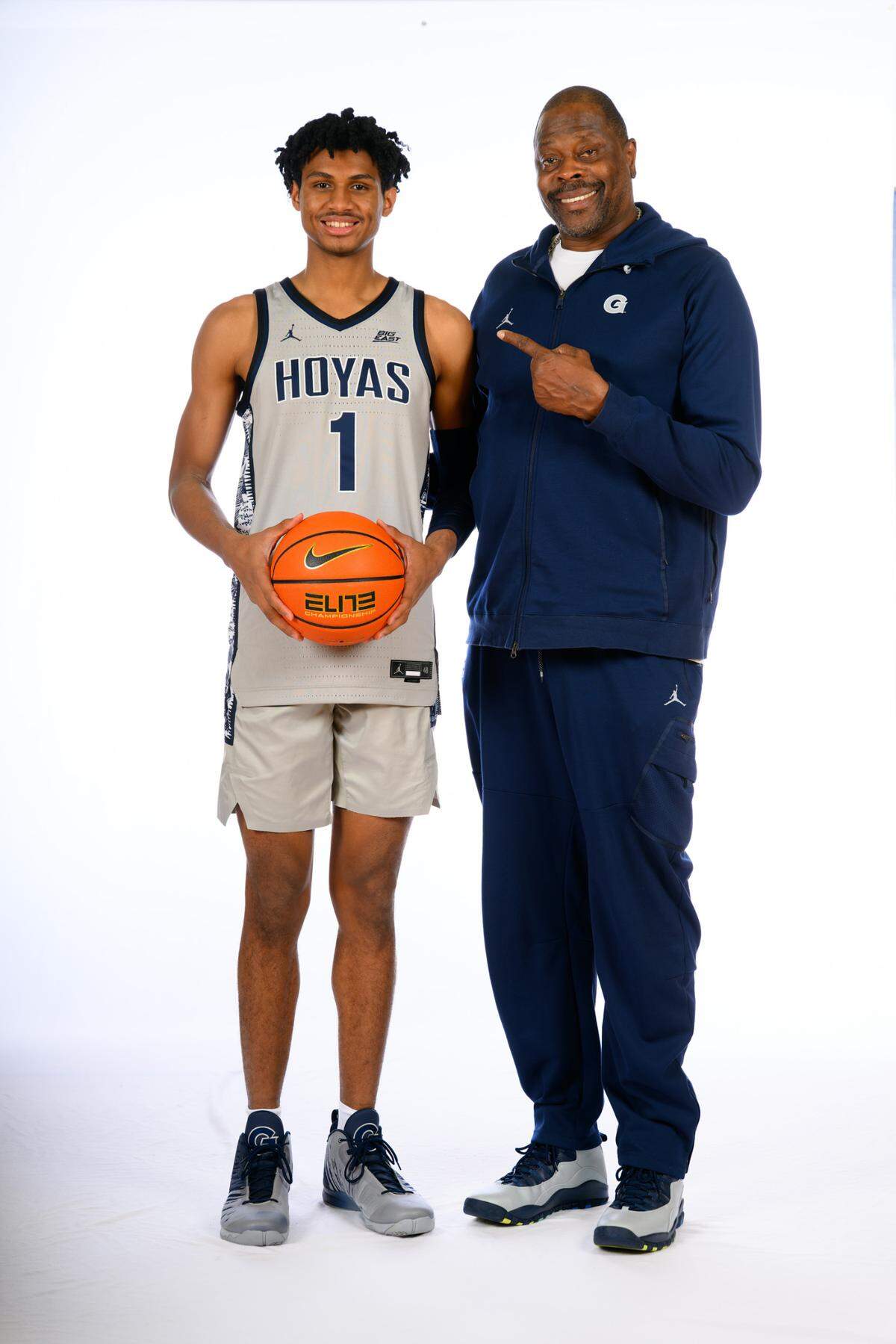
A recent week in the life of Jarin Stevenson, 17-years-old and perhaps the most-coveted high school basketball prospect in North Carolina, looked like this: an official visit to Georgetown on a Saturday and, that night, a steak dinner with Patrick Ewing, the Naismith Hall of Famer and Hoyas coach who told Stevenson, “I want to help you become the next me.”
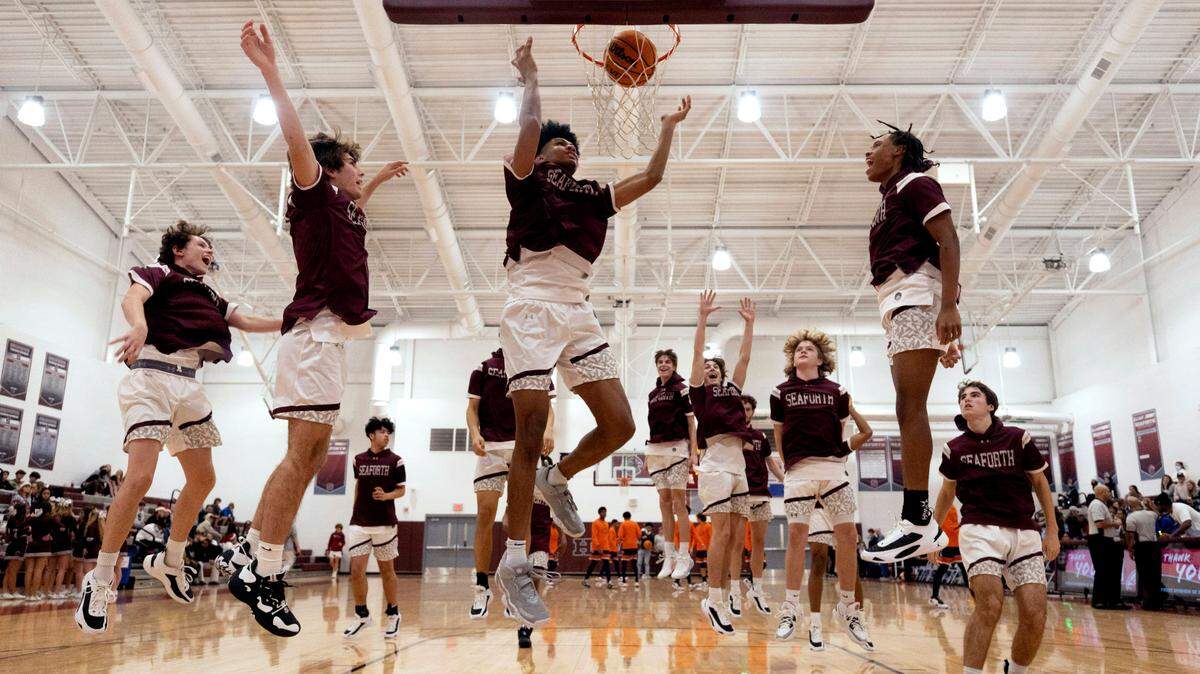
A practice a few days later at Seaforth High in Pittsboro, where Stevenson is a junior, and a visit from an assistant coach at Missouri who flew in to see Stevenson go through the workout. And then a game, on a Thursday night, with a special visitor. Hubert Davis, the head coach at North Carolina, walked in a back door and took his seat next to the court.
For the next 90 minutes or so, the coach watched one of the Tar Heels’ prime recruiting targets in Stevenson, whom Davis and a legion of fans hope becomes a part of UNC’s basketball future. It was the visit from Davis that made Stevenson a little anxious. He’s still getting used to all this attention and sometimes he sounds surprised, almost bashful, that he’s starting to receive it.
“Honestly, at first, I do get a little nervous,” Stevenson said recently, flashing the wide smile that is his trademark. “Because to me it’s big, you know, having a coach coming out and watching you play. It’s a blessing, for sure.
“But once I get into the game, I’m ready and I’m ready to do what I need to do.”
Not long ago, before the start of the high school season, Stevenson’s father and coach, Jarod, hypothesized that things were “about to get crazy” for his son, and his recruitment. It’s a wise prediction. College basketball recruiting has always been a bit crazy — and these days it’s only crazier, what with the increased options and exposure and changing dynamics of college athletics.
Fifty years ago, David Thompson was relatively unknown in Shelby before N.C. State emerged the winner in a bitter recruiting competition with rival UNC. Forty years ago, Michael Jordan — Mike, as he was most often called then — didn’t start receiving national attention in Wilmington until his senior year of high school, and even then it was nothing compared to today.
Twenty years ago, or a little more, the Internet changed everything, and then social media did, too, allowing fans direct contact, for better or worse, with the prospects they most desire. Both of Stevenson’s parents experienced their own basketball recruiting journeys in the mid-1990s — Jarod Stevenson’s ended at Richmond, where he became an all-conference guard and Nicole Walker Stevenson played for Sylvia Hatchell at North Carolina — back when the landscape was a little calmer, and simpler.
Now we’re in the midst of a kind of college basketball recruiting revolution. Jarin Stevenson, 6-foot-10 and still growing, with size 19 shoes and an enviable basketball pedigree and with the kind of skilled athleticism that portends stardom, is living through those changes.
The options are limitless for him, as they are for any prospect of his caliber. He has a list of schools — UNC, N.C. State and Virginia, among them — lining up to impress him. He has heard from Overtime Elite and the NBA’s G-League Ignite, both of which offer elite basketball players alternative, incentive-laden paths in contrast with the traditional collegiate model.
Then there’s everything else related to the ability to monetize name, image and likeness, which has more and more become a part of any highly-recruited athlete’s matriculation to college. Two years ago, it would’ve been against NCAA rules for an athlete to make money, or for a school to offer a financial inducement to help lure a prospect to sign. The second part is still against the rules, technically, but it has become a part of the game, nonetheless.
At the center of it all are teenagers trying to make decisions that will determine their futures. Stevenson has no shortage of approaching moments that will be pivotal. Does he remain at Seaforth, a brand-new school that rose from the pines next to Jordan Lake on the Chatham County line, or leave for a more well-known prep school? Does he consider Overtime Elite, or G-League Ignite, or stick to a traditional college path? Does he hire an agent? Try to build a “brand”?
It can all be a bit overwhelming. For now, Stevenson is but a kid. He’s a bit quiet and shy. He likes Fortnite. He tries hard in school, is an A student and has enjoyed learning about Chemistry. He just happens to be a kid that a great many people — millionaire coaches, upstart leagues backed by big money — now have a vested interest in. He doesn’t know where he’ll be next year, and certainly doesn’t know where he’ll be the year after that.
His main goal is on the horizon in the distance, three years out. By then he wants to be in the NBA.
A blessing and a curse to be a high-level prospect
North Carolina’s greatest sporting export could be stock car racing, arguably, but it is more likely basketball, and basketball talent in particular. The game wasn’t born here but some of the greatest who ever mastered it came of age here, from Pete Maravich to Thompson to James Worthy and Dominique Wilkins and Jordan and on down the line, to a great many over the past two or three decades who’ve gone on to memorable college and NBA success.
Is Stevenson next? It’s too early to know.
What’s clear is that he’s next among an extended list of high-level prospects to be recruited out of a North Carolina high school. The website 247sports.com, which provides extensive nationwide football and basketball recruiting coverage, ranks Stevenson the 10th-best national prospect in the high school graduating class of 2024. He’s the top one in the state, and North Carolina’s highest-rated prospect since Harry Giles, who appeared bound for stardom until injuries derailed his progress.
The lofty ranking is both a blessing and a curse, for it comes with bountiful hope and the proof of potential but also the burden of those things, and the pressure. What the ranking does not come with is any kind of guarantee. For every Zion Williamson, who met his considerable high school hype, and then some, during a whirlwind freshman season at Duke, there are many more stories like the one belonging to Seventh Woods.
When still in middle school Woods was once described as “the BEST” 14-year-old in the country, in a YouTube video with 16 million views and an array of splendid highlights, especially for someone of Woods’ age. Other players caught up to him, though, and during three long seasons at UNC, Woods never looked comfortable, or all that happy. The unmet expectations, whether they were ever fair to begin with, hung over him like an inescapable shadow.
For now, there is no such unreasonable (or perhaps reasonable, depending on how it all turns out) hype surrounding Stevenson. If anything, he is much farther off the radar than should be expected given his ranking, even if he’s but a junior in high school. He “only” has a little more than 2,050 followers on Instagram and 1,200 on Twitter. These numbers do not mean anything, until one learns that Mikey Williams, a Memphis-bound guard in the Class of 2023, already has 3.7 million Instagram followers. As a high school senior.
In Williams’ profile, he lists an email address for the agent handling his “business inquiries.” That’s one snapshot of what college basketball recruiting has become: kids with large social media followings, already with agents before arriving on a college campus, let alone while they’re in college — which itself would’ve been against NCAA rules two years ago. And on the other end of the spectrum, there’s Stevenson, who it seems is only beginning to understand all that’s ahead of him.
‘The exposure is going to come’
It does not bother Stevenson that he’s yet to receive the attention of other high-level prospects. If anything, his parents have tried to shield him from it, knowing that eventually there’d be no stopping the machine.
“The biggest thing is focusing less on exposure, and more on development,” said Stevenson’s mom, Nicole, who also coaches her son’s team at Seaforth. “Because we feel like once he got to high school, then the exposure is going to come. If he’s doing what he needs to do, then the exposure is going to come.
“And it hasn’t, for the caliber of player that he is. But now that it’s his junior and senior year, now it’s going to start to pick up. We can’t shelter him any longer, because once he gets to college, you don’t want him to be shocked by what’s getting ready to happen.”
Nicole Stevenson and her husband have been deliberate about their son’s basketball journey. They’ve both traveled their own. Jarod was the Colonial Athletic Association Player of the Year when he led the Spiders’ memorable upset of South Carolina in the 1998 NCAA tournament, and he went on to establish a successful career overseas. He was a star professional player in South Korea, where Jarin spent part of his childhood.
At UNC, Nicole was a part of three ACC championship teams. While Jarod played in South Korea, she worked at a school for international students and established basketball camps for children there, and taught them the game. Jarin was among her students, and she’s as responsible for his development as anyone. Jarod and Nicole grew up together in Fayetteville — both had fathers in the military — before basketball shaped their futures.
They both possess a keen understanding of how things have changed in recruiting; how more attention isn’t always better, how prospects can become targets of exploitation by the unscrupulous. Those dangers have always existed but recruiting has only become more complicated since then, with younger athletes gaining more independence and exposure -- and, now, the ability to monetize that exposure before arriving in college.
Deciding on a school includes NIL compensation, branding
This is now perhaps the pre-crazy stage. The quiet. Things have not yet become crazy in Stevenson’s recruitment, as his dad predicted they would, but it’s early yet. If anything, it’s a little crazy how quiet it has been, how under-the-radar Stevenson seems to be, despite his standing as one of the best juniors in the country.
Part of it is Stevenson’s nature. He’s unassuming, unconcerned for now with brand-building or social media followings or any of the stuff that some others his age consider to be of great importance. And another part of it is that, yes, a lot of people assume that Stevenson’s recruitment has already ended before it really started — that he’s bound for North Carolina, anyway.
The presumption makes sense. His mom played there, and when the Stevensons returned to the United States after their time in South Korea they made a home in Chapel Hill. Stevenson has spent no shortage of time on UNC’s campus. He was there, on an unofficial visit, for the Tar Heels’ marquee preseason event, “Live Action with Hubert Davis.”
In an interview with ncpreps.com during his freshman year, Stevenson was asked to name his dream school and he answered with UNC, “because of my mom and Michael Jordan.” Davis was the first college coach to offer him a scholarship, and that offer came a little more than a year ago, in Davis’ office.
In another time, it might’ve been easier for Stevenson to make a quick decision. In this time, prospects have more to consider. There’s everything related to basketball, though Stevenson acknowledged recently that he wants to learn more about which programs best prepare players for the NBA. Then there’s everything tangential to basketball, things like exposure and the possibility of NIL compensation, and those are new considerations.
“There’s a lot of kids who are very, very interested in curating their brand, so to speak, or cultivating their brand online via Instagram, Tik Tok, or whatever,” said Eric Bossi, who covers national college basketball recruiting for 247sports.com. Bossi referenced Williams, and his millions of Instagram followers, and other high school players attuned to profiting off of their NIL. “So yeah,” he went on, “it’s a totally different world.”
NIL didn’t come up during the recent visit to Georgetown, or during the steak dinner with Ewing, Stevenson said, though it has emerged as a prominent factor in recruiting, in general. It was never meant to be used as a tool for inducement but that’s exactly what it is, with unconfirmed accounts of players in basketball and football receiving exorbitant sums in exchange for their commitments, or for transferring to this school or that one.
That is the college athletics world Stevenson will enter, if he chooses to enter it. He has not made any decisions, he said, and as difficult as some might find that to believe, given his ties to UNC and the boyhood dream of playing there one day, he and his parents insist it’s true. His recruitment is open. He’s considering his options. He’ll take an official visit to Missouri next month, and at some point will do the same at Virginia and UNC.
For now, though, the process resembles a slow burn. The fire is building, little by little.
‘Jar-in, Stev-en-son!’ ‘He’s a five-star!’
The work continues. At Seaforth, Stevenson stands out both for his height and his athleticism. He doesn’t run so much as glide, his movement as smooth as a dancer, as if each step or turnaround or crossover had been choreographed. Ask him if he’s tried to model his game after anyone and yes, Stevenson will say, smiling, he does have someone in mind: Giannis Antetokounmpo.
Except, Stevenson said recently, Giannis “with a jump shot.”
Watch Stevenson for any length of time, and it’s easy to see what the college coaches see. They’d probably like to see more of it because, if anything, Stevenson plays too unselfishly. In good old-fashioned, regular high school games he’s always the most skilled player on the court, by far, a lanky and prodigious stretch forward in a No. 15 burgundy and white jersey.
His parents are the coaches at Seaforth, along with an uncle, Greg, who like Jarod also starred at Richmond. They have all taught Stevenson well, and to be a good teammate, though he could probably score 40 points a night if he wanted. Instead, he’s averaging about 23 points and 10 rebounds a game, and the Hawks are 6-2, despite not having any seniors given the school is only in its second year. The gym where they play still smells new, and of fresh paint, and the trophy cases outside are mostly empty, the banners on the walls waiting to be filled with accomplishments.
When Davis walked into the place on a recent night, it was a big deal. Students nervously approached and asked for selfies. The student section chanted his name. Some people just wanted to shake his hand. Davis obliged and smiled and settled in to watch the show. It was something of an ugly game, a 46-28 Seaforth victory against Western Alamance. Stevenson finished with 15 points and nine rebounds and at least a few moments that rewarded Davis for his trip.
Moments after Davis entered the gym, Stevenson spun free from a defender and made a step-back jumper. He blocked a couple of shots. He accelerated through the lane, later, for a layup that helpless defenders could only watch. Davis sat cross-armed, inexpressive throughout most of it while Stevenson’s classmates chanted his name — “Jar-in, Stev-en-son” — and “he’s a five star!” while Stevenson did his thing. While he played, he often looked like the happiest player on the court, a smile almost permanently etched on his face.
He looked like he was having the time of his life, and even in practices Stevenson looks like that; joyful at just about all times. There’s an innocence to it, a purity, that’s sometimes missing from higher levels of the game. For now, Stevenson is a kid having fun. Soon enough the pressure will grow. The expectations will continue to rise. Soon enough he’ll have to make decisions that will set his course. A long journey is only beginning.
This story was originally published December 20, 2022 at 6:00 AM.