
Before Duke-UNC basketball game, another Tobacco Road rivalry rages to help students
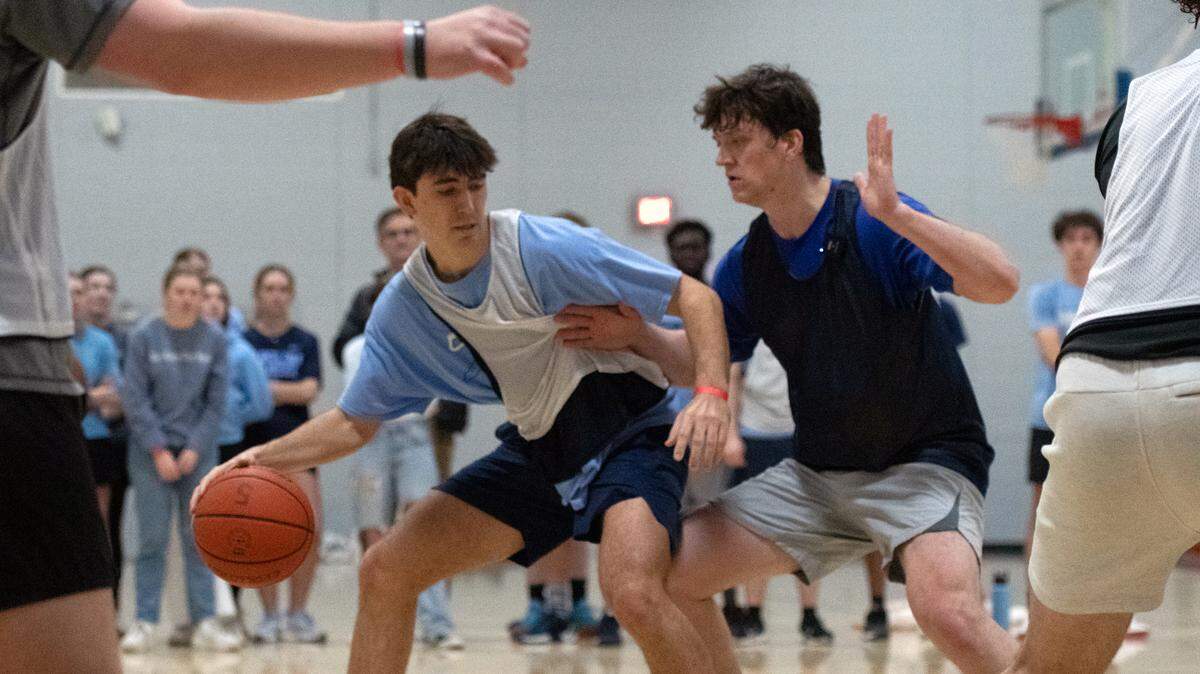
The Daily Tar Heel’s Ansel Whitley pulled up from deep, launching a 3-pointer over the outstretched arm of The Chronicle’s sports editor, Ranjan Jindal.
Swish.
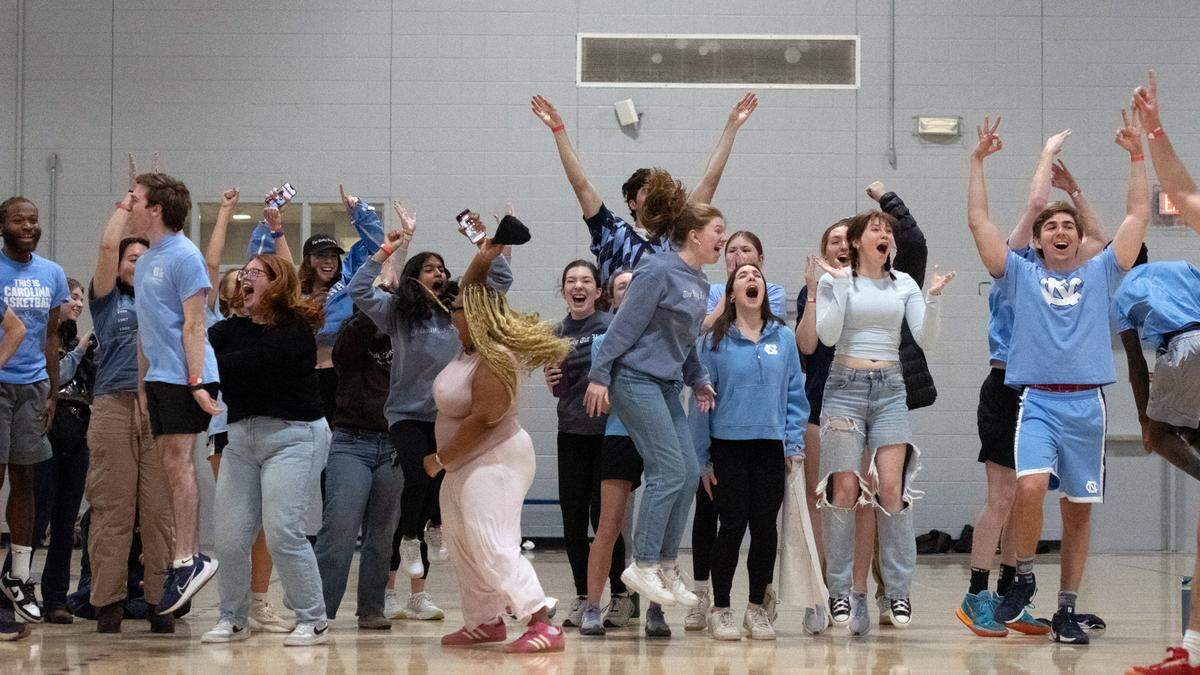
The DTH bench erupted. Whitley had just sealed the annual student journalist showdown at Duke’s Brodie Gym. During the Jan. 24 pickup contest, bodies hit the floor. Bricked shots clanked off the rim. The play was scrappy, unpolished — but intense.
More than just bragging rights were on the line.
As UNC and Duke’s men’s basketball teams prepare to clash on Saturday, another Tobacco Road contest rages: the seventh annual Rivalry Challenge. The week-long fundraiser helps fuel both schools’ student papers, which rely on donations to pay staff, replace equipment and keep local journalism alive — accounting for about 10% of each paper’s annual revenue.
Last year, The DTH edged out The Chronicle by just $417 (the papers raised over $128,000 combined) to tie the series at 3-3. Now, both are fighting to take the lead — and keep their newsrooms thriving.
“It’s a really great way for both The Chronicle and The Daily Tar Heel to come together for a collective cause,” The Chronicle’s editor-in-chief Abby Spiller said. “And it’s really cool that we get to do that with the biggest rivalry in college sports.”
Saving student journalism
Since 2005, more than 2,500 newspapers have shut down (according to a 2022 report by Northwestern University’s Medill School of Journalism), leaving many communities without reliable, on-the-ground reporting. The Medill School found that these growing “news deserts” now encompass roughly 55 million people in the U.S. Without dedicated local coverage, critical issues — government accountability, education, housing and public safety — often go unreported.
Student media outlets face their own financial challenges. Neither The DTH nor The Chronicle receives university funding, making them fully dependent on advertising, subscriptions and donations.
Just a year before the first Rivalry Challenge, The DTH was in a particularly dire position, said Erica Perel, the DTH general manager at that time. Advertising revenues had plummeted, forcing drastic budget cuts and a move from its long-time office on Rosemary Street to a much smaller space on Franklin Street.
The paper had to rethink how it operated, how it could diversify its revenue.
That struggle led to the creation of the Rivalry Challenge — an idea that emerged from conversations between Perel and Chrissy Murray, the Chronicle’s general manager and a DTH alum. For years, they had discussed ways for the two papers to collaborate around the UNC-Duke basketball rivalry. Then, in late 2018, they decided to not only produce a special print edition, but also layer in a fundraising challenge.
“It was just one of those things that was genius from the get-go,” Murray said.
Since its launch in 2019, the challenge has raised more than $500,000 to support both papers. With each passing year, the stakes grow higher, ensuring both independent newsrooms continue serving their communities.
“It just plays off the energy of Carolina and Duke hating each other,” current DTH general manager Will Lingo said. “That’s the beauty of it. That’s what has made it grow every year, because people see that little bar graph [the online donation tracker], and if the other school is ahead, they’re like, ‘Well, I have to give more money.’”
He paused for a second.
“It’s wild to me that it works that way, but I’m glad it does.”
Two newsrooms, working together
Back at Duke’s Brodie Gym, there was a scene of organized chaos. Journalists barreled into the lane, cries of “and-one!” echoing through the facility. Self-officiating led to heated disputes. The DTH players groaned after their opponents called back-to-back foul calls. On the sidelines, the Blue Devil mascot broke into the worm dance after a wild shot dropped.
The Chronicle’s Associate Sports Editor Caleb Dudley squatted courtside like a coach, taking notes on an iPad.
“I thought we played hard,” Dudley said after the loss. “Not the outcome we wanted… but a good time all around.”
It was classic coach-speak — on to the next one. Soon, Dudley and the celebrating DTH editors would pack up, shake off the battle and head back to their respective newsrooms.
There was still a joint paper to put out.
Despite the fierce competition on the court, the two papers are united by a shared project: creating a special print edition for the Rivalry Challenge. This annual edition features coverage from both The DTH and The Chronicle on opposite sides — a clever metaphor for the way they collaborate while fiercely competing.
“It was the first time that I was seeing the two newsrooms really working together,” DTH sports editor Caroline Wills said.
There’s a camaraderie that exists between the two papers amidst this project, despite the fierce rivalry on the court. Wills and Jindal shared a smile and conversed warmly during a recent segment on The “OVIES & GIGLIO” podcast — one of many local press stops for the two young journalists during this hectic week.
“The features and the pieces that we have in here are incredible,” Jindal said of the special edition. “I know that we were able to get an interview with Coach K, so that’s something to look forward to.”
The edition, which hits both campuses Friday, is filled with in-depth features, historical context, and analysis from both newsrooms — an effort that goes beyond the rivalry itself to celebrate student journalism.
For assistant sports editor Emma Moon, who joined The DTH in the spring of her freshman year, picking up her first Rivalry Edition on campus was a moment she’ll never forget.
“I was just so excited to have something tangible from the rivalry,” she recalled. “Of course, you can watch it, you can buy merch, but to have 20 stories that are written that are very specific to that year… I remember being so excited to have that in my hand.”
With the paper off to the printers and the cantankerous pickup game already played, Moon, Wills and Jindal are now turning their attention to their first UNC/Duke game at Cameron Indoor Stadium — an assignment that, unsurprisingly, has them all excited.
“I know it’s gonna be a memory that I’ll remember for probably the rest of my life,” Jindal said.
“I think for the first hour, I’m going to be looking around like, jaw on the floor,” Wills said.
“I am worried about tearing up,” Moon said.
As for Lingo, he didn’t just worry — he actually did tear up.
“We do things a certain way, and that’s why we’re still here,” he said, sitting at his desk in the DTH office. “Carolina basketball does things a certain way, and that’s why it’s still here. That’s why you can connect [with the student paper] through the years.”
His voice caught with emotion as he added, “There’s just not that many things in life that are everything they’re cracked up to be. And to me, The DTH... The DTH and Carolina basketball are that way.”
For both The DTH and The Chronicle, the challenge is about just that — sustaining a tradition.
“People in the community — on campus, off campus — would stop me and say, ‘I love this,’” Murray said of the challenge. “People were just really passionate about it because they love the rivalry and they love that we were working together to do something, but also hating on each other just a little bit too.”
To support The Chronicle, visit this link. To contribute to The Daily Tar Heel, go to this link. Donation pages are open online until the men’s basketball tipoff at 6:30 p.m. on Saturday.
Editor’s Note: The author, a former Daily Tar Heel sports editor, is not directly involved in the Rivalry Challenge.
This story was originally published January 31, 2025 at 10:47 AM.