
Where Duke, UNC, NC State, Wake Forest stand in the improved ACC basketball scene
AI-generated summary reviewed by our newsroom.
- ACC nonconference surge positions league for its largest NCAA bid total since 2021.
- Duke, North Carolina and N.C. State sit poised for NCAA bids at midseason.
- Wake Forest needs Quad 1 wins and defensive consistency to reach the NCAA field.
The ACC, as a whole, played so much better in nonconference matchups this season compared to the previous few years that it is in line to get more NCAA tournament bids than it has since 2021.
In varying ways, North Carolina’s big four programs contributed to that success. At the season’s midpoint, Duke, North Carolina and N.C. State are in good position to earn tournament berths while Wake Forest still has opportunities to claw its way in.
Duke (16-1, 5-0 ACC) and UNC (14-3, 2-2 ACC) are league title contenders well on their way to their usual NCAA tournament berths. N.C. State (12-5, 3-1 ACC), in Will Wade’s first season, is rated high enough in the analytical rankings to feel confident about getting back into the tournament field after missing out last season.
Wake Forest (10-7, 1-3 ACC) has become a stranger to the NCAA tournament over the last 16 years, making only two appearances. Between now and March, the Deacs’ schedule allows for chances to get the needed wins.
Here’s a look at what Duke, UNC, N.C. State and Wake have done thus far and what they need to do the remainder of the regular season.
Duke
Duke coach Jon Scheyer often leans on the words of Mike Krzyzewski, his former coach, in running the basketball program and in analyzing his team.
“I remember my freshman year I heard a story from Coach K that January is the month when you learn about who you are as a team,” Scheyer said this week. “Not December, not February. It’s January you find out.”
Scheyer said that as the No. 6 Blue Devils prepared for this week’s trip to the West Coast for ACC games against California and Stanford. Duke was 15-1 overall and 4-0 in the ACC before the trip, and its first four conference wins, to be realistic, were closer than many who follow Duke expected. (Duke beat Cal 71-56 Wednesday night.)
“What better time to find out about ourselves than halfway through the month of January on the road together for a week,” Scheyer said. “I think it’s an amazing opportunity for us to grow, learn something new, and we plan on doing that.
“The theme for me is taking the next step and maxing out on who we can be.”
What Scheyer and his staff have learned already is that he has a team that appears to thrive in competition and finds a way to win. The Blue Devils slipped up just once, taking an 82-81 loss to Texas Tech in New York City a few days before Christmas. Duke had a 17-point lead in the second half but was shot down by a torrent of Christian Anderson 3-pointers and his 23 second-half points for the Red Raiders.
The one loss also provided a lesson for the Blue Devils.
“We can’t let up or take our foot off the gas,” Cameron Boozer said. “We get leads and we kind of get comfortable, and we’ve got to find a way to figure that out.”
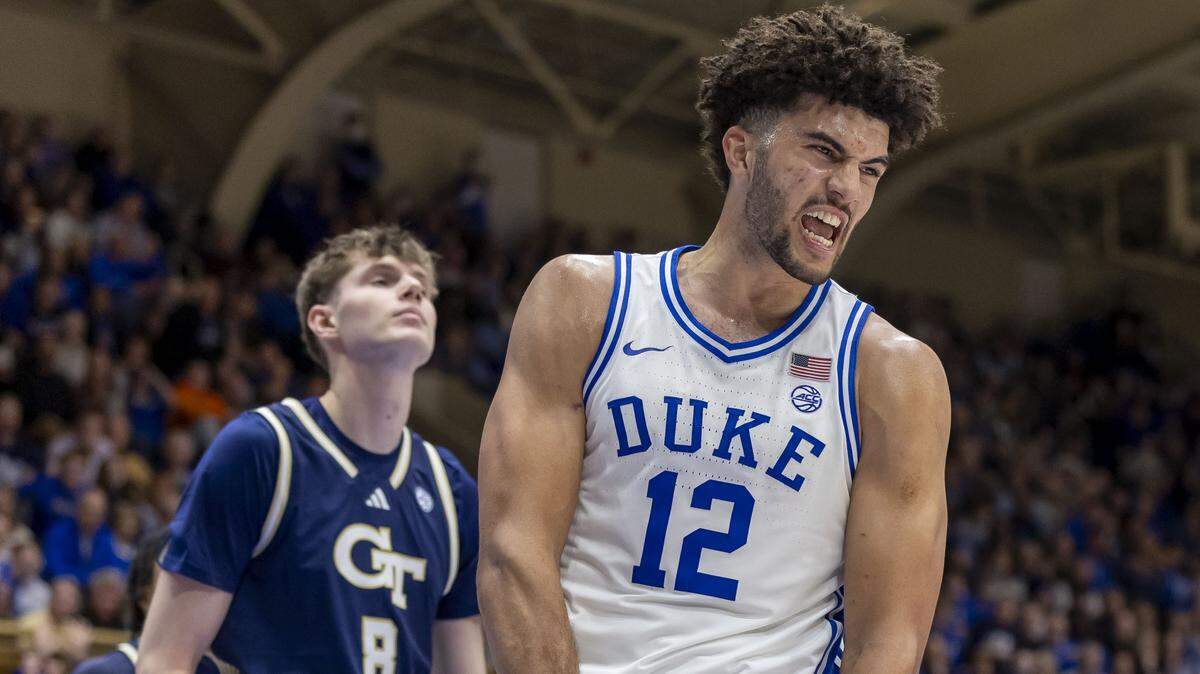
Top player: No guesswork here. Cameron Boozer came to Duke touted as the best freshman power forward in the country, a five-star recruit following the college path of his father, Carlos, to the NBA. He’s Duke’s best player, likely the ACC’s most complete player.
Boozer began the week as the ACC scoring leader and was fourth nationally at 22.8 points a game. His 134 baskets included 24 made 3-pointers, making the 6-9 forward a threat inside and out for opponents. The big guy can score.
Boozer averages 9.5 rebounds and has eight double-doubles this season. He’s the kind of player who goes into the crowd under his basket and comes away with the ball in those big-boy battles in the paint.
He twice has threatened to notch a triple-double with his ability to find the open man – he has averaged 4.2 assists per game, getting a season-high 9 dimes against Florida State. The big guy can pass.
“He’s an unbelievable player. He does all the little things to help you win games,” FSU coach Luke Loucks said. “He’s going to make hundreds of millions of dollars playing basketball.”
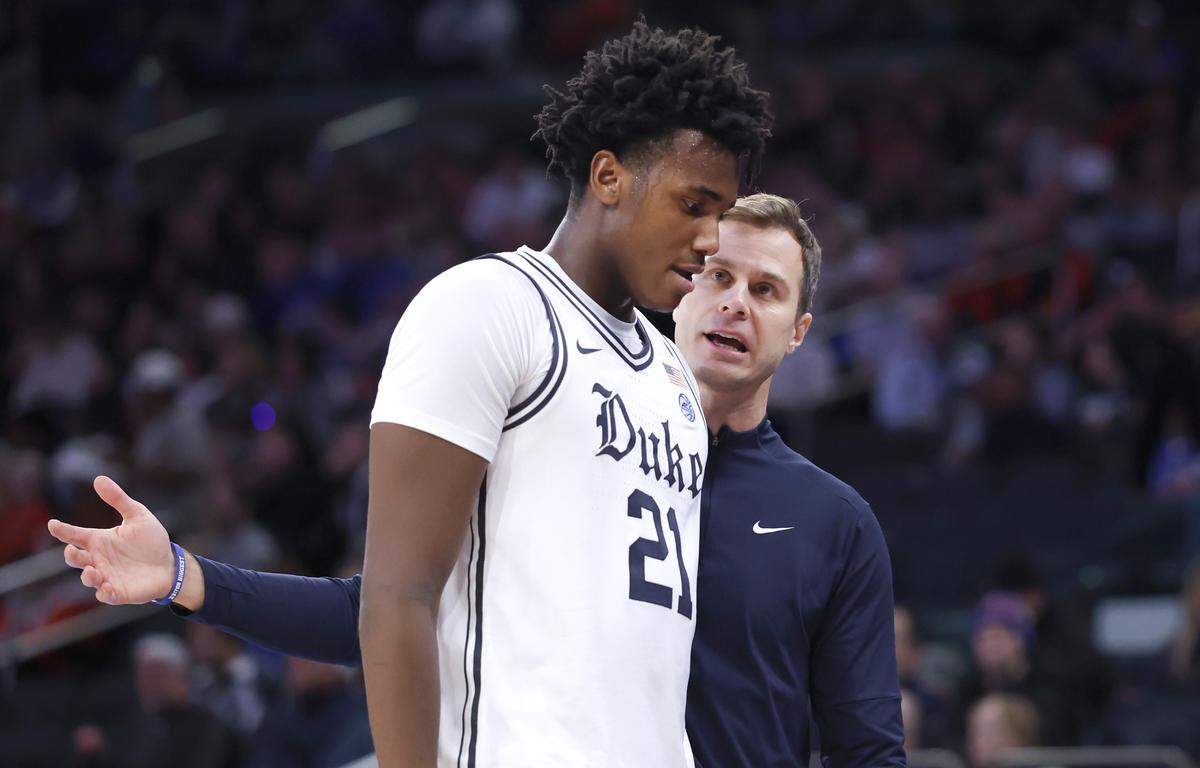
X-factor: One challenge for Scheyer and his staff is helping Patrick Ngongba II to stay out of foul trouble, on the court, be a defensive stopper and a point contributor, and be able to do it all consistently.
The sophomore center had one of his best games Saturday against SMU, matching his career high with 17 points in 27 minutes as Duke won, 82-75. He was 6-of-10 from the field, made 5 of his 6 free throws and banged inside with SMU’s big man, Samet Yigitoglu.
Ngongba had five blocks and five assists in the win over Florida in the ACC/SEC Challenge. He has scored in double figures in 12 games, averaging 10.8 points. He has played big much of the time.
But Ngongba had four points and four fouls at Louisville, playing 10 minutes in the game. He has four points in 21 minutes in the loss to Texas Tech. In both games he was involved in incidents – with Texas Tech’s JT Toppin, with Louisville’s Kasean Pryor – that appeared to affect his focus.
NCAA resume (the good): Duke registers high in nearly every basketball metric and, barring a run of injuries, should stay there. The Blue Devils are third in the NET rankings, and are 8-1 in Quad-1 games – the eight wins leading Division I.
The Devils are slightly lower in the KenPom rankings at No. 6. They are 12th in offensive efficiency and No. 7 in defensive efficiency in the KenPom compilations.
NCAA resume (the bad): There’s not much to dislike through 16 games. The biggest question for Duke midway through the season is whether the Blue Devils can be a No. 1 seed in the NCAA tournament.
Where it could finish in the ACC: The Blue Devils were the regular-season winners and won the ACC tournament championship last season. There is no reason to believe the Blue Devils can’t repeat that again in 2025-26.
Looking at the schedule, the Devils have the two rivalry games against UNC – both figure to be 40-minute wars – and will play its one game against N.C. State this season in Raleigh, where the Lenovo Center should be rocking. They play both Clemson and Louisville in Durham.
A year ago, Duke had one conference loss – at Clemson in early February – and finished one game ahead of Clemson and Louisville in the regular-season. The Devils then won the ACC tournament in Charlotte despite Cooper Flagg’s injured ankle.
It’s a stronger, deeper ACC this year but the Blue Devils should again finish up at the top
NC State
First-year N.C. State head coach Will Wade promised a “Red Reckoning” during his introductory press conference last March. The unranked Wolfpack, sitting at 12-5 overall and 3-1 in ACC play, hasn’t quite lived up to the billing.
N.C. State has proven to be a solid team, but is struggled with consistency –something that’s shown up in its marquee games. Kansas’ Melvin Council entered Lenovo Center on Dec. 13 as an 18% 3-point shooter. He scored 36 points and made nine 3s in the Jayhawks’ 77-76 overtime win, and the Wolfpack was unable to stop him.
Virginia’s Sam Lewis scored 23 points on 5 of 9 3-point shooting against N.C. State on Jan. 3. He tied his career high in the Cavaliers’ 15-point win.
“For whatever reason, we haven’t been able to put it together in our high-level games, which, at the end of the day, we’re judged on our high-level games,” Wade said after the loss to Virginia. “We haven’t done that like we need to, that’s just a fact. We’ve got to keep working at it, and, eventually, the dam will break at some point, if you keep working. We’re not there yet.”
N.C. State looked better with wins over Boston College and Florida State, two must-win road games, last week. Wade also said last week one of the Wolfpack’s biggest issues has been stopping the “snowball” when an opponent finds a rhythm and allowing frustration on offense to dictate defensive effort. His team handled runs from both opponents — Boston College cut the N.C. State lead to one possession in the second half — with poise it hasn’t always shown.
N.C. State ranks No. 25 on KenPom and in the national top 30 for offensive and defensive efficiency. The Wolfpack can shoot the ball well, hitting a blistering 40.1% from 3 and more than 55% on 2-point shots. In ACC play, N.C. State ranks No. 4 in the conference for scoring offense (80.8 points per game) and No. 4 for scoring defense (68.3).
Though there have been struggles this year, it appears the Pack is starting to find its stride. It will continue to test that growth in the next three weeks, when it plays Clemson, Pittsburgh, Wake Forest, SMU and Louisville on the road.
Top player: Quadir Copeland has been the best overall contributor for the Wolfpack, despite Darrion Williams being named Preseason ACC Player of the Year. Copeland does it all for N.C. State — scoring, distributing, rebounding and defending — and is among the team’s top 3 in every category but rebounding.
Copeland, a Syracuse and McNeese State transfer, averaged 13.5 points, 3.2 rebounds, 6.1 assists and 1.6 steals per game in the Wolfpack’s first 17 games.
He boasts a 2.2 assist-to-turnover ratio on the season, which includes eight games when he finished with at least six assists and an assist-to-turnover ratio higher than his season average. The senior ranks No. 5 in the ACC for his assist average and No. 27 in scoring. KenPom lists the guard at No. 8 nationally with a 40.9% assist rate.
Copeland is adept at driving to the lane and drawing fouls, as well, leading the team with 80 free throw attempts and 60 made foul shots. He draws 5.3 fouls per 40 minutes, according to KenPom.
N.C. State’s roster features plenty of talent and a handful of players who could be the top dog, but Copeland’s toughness and impact has shown to consistently affect winning.
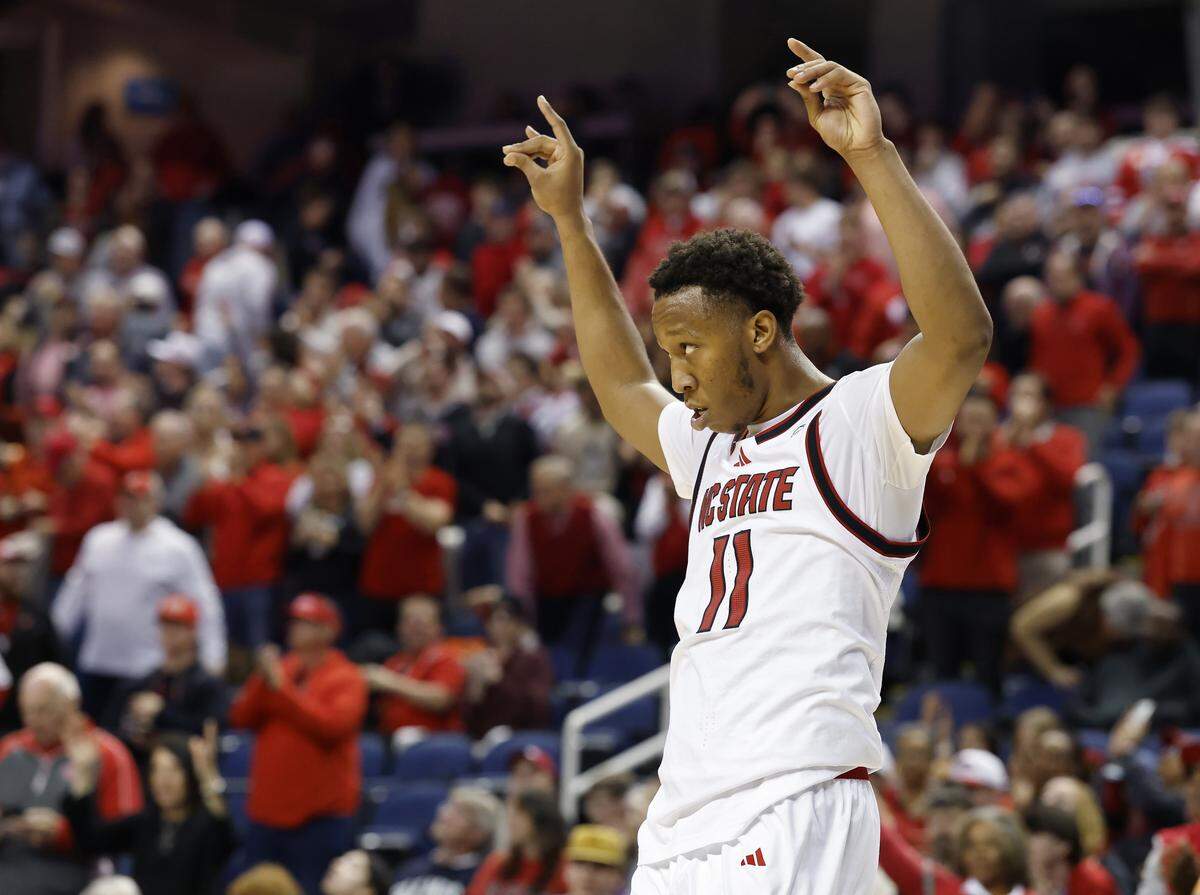
X factor: Matt Able’s freshman season has experienced some bumps this year, but he continues to be one of the keys to the Wolfpack’s success. N.C. State is 7-1 when the rookie scores at least 10 points and it’s 6-1 when he makes at least two 3-pointers.
Able doesn’t have to light up the stat sheet, but positive things happen when he knocks down a few shots and nabs a couple of steals and rebounds.
NCAA resume (the bad): N.C. State is listed at No. 29 in the NET and No. 25 in KenPom. The team is now 0-5 in Quad 1 games after Boise State (who the Wolfpack beat 81-70 on Nov. 25) dropped to a Quad 2 win.
The Wolfpack has lost two games (against Kansas and Texas) by five points or fewer and ended up losing four games where they were winning. Will Wade said after the Auburn loss on Dec. 3 that his squad had kicked opportunities down the road. He was right. Boise State was, at the time, its best win — until the last couple of weeks.
NCAA resume (the good): Despite no signature wins, the Wolfpack doesn’t have any bad losses. Boston College and Florida State were “must-win-by-any-means-necessary” games. N.C. State held on at BC and routed the Seminoles.
Now, it has eight Quad 1 opportunities this season and is favored by KenPom in its games against North Carolina, at Wake Forest and at Notre Dame. Its other Quad 1 chances (Duke, Clemson, SMU, UVA and Louisville) could be challenges, but it wouldn’t be the first time a Wolfpack squad has pulled off a big upset.
Additionally, Miami is a high Quad 2 win. By the time N.C. State plays the Hurricanes next month, Miami could rise to a Q1 team.
ESPN’s Joe Lunardi has N.C. State as one of the last four teams with an NCAA tournament bye. He projects the Wolfpack to be a No. 10 seed, which is what it was during their 2024 Final Four run, and likely as high as a No. 9 seed.
Virginia Tech and Stanford are currently listed as the “Next Four Out.” If they improve their resumes and N.C. State wins as predicted, those games could boost the Wolfpack’s stock.
Where it could finish in the ACC: N.C. State in the preseason was picked by the media to finish fourth in the ACC. Based on its upcoming schedule — it has Clemson, SMU, Louisville, Virginia and Notre Dame among its road opponents and Duke and UNC at home — the Wolfpack is likely to finish with 11 or 12 wins in league play. That would put the Wolfpack finishing around 6th or 7th place, assuming the standings remain relatively stable with the current top teams.
North Carolina
UNC coach Hubert Davis warned his team ahead of its Jan. 10 Wake Forest game. He told them the Demon Deacons had been in a number of tight games — pushing ranked opponents like Texas Tech and Michigan to the edge — and that, with scorers like Juke Harris, they are “never out of a game.”
So it wasn’t shocking when the Tar Heels struggled to maintain a second-half lead that, at one point, ballooned to 15 points. But it was another instance of North Carolina letting its foot off the gas late. Another game that saw a sharp decline in the team’s defensive performance. Davis highlighted both in interviews following the win.
“That’s one of the things we have to grow on, is getting to that level where you’re up 15, 13, 11, and being able to sustain what allowed you to get that lead,” Davis said during his Monday radio show. “That’s something that has been consistent with us all year — us taking a deep breath and not continuing to do the things that allowed us to be successful out there on the floor. Teams aren’t giving up. They’re continuing to play.”
Davis said he talks about the necessary mindset “all the time,” and yet the trend continued in a 95-90 loss to Stanford on Wednesday night in Palo Alto.
North Carolina ranked 5th in the nation this season in effective field goal percentage defense, per Bart Torvik, entering its contest against Ohio State. In the games since, the Tar Heels’ defensive efficiency has cratered — ranking 250th nationally over this recent five-game span.
Top player: While freshman phenom Caleb Wilson is the one who has NBA scouts buzzing — a few scouts in Dallas said they think his floor is a No. 8 pick and he will contend for the top spot — Henri Veesaar is arguably the team’s most valuable player.
He’s a unique prospect that North Carolina has never quite seen, although his prowess on the perimeter is drawing comparisons to Brady Manek. Get this: Veesaar is one of three Tar Heel 7-footers who’ve made a 3-pointer at UNC. Serge Zwikker had one, as did Walker Kessler. Veesaar’s recorded 23 so far this season at a 53.5% clip — the best percentage on the team by miles.
“We’ve got to get him shooting more threes,” Davis said Monday.
Behind Cam Boozer, Veesaar ranks second in the ACC in overall value per Evan Miyakawa’s advanced metrics site, which takes into account defensive and offensive impact.
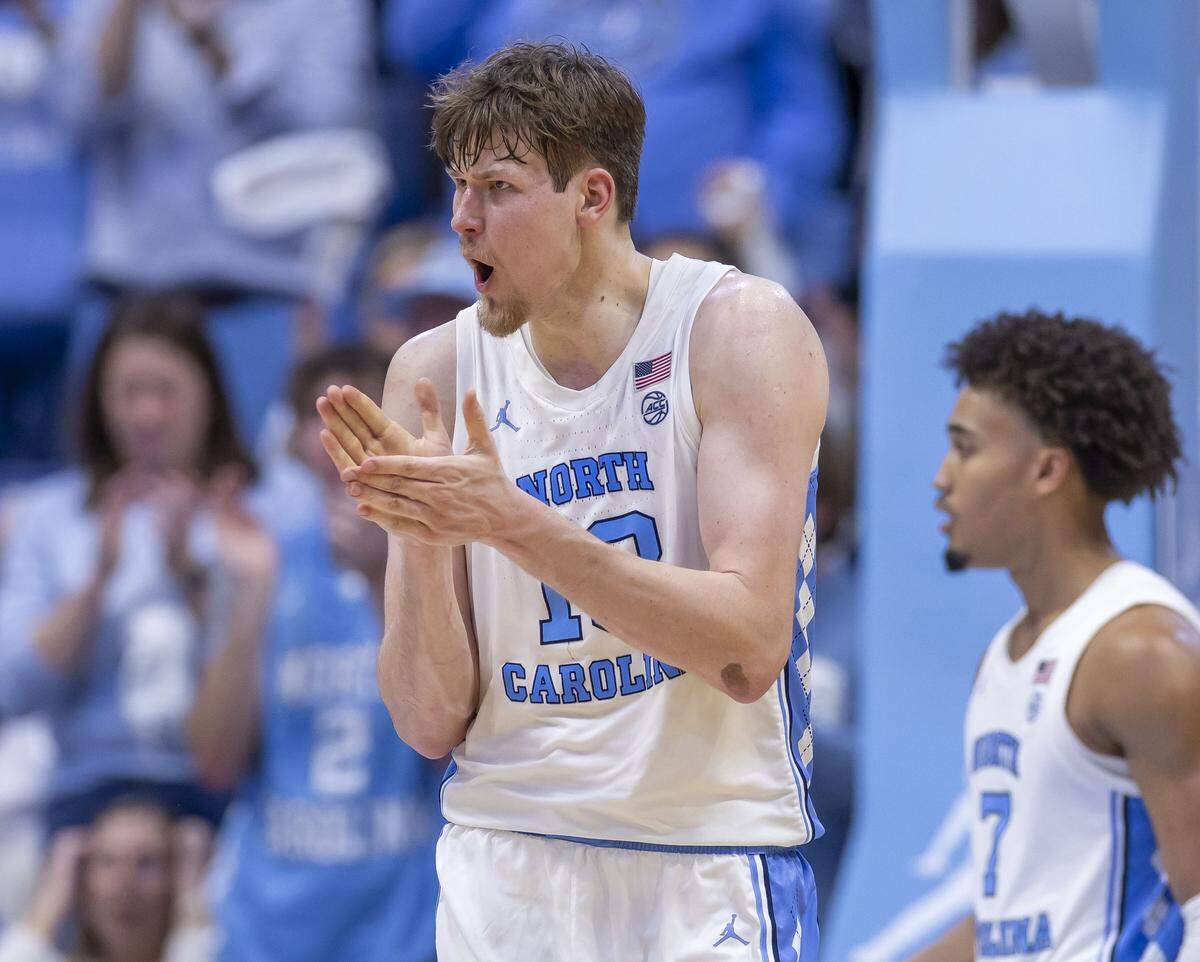
X-factor: One challenge for Davis and his staff, recently, has been getting Caleb Wilson involved late in the game. Saturday was the latest example of a long Wilson-less (or rather Wilson-lite) stretch. In the second half against the Demon Deacons, Wilson made one of two field goal attempts.
The freshman laughed off his lack of touches after the game with a simple, “I don’t know, man.” Davis stated bluntly in the postgame press conference that opponents are putting more defenders on Wilson late.
In losses to SMU and Michigan State, Wilson endured spans of 20 and 13 minutes, respectively, without scoring. North Carolina managed to pull away from Wake Forest, but the trend continued.
Davis, though, doesn’t see it as particularly troubling.
“The two field goal attempts in the second half are somewhat misleading,” Davis said Monday, reflecting on the Wake Forest game. “The ball’s in his hands. So it wasn’t a situation where he was never involved in the offense. The ball touched his hand every possession, almost. And as much as he gets to score, he is a gifted passer.”
Sure enough, Wilson had 20 points in the second half against Stanford on 8-of-8 shooting from the floor. North Carolina will need that late-game production from him — especially if its defense continues to struggle.
NCAA resume (the good): The Tar Heels were No. 22 in the NET rankings before this week’s California games and were 3-2 in Quad-1 games behind the power of their top-tier frontcourt duo. The loss to Stanford on Wednesday drops them to No. 30 and 3-3.
UNC is a good bit lower in the KenPom rankings at No. 35, which values blowouts more than close wins. North Carolina is 33rd in offensive efficiency and 51st in defensive efficiency per KenPom compilations. The Tar Heels are No. 85 in overall strength of schedule, per KenPom.
NCAA resume (the bad): This critique is, unfortunately, out of North Carolina’s control. Since the Tar Heels beat then-No. 19 Kansas at home and then-No. 18 Kentucky on the road, both programs have fallen.
The return of Darryn Peterson for the unranked Jayhawks should be a boost. Kansas’ win Tuesday night over No. 2 Iowa State is a sign that the season is on the mend.
Things are looking much worse for the Wildcats. Not too long after Mark Pope went viral for an interesting choice of words to describe his distraught emotional state, news broke that the team’s only true point guard, Pitt transfer Jaland Lowe, will undergo a season-ending shoulder surgery. Kentucky is 11-6 and has been crushed by the likes of Gonzaga and Michigan State.
Where it could finish in the ACC: UNC is sitting at the middle of the league thanks to a 2-2 start to ACC play. SMU is the only team with the same record in conference play at the moment. North Carolina’s biggest weakness has been its porous defense and with a deeper ACC this season, the Tar Heels won’t be catching any breaks soon. Shore up that side of the ball and North Carolina has all the star power to be a top-3 team alongside Duke and Virginia.
Wake Forest
Seven NCAA tournaments have come and gone since Wake Forest last participated. Going back further, since Dino Gaudio led the Deacs into the 2010 tournament field, the only time Wake has made it since then was a first four appearance in 2017 under Danny Manning.
So Steve Forbes, in his sixth season coaching the Demon Deacons, really, really needs to get this season’s Wake team in NCAA tournament contention. So far, though, it’s looking like a long shot once again.
Entering Saturday’s game at Florida State, the Demon Deacons (10-7, 1-3 ACC) have lost four of their last five games and are in dire need of a turnaround. That time is arriving quickly, with games against Duke, SMU, N.C. State and Louisville on the schedule over the next three weeks. They need wins to boost their metrics, which have them No. 59 in the NET ratings and No. 60 in KenPom.
Top player: Juke Harris’ development between his freshman and sophomore seasons has proven to be dramatic. He’s averaging 20.3 points per game to lead the Deacs and is one of the ACC’s top scorers this season. The 6-7 sophomore forward from Salisbury played in 31 games with 20 starts as a freshman, averaging 6.1 points per game last season. If Wake is to climb up the ACC standings, Harris will be a big reason.
X factor: A 6-7 forward who began his career at Appalachian State, Tre’von Spillers has started every Wake Forest game this season and last season. He’s currently averaging 11.4 points and 5.7 rebounds per game, but his play has been inconsistent.
He scored 15 points in Wake’s key 81-78 win over Virginia Tech and had 16 when the Deacs beat West Virginia. But he’s fouled out of Wake’s past two games, scoring four points in an 81-77 loss to Miami and seven when UNC edged Wake, 87-84, last Saturday night.
To make a run to an NCAA tournament berth, Wake needs more from Spillers against the better teams on its schedule.
NCAA resume (the good): Wake Forest picked up a pair of quadrant 2 wins, both beating West Virginia on a neutral court and Virginia Tech at home. The Demon Deacons have no ugly losses to dent their resume, going 8-0 thus far against Quads 3 and 4.
NCAA resume (the bad): The Deacs lack a Quad 1 win, currently 0-5 in those games. They had two narrow misses in November, losing 85-84 in overtime to Michigan in Detroit and 84-83 to Texas Tech in the Bahamas. Collecting just one of those wins would have Wake in far better shape. Instead, the Deacs will have to take care of its business in ACC play where there are lots of Quad 1 opportunities this season.
Where it could finish in the ACC: It’s early, but Wake is closer to the bottom of the league, which means not making the ACC tournament field, than the top of the standings. Only four teams, cellar-dwellers Florida State (7-10, 0-4) and Boston College (7-10, 0-4), plus Georgia Tech (10-8, 1-4) and Cal (13-5, 1-4), have more ACC losses than Wake Forest. The rest of the ACC schedule shows Wake plays five games against teams it is currently tied with or above in the league standings, which leaves nine games against teams above it. A middle-of-the-pack finish looks likely.
This story was originally published January 15, 2026 at 1:11 PM.