
How a college lark turned into K-Ville, one of sport’s enduring traditions
AI-generated summary reviewed by our newsroom.
- Students started Krzyzewskiville in 1986 to secure rival-game seats at Cameron.
- Student-run rules, checks and tiers transformed spontaneous tents into system.
- K-Ville sustains community, pageantry and legacy across generations at Duke.
On a freezing winter morning in 1986, a group of Duke seniors walked into a U-Haul rental center on Hillsborough Road in Durham with an unusual request: Give us every tent you have.
The idea came, as many great ideas do in college, over a couple of beers in a dorm common room. Kim Reed and her friends weren’t planning a camping trip per se. They were trying to guarantee seats for Duke’s rivalry game against North Carolina that weekend. So Reed grabbed all the tents in stock — about five or six — and brought them to the parking lot beside Cameron Indoor Stadium, where she met her fellow campers.
“We unloaded the tents, and we said, ‘Well, should we ask somebody if this is OK?’” Reed recalled. “And we almost immediately decided, ‘No. It’s better to ask forgiveness than permission. Let’s just do it.’ So we pitched the tents right up against the entrance of Cameron.’”
In the process, they accidentally started one of college basketball’s most enduring traditions.
What began in 1986 as a spontaneous way to secure basketball tickets has evolved into Krzyzewskiville: a sprawling, student-governed system — complete with mandatory trivia tests, tiered commitment levels and random overnight checks — that is celebrating its 40th anniversary this year. Each winter, more than 1,000 students participate in the tradition — trading sleep and comfort for the chance at coveted seats inside Cameron Indoor Stadium when Duke hosts North Carolina.
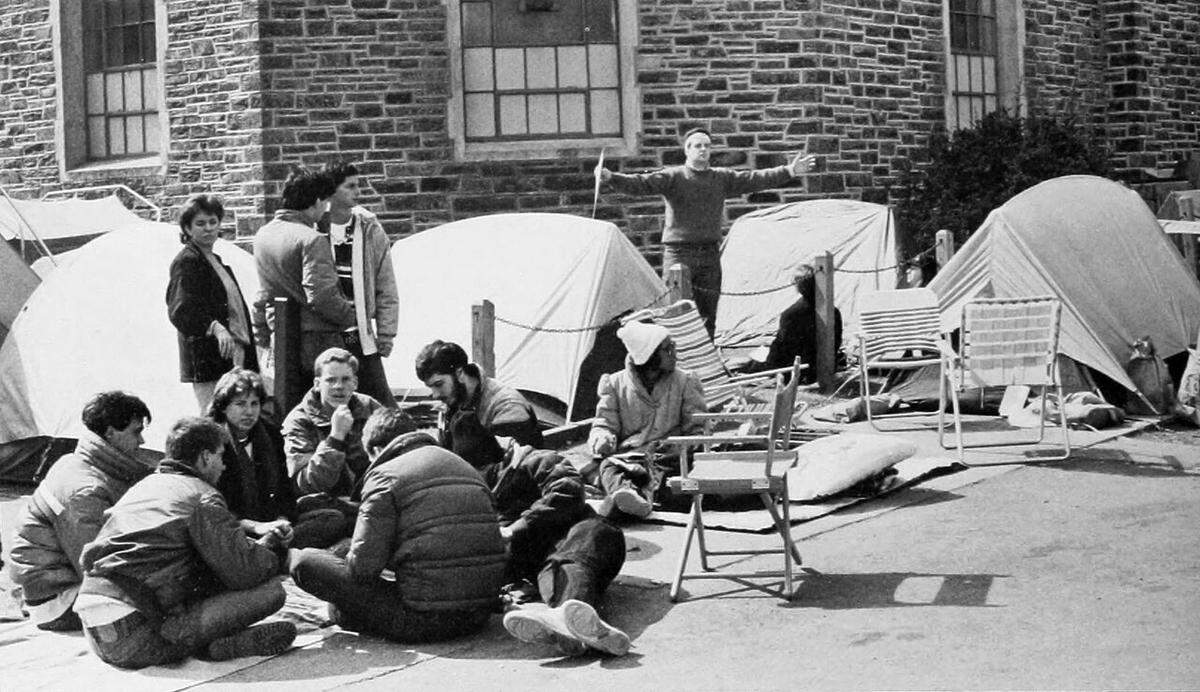
Named for longtime coach Mike Krzyzewski, the tent city has grown alongside the program’s rise. But, years after K’s retirement, why does it still prevail? Students say it’s less about a single game and more about a shared rite of passage.
“People love to make fun of it,” said Aidan McCarthy, a senior and co-head line monitor at Duke. “I think it’s the most special tradition in college sports, definitely the most special tradition at Duke — regardless of what they say.”
Yes, alcohol played a role
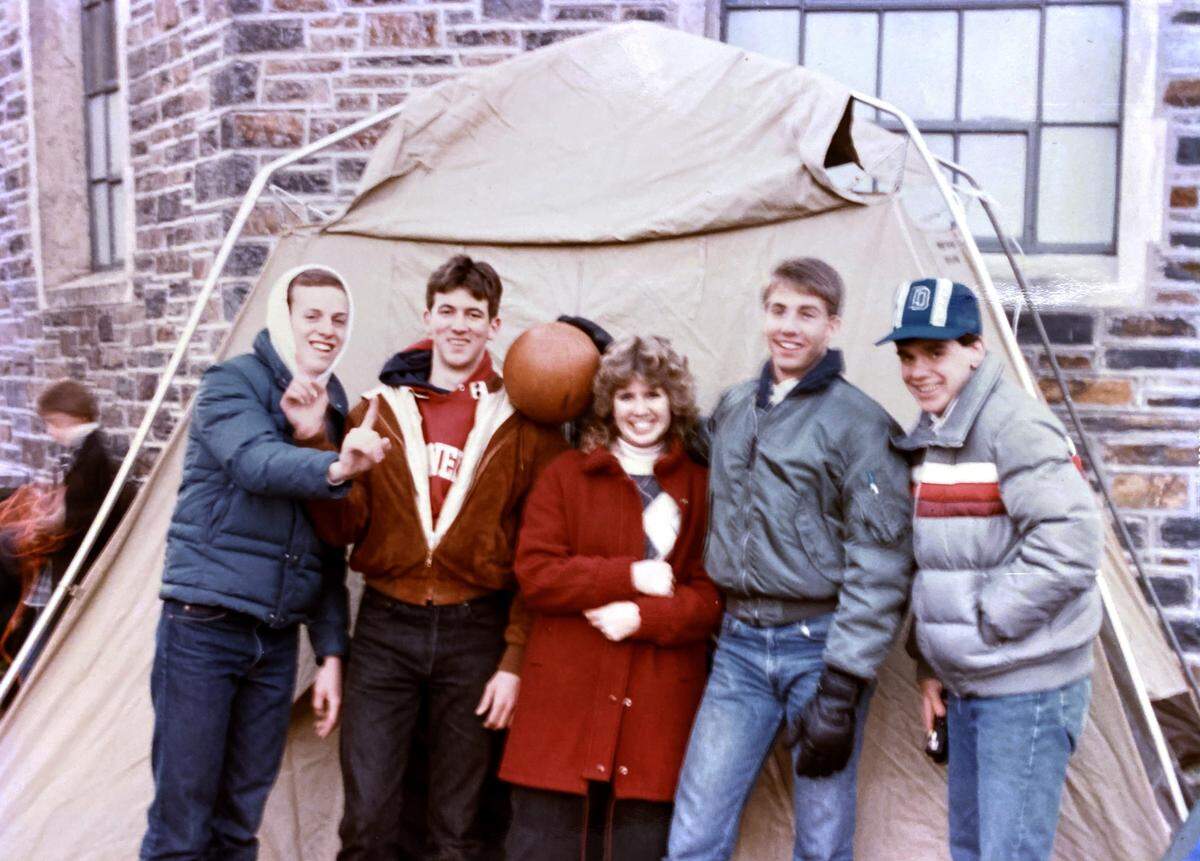
The first Saturday night at K-Ville was, in then-student José Isasi’s words, “one of the biggest parties I’ve ever seen.”
It was the eve of a No. 1 vs. No. 3 showdown between Duke and North Carolina and, according to Isasi, no one slept.
“There was a fair amount of alcohol being consumed,” Isasi said. “Kegs everywhere. I believe that was a game where someone rented a hot tub and brought it to the line. I know that Coach K came out to deliver pizzas.”
Come morning, the chaos continued. Students who hadn’t camped filtered into the line. When the doors opened, people ran.
“There was no real organized system … and that’s what gave me pause,” Isasi said. “For the next basketball season, I wanted to try to do something to make sure that the system was a little less ‘law of the jungle,’ and that students could have fun, but weren’t going to get injured.”
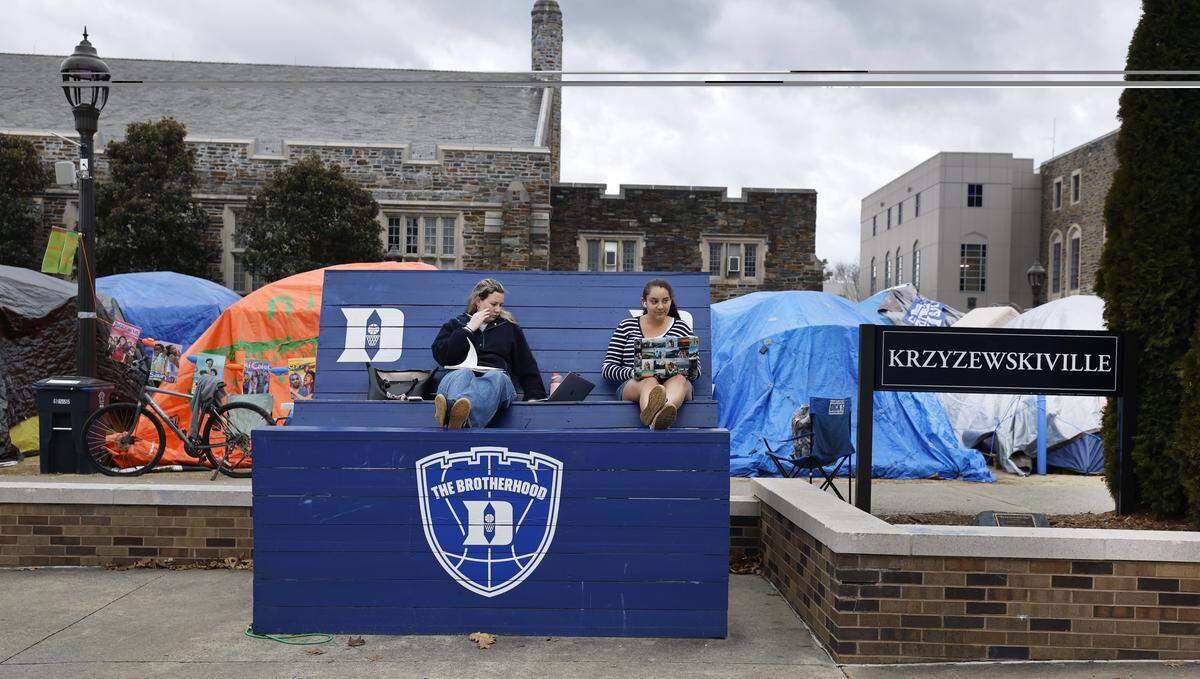
Enter: line monitors. The next season, Isasi helped create a system of volunteers, working with Duke student government, tasked with eliminating “phantom tents.”
“I don’t know if people really understand just how spontaneous the original versions of Krzyzewskiville really were,” Isasi said. “The line monitors didn’t have that many rules that they enforced in those early years. I mean, I had a clipboard, a high-vis vest and a bullhorn on game day, and that was it.”
Over time, the system hardened. By 2001-02, wristbands and more walk-up regulations were in place. A few years later, students could choose tenting tiers based on how early they wished to camp out. Personal checks emerged, requiring every individual in a tent — not just an elected tent representative — to prove their presence in the final 48 hours before tipoff.
In Isasi’s era, there were maybe three tent checks before the game. This year, students woke to roll-call sirens at 1:15, 2:30, 3:43 and 5 a.m, according to the Duke Chronicle.
“The citizens of Krzyzewskiville, they came up with their own innovations and their own plans … it really was very organic, which meant every version of Krzyzewskiville was very different,” Isasi said. “From one game to another, you’d get different vibes in Krzyzewskiville. As line monitors, we would be wondering, ‘What version would show up? Would it be the loud, unruly version? Would it be the really tired version at the end of a long school week, something in between?’”
Tough tests, silly puns and camaraderie
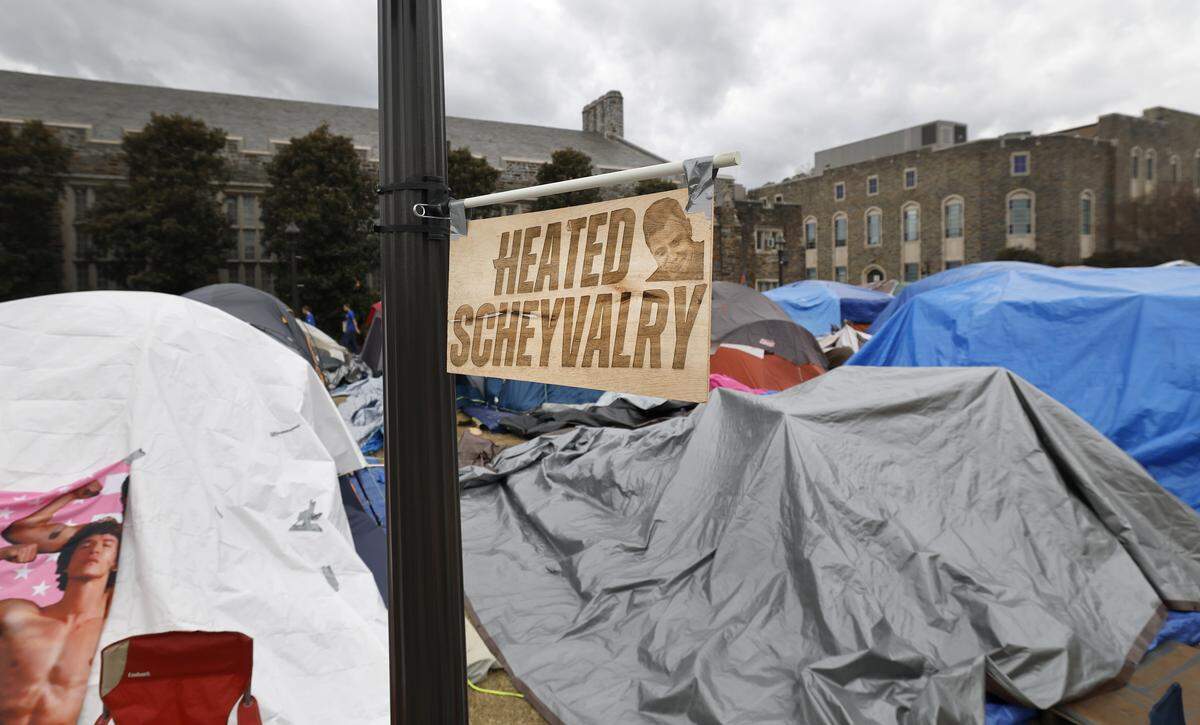
It’s Feb. 18, and two Duke students sit side by side at a folding table — the kind that snaps in the wind and pools rainwater at the corners. The tent behind them leans fully into its Don Julio theme, featuring wooden engravings recasting Duke coach Jon Scheyer as “Jon Julio” and freshman guard Dame Sarr as “Dame Julio.” An Italian flag juts from the grass on a thin post. Sarr’s face is photoshopped into the white stripe. The international-player-turned-Blue-Devil smiles over the nearby sidewalk like a patron saint of tenting season.
A few yards away, another tent — “Caleb Foster Care” — appears to double as a donation hub, with bins collecting food, toys and other supplies for foster children. Back at the Julio tent, a black-and-white image of UNC coach Hubert Davis’ face is wedged inside a toilet seat.
From a distance, the two Julio tenters look like they’re studying. Up close, it’s clear the discussion is more centered on KenPom pages instead of lecture slides. They talk offensive and defensive metrics, debating matchup edges for Duke’s game against Michigan later that week in Washington. The entry test, the baseline trivia exam required to tent, is already behind them. But the ordering test, which determines where the tents fall in line, still looms. It draws from the same deep well of program knowledge — stats, roster details, history and some truly random facts, like Cooper Flagg’s exact birth time.
“As someone who likes trivia, I really enjoy it,” said Charlie Linder, a senior mechanical engineering student at Duke. “So to me, it doesn’t really feel like work. It’s something fun that I do like the same as any of my other hobbies.”
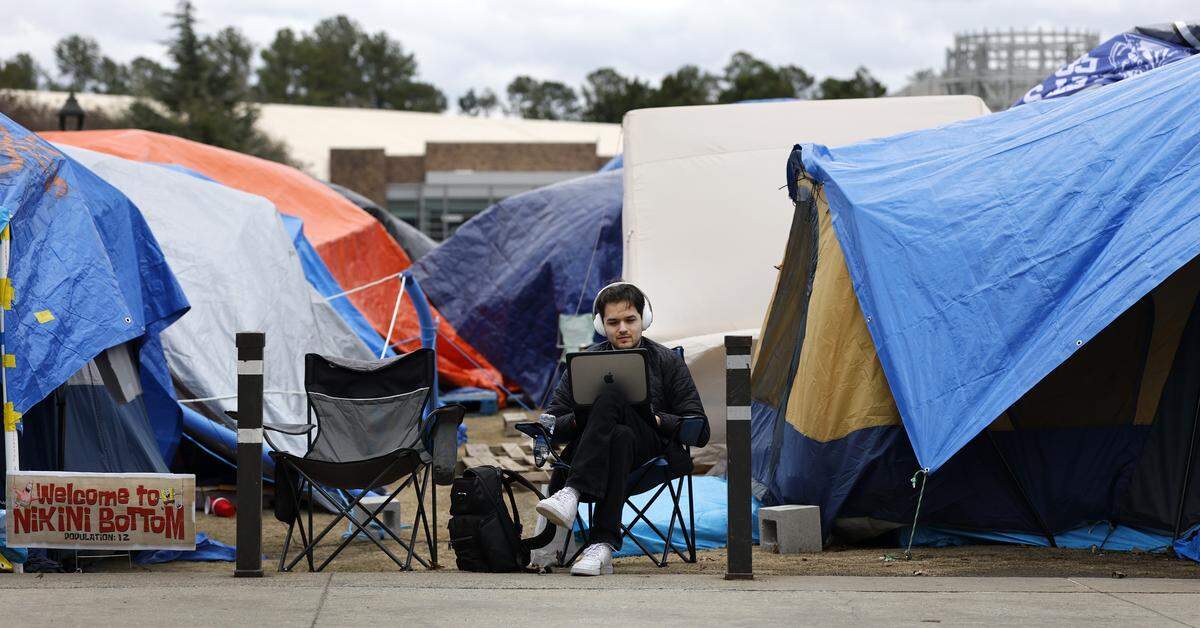
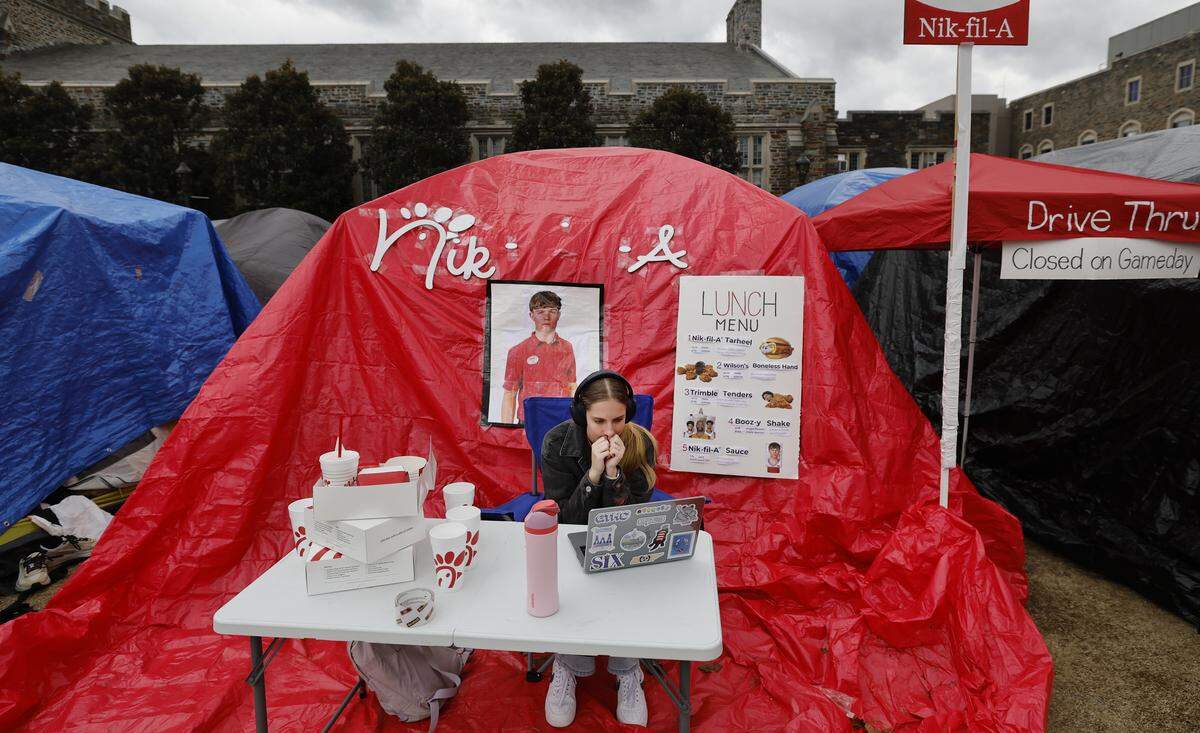
Linder detailed the process as he stood proudly in front of his Nik-Fil-A tent: a crossover between Chick-fil-A and Duke freshman guard Nikolas Khamenia. Several Khamenia-themed tents crisscrossed this year’s K-Ville — from an ode to the TV channel Nickelodeon to Durham’s very own Nikini Bottom (a reference to SpongeBob).
So why is Khamenia so revered by the Duke student body?
“I’d say it’s primarily just ease of incorporating it into a pun,” Linder said.
If it all feels a little absurd — tequila jokes, a random toilet seat, Italian-flag iconography and a freshman’s name stretched into every conceivable play on words — that’s because it is. Absurdity is the currency here in K-Ville.
“The one thing that remains consistent across all the decades since I was there is (Duke students) are competitive and they are creative,” Isasi said. “So, if you can create a system where students compete … and then they’re creative in terms of, ‘OK, we’re going to be stuck here in a tent. How can we make this as comfortable as possible? What can we do?’ All of that works to keep Krzyzewskiville going.”
A bent rule, with good intentions
There are things that happened at K-Ville, Megan Erickson admits, that “probably shouldn’t be discussed in the newspaper.” College things, equal parts chaos and fun.
But the former line monitor’s favorite K-Ville memory centers on her mom, Linda. Erickson said Linda was “the most intense, rabid fan.” Watching Duke games at home as a child meant hearing Linda’s “primal screams” from the living room.
But seeing Duke play at Cameron Indoor seemed like a distant dream for Erickson. That is, until she was admitted as a student. By the time her senior year came around in 2007, Erickson came up with an idea to repay the biggest Blue Devil fan she knew.
“There are grad students who are line monitors, and there’s no reason she couldn’t just blend in,” Erickson said, recalling her plot. “So let’s just find her an extra line monitor jacket.”
It didn’t hurt that Erickson was in charge of who got into the student section.
“So we threw a jacket on my mom and got her into the Carolina game,” Erickson said.
The moment means way more now in hindsight. Months after that game, and just weeks after Erickson’s graduation, Linda died of a sudden heart attack.
“Without her, I wouldn’t have even imagined that I could go to Duke, much less have ended up going there,” Erickson said. “So it was a thank-you and it ended up being, honestly, a lifelong thank-you. Little did I know that she would suddenly pass away … I’m immensely grateful that we were able to give her that.”
Why do this? A ‘communal experience’
It may seem counterintuitive, but not all those who tent are hoops fanatics.
“Not everyone here is a huge basketball fan, but you’re out here with people you know and people you don’t know,” Brandon White, a then-Duke junior, told the N&O in 2006. “It’s a real communal experience.”
Cynthia Ding, a junior from Toronto studying neuroscience, has attended just one Duke basketball game in her three years on campus. Still, she camped out this year.
“It all goes back to the reason that I decided to come to Duke for the student experience,” she said. “It’s very much a work hard, play hard spirit here, and to maximize that—and to be part of a Duke tradition like K-Ville — is something I definitely want to get out of my college experience.”
Cameron Indoor Stadium, Duke’s 86-year-old arena, routinely squeezes 9,314 fans into its confines in an era defined by larger, more modern venues — and debates not far down the road on the benefits of renovating or relocating other historic college hoops halls. It anchored Krzyzewski’s 42-year run, during which his teams won 88% of home games.
Even after Scheyer’s arrival in 2022, the arena — and K-Ville — remain central to the Duke experience. The Blue Devils have won 30 consecutive home games, including 17 straight against conference opponents, while posting a 61-3 (.953) home record under Scheyer.
Students still follow the K-Ville manual (this year’s edition is over 30 pages long), line monitors still enforce rules, and the university still works with the student body to keep the event safe. And the irony? The whole thing could have been shut down before it had the chance to begin.
Years ago, Reed asked Sue Wasiolek, the Dean of Students during her time at Duke, what she would have said if that original group of seniors had asked permission to camp out.
“And she said, ‘I absolutely would have said no,’” Reed said with a laugh.
Yet Reed’s daughter, Duke alum Erika Pietrzak, got to participate in the same tenting ritual decades later.
“It was awesome seeing it through her eyes,” Reed said. “And I think she, like many of the other students, found it a really, really central experience to their Duke lives. She bonded with some people that she hadn’t known before... and I loved knowing that I was a part of starting this tradition. And not just my daughter, but many of her friends and generations of Dukies now have taken part in it. It’s really amazing.”
This story was originally published February 27, 2026 at 5:30 AM.