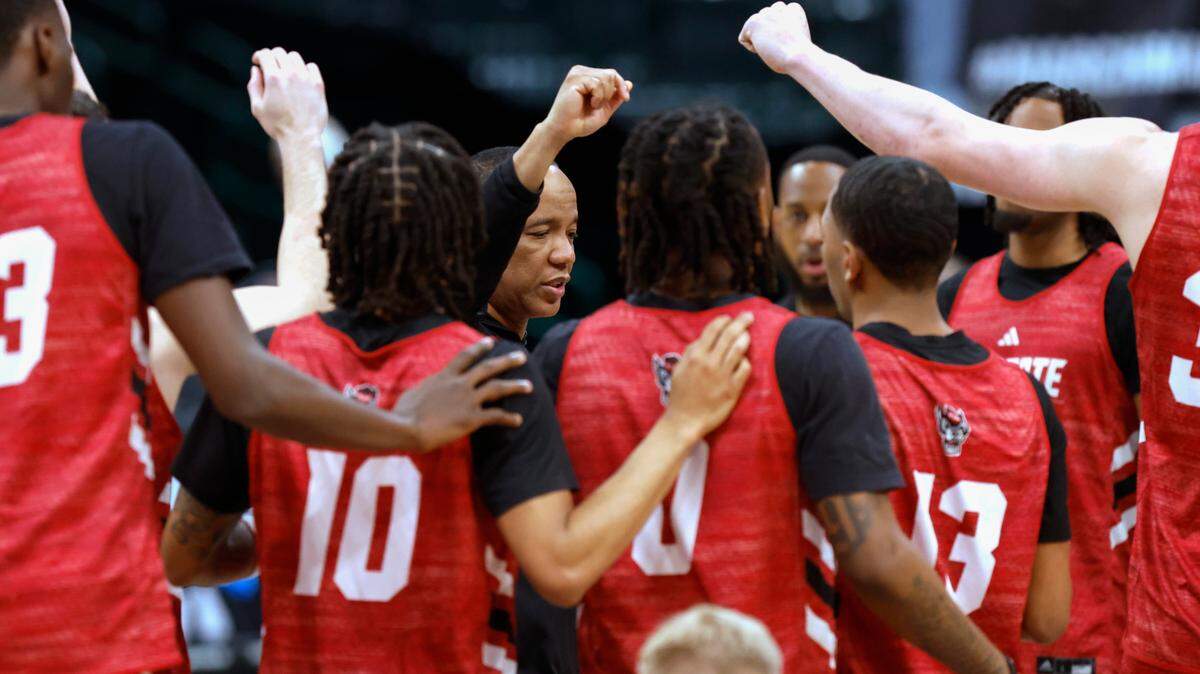
Why was NC State better in the first half against Virginia? Togetherness, communication
Michael O’Connell smiles and gives a humble laugh every time he’s asked about “the shot.” You know, the 3-point bucket in the ACC Tournament that sent Virginia and N.C. State into overtime and continued the Wolfpack’s miraculous run to the conference championship and Final Four. He’s seen the video hundreds of times.
Fast forward to Tuesday, with about 1.5 seconds remaining on the clock and down three to Virginia. O’Connell lobbed the ball from half court at John Paul Jones Arena. A second moment of glory?
Not this time.
He was off target, and that ended the Wolfpack’s impressive 2024 with a bitter taste. He didn’t get to have his second Sports Center moment, to be the hero of the team.
N.C. State (8-5) possessed a 10-point first-half advantage and extended that to 14 points in the first minute of the second. Then it all fell apart.
There’s a lot that went wrong in the 70-67 loss on Tuesday. From the post depth, to communication, to Virginia’s own adjustments, the Wolfpack suffered its first ACC loss of the season in dramatic fashion.
On the defensive end, it gave up 41 second-half points after holding Virginia to 29 points in the first half.
It allowed the Cavaliers (8-5) to shoot 7 of 13 (53.8%) from the field, when it typically allows opponents to make 32% of their 3-point attempts. Plus, it only forced one second-half turnover.
N.C. State didn’t look like the tough defensive-minded team it has showed in other games.
On the offensive side, the Pack scored 28 points on 11-of-33 shooting (33.3%) in the second half after shooting 13 of 21 (61.9%) in the first. Additionally, it made six 3s in the first and only two in the second.
The movement stalled, too. N.C. State recorded 11 assists on 13 made buckets to take the early lead. It added just three assists on 11 baskets in the second.
“We played well on both ends,” head coach Kevin Keatts said. “We came out in the second half, I thought we played well enough the first two minutes offensively, and then I thought the ball stuck.”
But why did it happen? The team didn’t experience a breakdown or falter in a singular area.
If the team had to boil down the breakdowns to one thing, it has to be the challenge it’s faced all season: Playing together.
“I think we just didn’t play together in the second half as well as we did in the first half,” guard Jayden Taylor said. “First-half shots were just way easier. They were high-percentage looks. (In the) second half we kind of got in our own world. Got to taking tougher shots, and tougher shots are hard to make.”
Taylor pointed to his own improvements. At times, he over penetrates the post, leading to turnovers or missed shots due to defensive pressure. He tied his career high with five assists — but they all came in the first half — because he made smart, decisive reads.
“I feel like you’ve got to want to do it,” Taylor said. “It’s not rocket science to just pass the ball when somebody is open. It’s just making the game simple. Nobody on our team is selfish, so you gotta be a willing playmaker.”
Taylor followed that up by saying the same thing impacted the defense. The players didn’t communicate effectively, leading to less precision on its switching and didn’t play with the same aggressiveness.
Plus, it missed Ben Middlebrooks inside. The forward was unavailable due to an undisclosed illness and was officially ruled out at halftime. Keatts planned to play Brandon Huntley-Hatfield and Middlebrooks together, a combination that’s worked well this season, to provide additional size against Virginia.
Ismael Diouf helped Huntley-Hatfield in the post, but the two couldn’t maintain the same intensity after the intermission.
“He’s had a great year so far. He’s the leading shot blocker in the league. He’s our toughness guy,” Keatts said. “That being said, I thought Brandon and Ish did a good job in the first half with his absence, but as the game went along, we completely missed him.”
Keatts called the defensive pressure “tremendous” in the first, but this new team still has to figure out how to play as a unit — when it leads and when it trails — to have success again this season.
“I thought we relaxed. I thought we took a couple bad shots and (had) a couple bad turnovers that led to them getting some easy baskets,” Keatts said. “Once that happened, the crowd gets involved, and the energy on the other end gets involved.”
What will it take for N.C. State to play with that togetherness and unity for a full 40 minutes? Keatts and Taylor say much of it comes down to “want to.”
Everyone has to play with intensity on defense, move on offense and make smart decisions. They have to be on the same page. Otherwise, it leads to situations where the team feels good and five minutes later is staring at a double-digit deficit.
Keatts thought the late-game execution was good, but O’Connell said the Wolfpack shouldn’t have been in a position to rely on another wild 3-point attempt. That’s unsustainable.
But, the team feels confident it can put the pieces together. It just wants to do it quickly — it doesn’t want to rely on winning the ACC Championship to earn an automatic postseason berth when it can make adjustments now.
“As soon as we do that and we communicate better, obviously, we see what we do,” O’Connell said. “In the first half, we played pretty well. We got a lot of good looks. We got good stops on defense. As long as we play like that, play together, we’ll be just fine.”
This story was originally published December 31, 2024 at 4:09 PM.