
Inside look: What are UNC’s top options for the future of the Smith Center?
AI-generated summary reviewed by our newsroom.
- UNC weighs three paths: renovate Smith Center, build at Odom Village or Carolina North.
- Renovation preserves Smith Center footprint, modernizes the 40-year-old arena on campus.
- Stakeholder feedback and further analysis now guide decision timing and site selection pro
Bubba Cunningham has said repeatedly that UNC “dropped the ball” with its communication process regarding the future of the Smith Center.
In an effort to be more transparent, the athletic department has unveiled a new limited podcast series called “The Arena Discussion,” which first published Feb. 25 on the “Carolina Insider” feed. Its latest episode, which was released Wednesday morning, dives into some of the figures that stakeholders are weighing in the decision-making process.
Late last year, UNC was nearing an impending announcement about the Smith Center’s relocation to Carolina North — the long-planned development site north of campus.
“It’s probably going to be (a) basketball arena going to Carolina North, so why don’t we go ahead and do that?” Cunningham said in February. “And then we started talking to more stakeholders and realized that’s not a good idea. Let’s pull that back. Let’s do the development of Carolina North without a basketball arena. And maybe it goes there. Maybe it doesn’t. So we probably got ahead of ourselves before the first of the year.”
Now, as UNC steps back for further analysis on the Smith Center’s future, three options have emerged as frontrunners: renovate at the current site, build new at Odum Village or build new at Carolina North.
Here’s an in-depth look at the three options (in no particular order):
Renovate at the Smith Center site
The first option — and most conservative path forward — is a full-scale renovation of the Smith Center at its current site, modernizing the 40-year-old arena while preserving its footprint on UNC’s campus.
Under this concept, the concourse would undergo a sweeping overhaul. The renovation would prioritize “best-in-class” training facilities for the men’s and women’s programs.
A central component is the conversion of the current natatorium into a state-of-the-art practice facility, giving both basketball programs dedicated practice gyms and locker rooms. The programs would share upgraded weight and training rooms, with the goal of bringing both programs fully under one roof with modern, competitive amenities.
On the fan side, the concourse would be significantly expanded to alleviate long-standing congestion issues with wider walkways, additional concessions, more restrooms and premium offerings to drive additional revenue.
“The status quo is not the ideal situation if we want to continue to evolve and adapt to the new world order and collegiate athletics — primarily based on the fact that we have a 40-year-old building that needs some work,” incoming AD Steve Newmark said.
According to UNC’s projections, the total project costs amount to $591 million. The bulk of those costs can be attributed to the $288 million it would cost to renovate the baseline arena, with $121 in associate project costs and $108 million in soft costs.
UNC projects just over $4 million in annual net cash flow and $41.6 million in annual net revenue, which rank second-lowest among the options (just ahead of Smith Center repairment).
With the option of renovation, UNC is encumbered by existing seating rights, making large-scale reconfiguration more difficult than in a new-build scenario.
The Smith Center currently has 4,357 permanent seats (54% of which are located in the lower bowl) and 2,096 endowment seats (82% of which are located in the lower bowl). Permanent seatholders maintain rights to seats in the current building in perpetuity (meaning forever), with required annual giving based on the founding capital gift. Endowment seatholders maintain rights to seats in any arena with the right to one pass down.
The issue of the Smith Center’s personal seat licenses (PSLs) is what drove Cunningham to take a look at the Bowles Lot as an option for relocation in 2012, the athletic director said.
“That is a very real issue that has to be taken into account on the financial modeling,” Cunningham said.

When asked, Cunningham, Newmark and senior associate athletic director Rick Steinbacher didn’t have any specific figures showing how much money UNC is leaving on the table with its current PSLs — a spreadsheet can’t predict human behavior, or who will buy new seats at new rates, Steinbacher argued — but they said the Rams Club and Newmark are continuing to look into the matter.
While UNC officials believe it is possible to complete the necessary renovations without missing games, doing so would extend construction timelines, increase costs and likely result in lost revenue. It could also create short-term recruiting challenges if UNC is playing amid ongoing construction.
Odum Village
University leaders knew that staying on main campus mattered to stakeholders.
“We said, ‘Hey, we’ve heard how important it is to stay on the core campus,” Steinbacher said. “We were already looking at the Smith Center, Bowles Lot, Friday Center and Carolina North. They said: do not leave a stone unturned. Go out and find every other possible on-campus location.”
So that’s what they did.
In the spring of 2024, Steinbacher and Gordon Merklein, UNC’s associate vice chancellor for real estate and campus enterprises, drove around campus surveying possibilities. Fraternity Court was examined, though officials acknowledged moving there would likely be unpopular. The idea of demolishing the Student Recreation Center, located near Stadium Drive, was quickly deemed cost-prohibitive. Rams Head Deck provided an intriguing option, as did the Ambulatory Care Center and the former EPA building — slated for demolition in the distant future — but those options, too, were ultimately ruled unrealistic.
Out of that exhaustive search for additional on-campus sites, only one emerged as feasible: Odum Village.
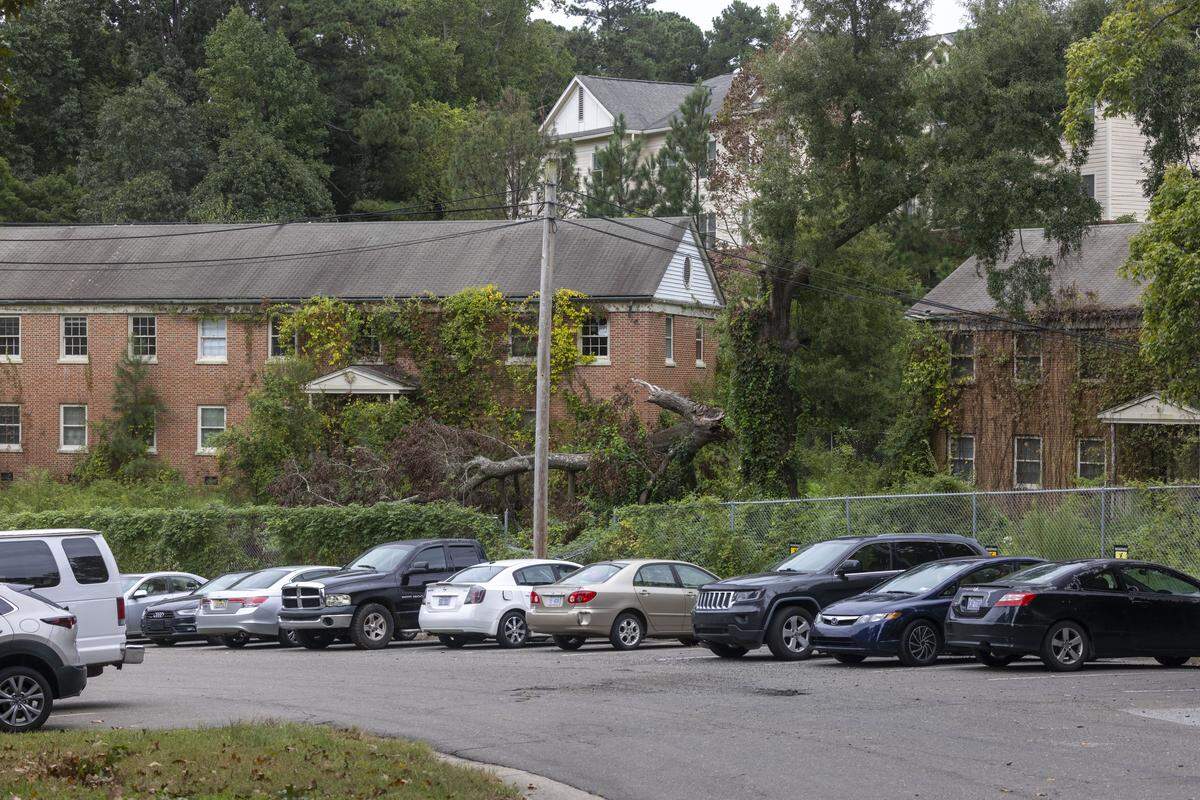
Located roughly a quarter mile from the Smith Center, Odum Village sits beyond the Bowles Lot and the business school parking deck and expansion, on about 14 acres of university-owned land. The former married-student housing complex is already being demolished — a long-planned move independent of arena discussions — making it one of the few clean-slate opportunities on or near UNC’s core campus.
Under this proposal, UNC would construct a new arena at the Odum Village site while continuing to play home games at the Smith Center during construction.
The arena itself would feature expanded concourses, significantly more restrooms and concessions, as well as enhanced premium seating options. Both the men’s and women’s basketball programs would receive practice facilities upgrades. Student seating would be redesigned, too.
The Odum Village option carries a projected total cost of $703.2 million. That includes $413 million for the baseline arena, $42 million to construct practice facilities, $154 million in soft costs and $39 million in baseline escalation estimates, among other site improvements and associated expenses ($40 million projected cost). University projections estimate $404 million in capital gifts and philanthropy, with annual net revenue of approximately $62 million against $20.4 million in operating costs. After debt repayment, annual net cash flow is projected at roughly $25.1 million.
Notably, those figures do not yet account for additional revenue that could be generated through a moderate mixed-use or entertainment district component around the arena.
If approved, officials estimate a new arena at Odum Village could open in time for the 2030–31 season — preserving a main-campus address while delivering a modern facility designed for the next generation of Tar Heel basketball.
Carolina North
The most expansive — and most debated — option is Carolina North, a 230-acre tract of university-owned land that was once a Horace Williams Airport runway.
Carolina North offers the highest mixed-use potential (what the arena may attract in terms of office space, hotels, apartments, restaurants, retail etc.) of any site under consideration, largely due to its size.
But that scale comes with cost.
The total projected price tag for a new arena at Carolina North is $786.46 million — the highest of any option studied by at least $4 million. A major reason for this is infrastructure. The site is largely undeveloped (it is, after all, a deserted airport runway) and would require significant power, water and soil work. Current estimates include $67 million in site improvements, $26 million in site work and utilities, as well as $177 million in soft costs — each the highest projected totals in their respective categories among the options under consideration.
Newmark acknowledged that those figures have prompted questions, especially since UNC has announced that it is going forward with the Carolina North project — regardless of where the Smith Center ends up.
“When the numbers were initially created two years ago, they did it as if it was a 65-acre project with nothing else around it,” Newmark said. “So there’s roughly $93 million of infrastructure site costs that were built in because they needed all of that in there.”
At the time, planners also assumed some level of state support for a project of that magnitude, Newmark said.
Now that the Carolina North development has officially been announced and is moving forward, as the N&O reported in January, those assumptions are being revisited.
“Some of those costs may be subsumed by the Carolina North project and not actually fall into the arena cost,” Newmark said. “That’s a long-winded way of saying: It’s a great question. It’s one that we’re continuing to evaluate, because that’s one of those things that has been adjusting over time.”
Even with the high upfront investment, UNC’s projections estimate the highest annual net cash flow of all the options at roughly $26 million for an arena at Carolina North. That’s slightly higher than the Odum Village model at $25 million. Neither figure accounts for additional revenue that should be generated from an entertainment district or mixed-use net revenue, areas that have the highest upside at the Carolina North location.
If UNC moved the Smith Center to Carolina North, it would likely target a 2030 or 2031 opening, similar to other new-build options.

Carolina North has drawn organized opposition. The Committee for a South Campus Arena, led by former UNC trustee Rusty Carter, has publicly urged university leaders to halt any relocation of the Smith Center — with specific opposition to the Carolina North location.
But for university leaders, Carolina North represents the most transformative — and most complex — path forward.
This story was originally published March 4, 2026 at 10:15 AM.