
How Bobby Petrino is guiding a young UNC offense as spring practice nears its end
AI-generated summary reviewed by our newsroom.
- Bobby Petrino leads UNC's offense emphasizing foundation and gradual installation.
- 59 of the 114 players on UNC's 2026 roster are true or redshirt freshmen.
- Belichick said shared background has helped accelerate UNC's offensive installation.
Bobby Petrino has spent decades coaching football at the highest levels, but he still traces his approach back to lessons he learned from his late father, also a college coach, back in elementary school.
“I never have felt like this is a job. To me, it’s always been a way of life,” Petrino said Tuesday in his first press conference as UNC’s new offensive coordinator. “I used to get out of school when I was in third grade and I had two blocks to get to my dad’s office and the practice field.”
Petrino was the read for triple option football. If he missed an assignment, his father, Bob Petrino Sr., the late longtime coach at Carroll College, let him know.
“It’s fun to grow up that way,” Petrino said, “and pretty much learn and absorb and try to know as much as you could about the game of football.”
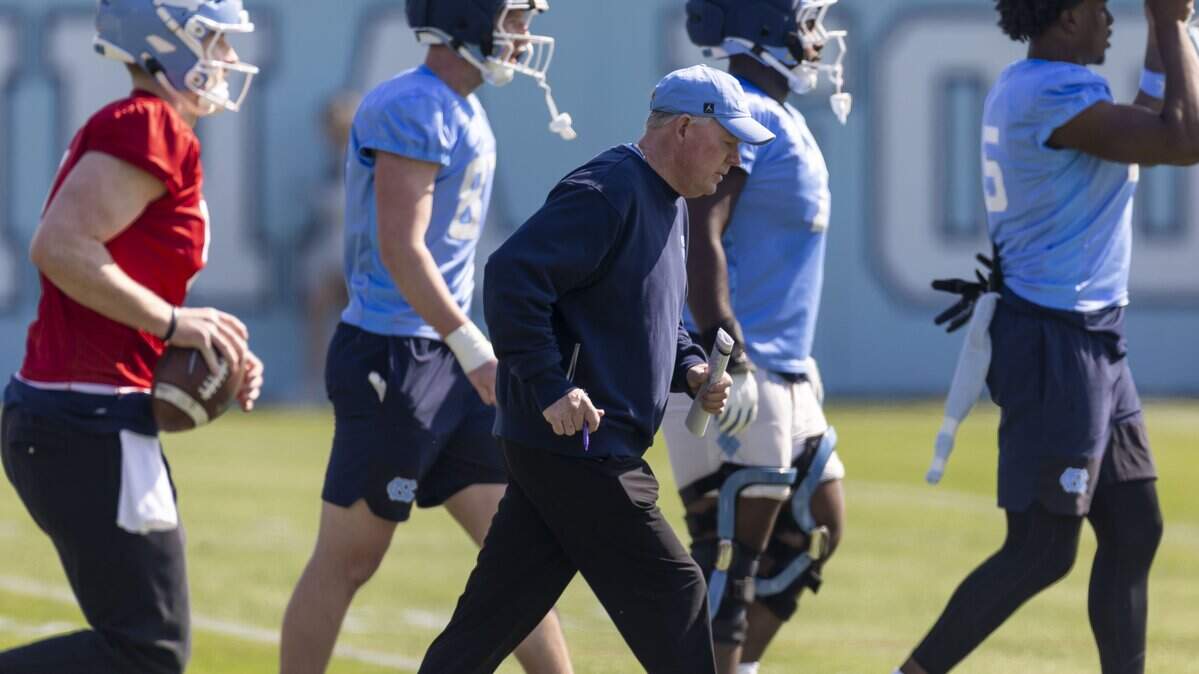
That early immersion, Petrino said, still shapes how he teaches today — especially now, as North Carolina works through the final week of spring practice with an uber-young roster learning a new system. Fifty-nine of the 114 Tar Heels on the 2026 squad are true or redshirt freshmen. Petrino will be tasked with revitalizing a unit that ranked among the worst FBS offenses last season, per multiple major statistical categories.
Petrino said Tuesday that setting the foundation has become even more relevant in a room filled with first- and second-year players adjusting to college football’s speed.
“My dad was always big on you need to crawl before you walk, you need to walk before you run,” Petrino said. “We’ve tried to do a good job with that in our installation and slow down a little bit.”
That approach has shown up in practice structure, where Petrino said the staff has occasionally repeated installation days rather than pushing forward too quickly.
“There’s a couple days where we didn’t move on to the next day’s install because we had to come back and get it right,” he said.
The emphasis reflects the reality of a roster that includes potential starters without Power Four snaps, particularly along the offensive line. Petrino said the learning curve isn’t just teaching the scheme, but about building confidence through repetition.
“They’re out of their comfort zone, and they make mistakes,” Petrino said. “But two weeks later they’re like, ‘Hey, I can do this.’”
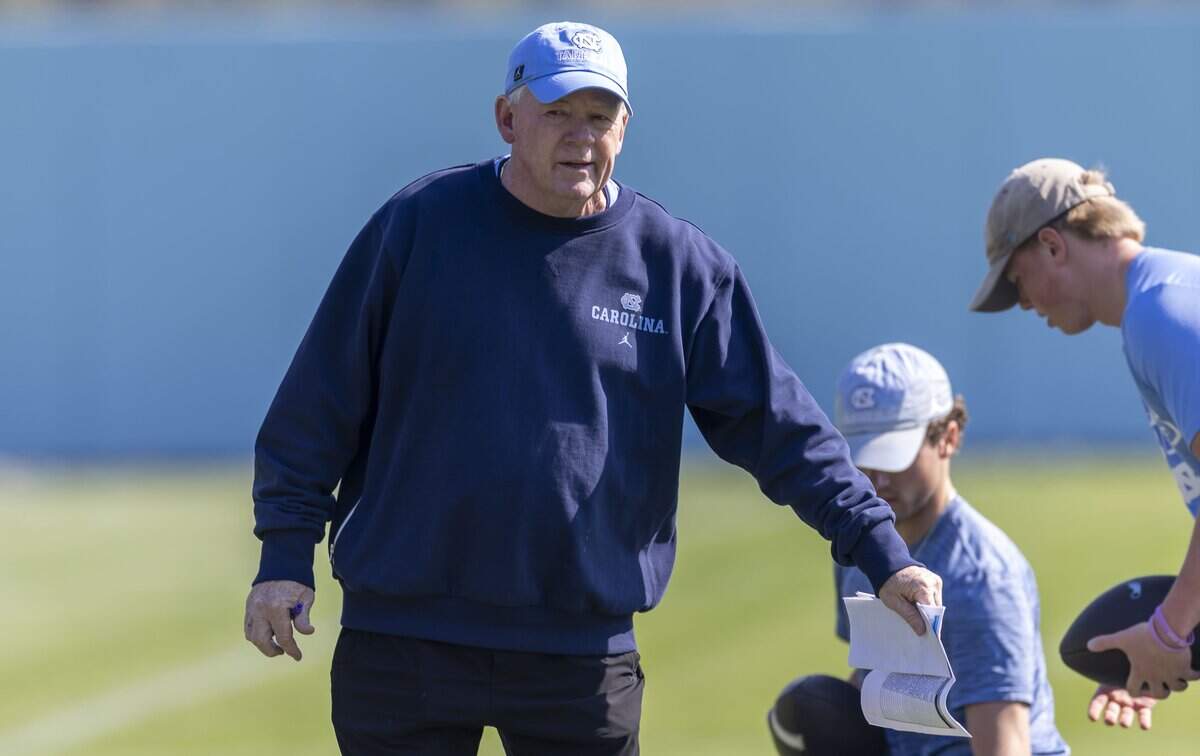
That developmental arc, he said, is part of what makes the current environment different from earlier stops in his career.
Petrino and Belichick shared experiences help
Petrino also credited the structure around him — including head coach Bill Belichick — for helping streamline the offensive installation and situational work this spring.
Belichick said the collaboration with Petrino has come naturally due to prior familiarity and overlapping football concepts.
“Well, Bobby will run it and call it,” Belichick said earlier in spring ball. “Foundationally, a lot of the things that Bobby did at Arkansas or even going back to Louisville… there’s definitely similarities in concepts.”
Belichick added that the staff’s shared background has helped accelerate the offensive installation compared to last season.
He described the working relationship as collaborative, with a clear split of responsibilities but regular joint input.
“It’s probably going to be similar to the relationship I had with Josh McDaniels,” he said. “They’re calling it, they’re running it, but there are certain things we’re going to collaborate on.”
Petrino said that collaboration has influenced how North Carolina structures practices, particularly in blending tempo work with situational defensive preparation.
“There’s times where we’re going no-huddle and going fast,” Petrino said. “Sometimes you’re doing that to help the defense, and sometimes you’re working it for our own guys.”
Developing UNC’s next starting QB
Quarterback development has been central to that process, with Petrino emphasizing protection rules and run-game execution as the foundation for decision-making behind center. While Petrino declined to comment in depth on how the quarterback battle is shaping up, he said there hasn’t been enough separation to indicate who will start in the fall.
That said, if Wisconsin transfer Billy Edwards Jr. wins the job, Tar Heel fans can expect a controlled version of Petrino’s scheme — quick-game concepts, rhythm throws and selective deep shots. Edwards brings experience (500+ career attempts) but lacks elite arm strength, which could limit vertical explosiveness early.
If Texas A&M transfer Miles O’Neill pushes into the role, the ceiling rises, but so does the risk behind an unproven offensive line replacing all five primary starters from 2025.
“I feel like it’s our job to mold the offense around what the quarterback does best and what he doesn’t do best... so it’s been fun to watch them and learn it and understand it,” Petrino said.
With spring practice nearing its conclusion, Petrino said the focus will shift to summer installation and continued development through player-led work and teaching tapes.
Despite the volume of new faces, constant installation and a new team in North Carolina, Petrino said his core approach has not changed.
“I’ve never felt like this is a job,” he said. “It’s always been a way of life.”