
The 1982 Tar Heels were also on a mission to win an NCAA title
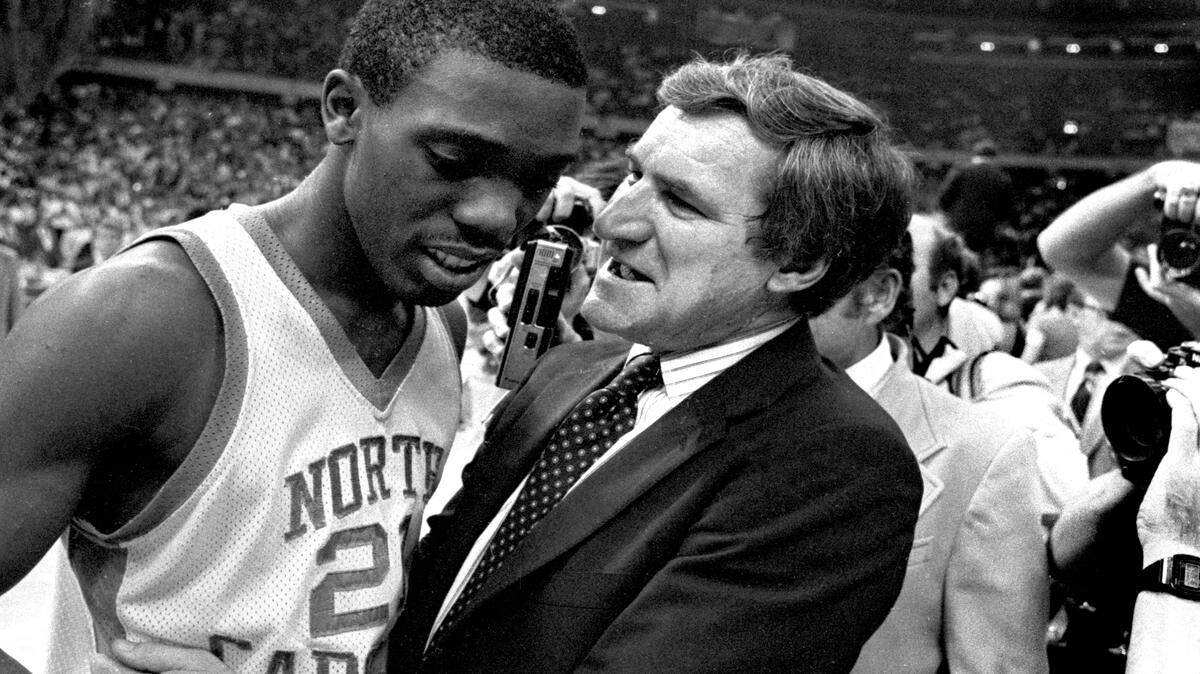
The mood in the North Carolina locker room at the Spectrum in Philadelphia was what one would expect following the 1981 national championship loss to Indiana. The somberness of the room was reflective in senior Al Wood, whose 39-point performance against Virginia in the semifinals carried the Tar Heels to the brink of a national title.
Wood fought back tears as he reflected on not only losing the championship game but also on playing his final game as a collegian, and UNC failing, once again, to win a title for its celebrated coach, Dean Smith.
Once reporters cleared the room, and behind closed doors, Wood approached freshman Matt Doherty.
“I’m done, but you’ve got three more years of this,” Doherty recalled Wood telling him.
A year later in New Orleans, Doherty and his teammates clipped the nets after defeating Georgetown for the national championship and winning the first crown for Smith in his seventh Final Four attempt.
In much the same manner as the current edition of the Tar Heels, who vowed after losing to Villanova in the national title game a year ago to return and win the championship this year, the returning members of the ’81 club committed to making every effort to capturing the following year’s title.
Jimmy Black, who resides in Durham, was the junior starting point guard on the ’81 team that worked through the West Regional with wins over Pittsburgh, Utah and Kansas State to reach the Final Four. Upon returning to Chapel Hill following the 63-50 loss to Indiana in the title game, Black recalled a team meeting.
“All of the returning guys were all in,” Black said. “We knew we had all of the pieces to be a pretty good team and we wanted to win it. So, everyone vowed to get better individually and collectively.”
The Tar Heels lost senior starters Wood and Mike Pepper, as well as reserves Pete Budko and Eric Kenny. Returning starters included Black, James Worthy and Sam Perkins, along with sixth-man Doherty. Then there were the additions of Buzz Peterson, the reigning North Carolina high school player of the year, and a prospect from Wilmington named Mike Jordan.
There were no national recruiting services, and no ESPN coverage or social media coverage of basketball recruiting like today. While Jordan was considered a top-level prospect, he was not recognized – even in the region – as the superstar player he would one day become and ultimately be known as simply “Michael.”
“We knew that we’d have good players coming in,” said Doherty, who resides in Mooresville, “we just didn’t know how good, and we didn’t know what roles they would play.”
Doherty and Jordan stepped into starting positions on a team that did not feature much depth. While winning both the ACC regular-season and tournament titles, UNC relied so heavily on its five starters that the Tar Heels often built first-half leads playing man-to-man defense before switching to a point-zone defense to avoid foul trouble in the second half.
Early in the October practices prior to the ’82 season, the coaching staff of Smith, Bill Guthridge, Eddie Fogler and Roy Williams came up with a couple of motivational tools for the team. First, the staff promised that it would run wind sprints instead of the team at the first practice following UNC’s capturing of the national championship.
Guthridge also introduced a new chant as the team broke the huddle following practice and in games. “Thirty!” the team shouted because that was the March 30 date in which the Tar Heels would celebrate the national championship after winning it the day before in New Orleans.
UNC returned home to Chapel Hill on that date, and the team and town toasted Smith’s first national championship team throughout the offseason. When the team returned to practice in October, Smith first dismissed all of the team’s newcomers, and the coaches lined up on one baseline to run wind sprints. Williams won, according to Doherty, because he was the youngest of the coaches at age 33.
The ’82 champions periodically hold reunions in Chapel Hill to relive those glory days. They do not forget how the ’81 team helped lay the groundwork for the title run.
“I would say every member of the ’82 team would probably say, we could not or would not have won the championship without going through what we did in ’81,” said David Daly, a manager for both teams who organizes the reunions.
When Daly sends out invitations to the ’82 champs, he always includes the four seniors on the ’81 squad.
This story was originally published March 31, 2017 at 1:02 PM with the headline "The 1982 Tar Heels were also on a mission to win an NCAA title."