
World of opportunity: Can NC’s Wilmington port cash in on national supply chain troubles?
READ MORE
A world of opportunity
Across the country, ships wait to dock and shipping containers stack up because there aren’t enough resources to handle them. North Carolina’s Port of Wilmington can handle the largest container ships that call on the East Coast, yet it remains underused despite supply chain backups. And a proposal to help the port keep up with competitors has raised environmental concerns. This is the N&O’s special report.
Expand All
World of opportunity: Can NC’s Wilmington port cash in on national supply chain troubles?
NC port’s next effort to keep up with competitors may be more controversial
Shipping containers are only part of the cargo traffic moving in and out of NC ports
What share of the nation’s shipping containers pass through the Port of Wilmington?
Where does Wilmington rank among the East Coast’s busiest ports?
News from America’s seaports recently has been of ships anchored offshore waiting to dock and of shipping containers stacking up because there aren’t enough trucks or drivers or warehouse space to handle them.
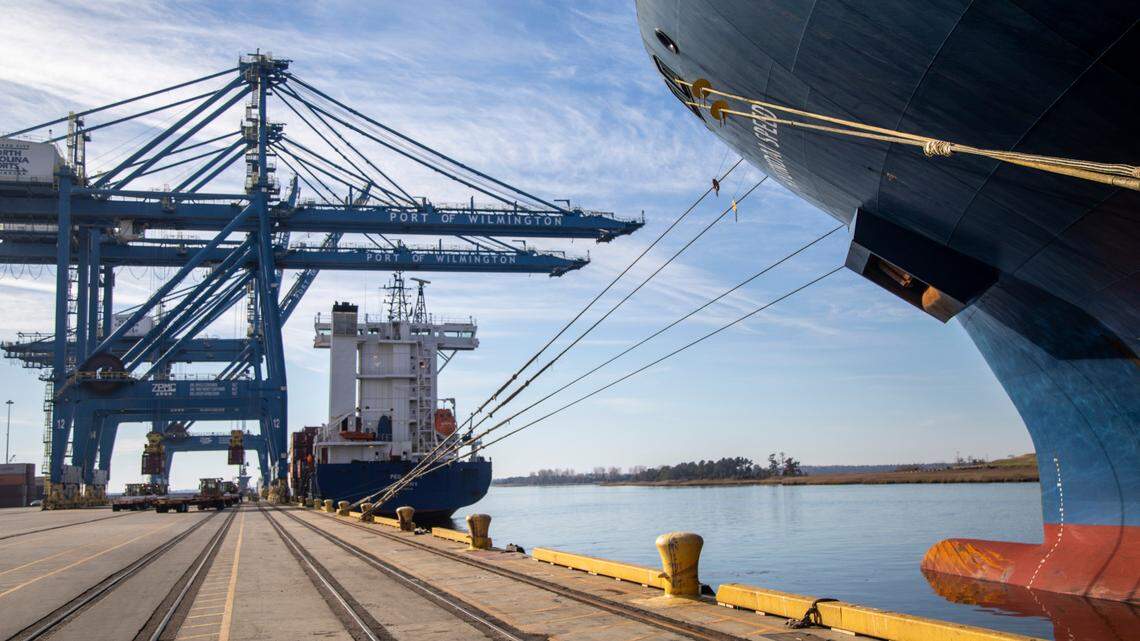
None of that is happening at North Carolina’s Port of Wilmington. Here, as often as not, the massive cranes that load and unload containers from ships stand idle over empty berths, despite the supply chain backups that have hobbled manufacturers and frustrated consumers.
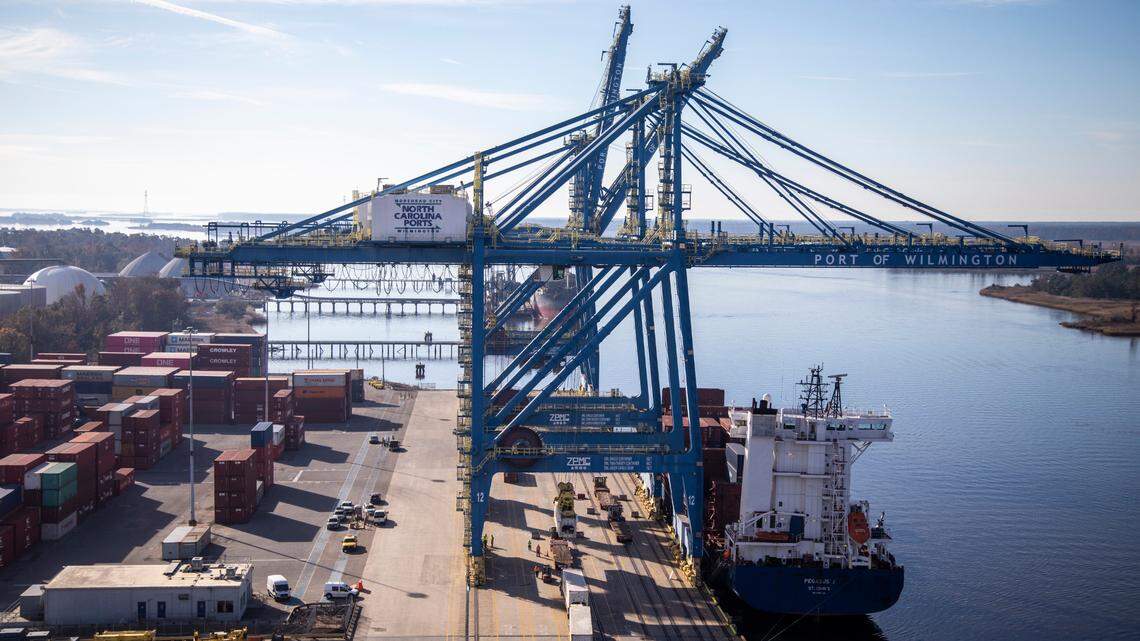
Three of those cranes are big enough to handle the largest ships that call along the East Coast. Installed in 2018 and 2019, they are among several upgrades made in recent years to help the port keep up with competitors. The General Assembly has provided $265 million for port projects since 2015, and the budget Gov. Roy Cooper signed in November includes $90 million more over the next two years.
But the port remains underused. The N.C. State Ports Authority estimates that North Carolina businesses move enough cargo by ship each year to fill more than 3 million 20-foot container units or TEUs, the industry’s standard measurement, yet less than 15% of that passes through Wilmington.
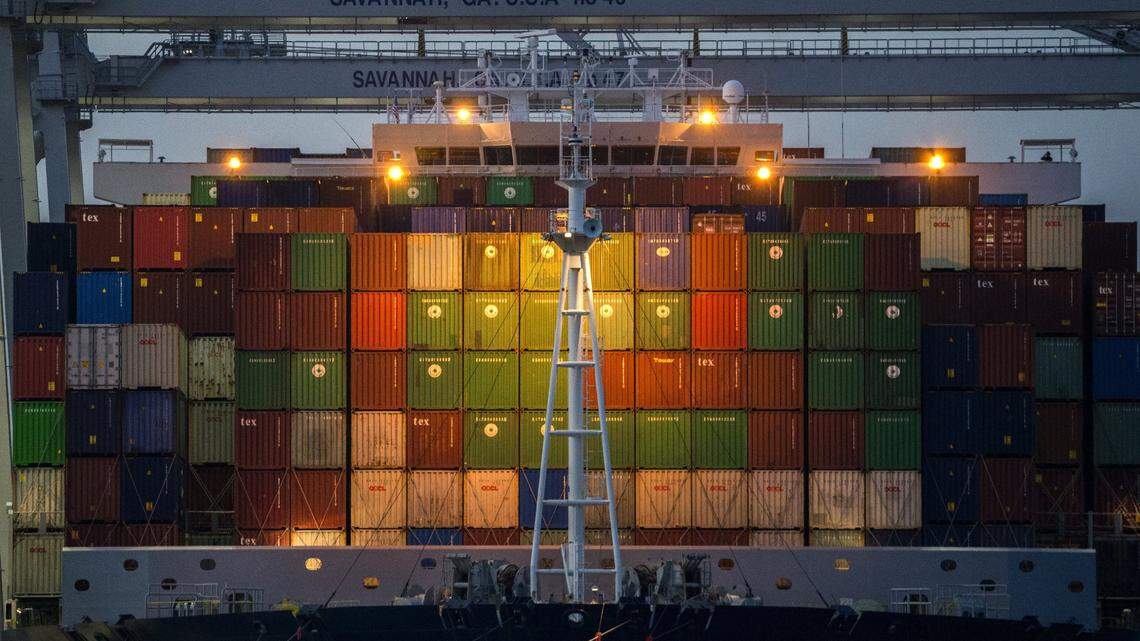
Most of the rest goes to larger, better-connected ports in Norfolk, Charleston, and especially Savannah, the largest in the Southeast and the third busiest port in the country, after Los Angeles/Long Beach and New York/New Jersey.
With a flood of imports clogging these larger ports, the people who run the Port of Wilmington are hoping to persuade more businesses to ship through North Carolina.
“Certainly cargo sitting out on a ship at anchor or experiencing delays of some other fashion does not help that cargo interest,” said Brian Clark, executive director of NC Ports. “So we see this as a great opportunity to grow our volumes and expand our service offerings.”
The General Assembly created the N.C. Ports Authority in 1945 and charged it with creating two state-owned ocean-going ports: one at Morehead City and the other at a former shipyard on the Cape Fear River in Wilmington where workers built Liberty and Victory ships during World War II. The authority oversaw the development and operations of the ports for decades, with little oversight or help from the legislature.
But legislators and state officials began to pay attention when companies started citing the condition of the ports as a reason to locate elsewhere. In 2012, Caterpillar and Continental Tire announced they had chosen Georgia and South Carolina for new manufacturing plants employing a total of 2,800 people, in part due to the proximity to Charleston and Savannah.
Sen. Bill Rabon, a Republican from Brunswick County who was trying to lure Caterpillar to his district, told The News & Observer at the time that when he met a top company official they “discussed nothing but port issues.”
“This port’s problem has cost southeastern North Carolina two major industries,” Rabon said.
Wilmington can now handle bigger ships
Much of the money poured into the port since then enables it to handle large ships that began calling on the East Coast from Asia after new larger locks on the Panama Canal were completed in 2016.
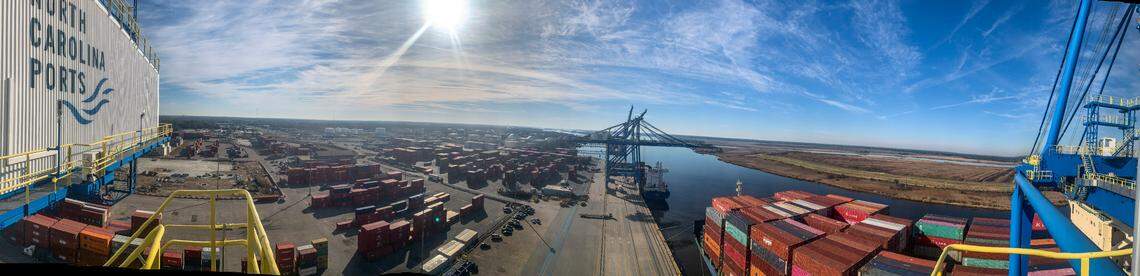
That includes those cranes. Standing 14 stories high and weighing 1,553 tons each, the Chinese-made cranes are large enough to load and unload what are known as neo-Panamax vessels, the largest to call on the East Coast. Their massive booms can reach up and over the big ships, grabbing containers stacked 10 high and 22 across. (The port also still has four smaller cranes.)
Before the new cranes arrived, the port began expanding the turning basin just upriver, so a ship 1,200 feet long, or nearly the size of the 102-story Empire State Building laid on its side, can now turn around before steaming back down to sea. The port also worked with Duke Energy to raise a set of power lines that cross the Cape Fear two miles downstream, so the larger ships can fit underneath.
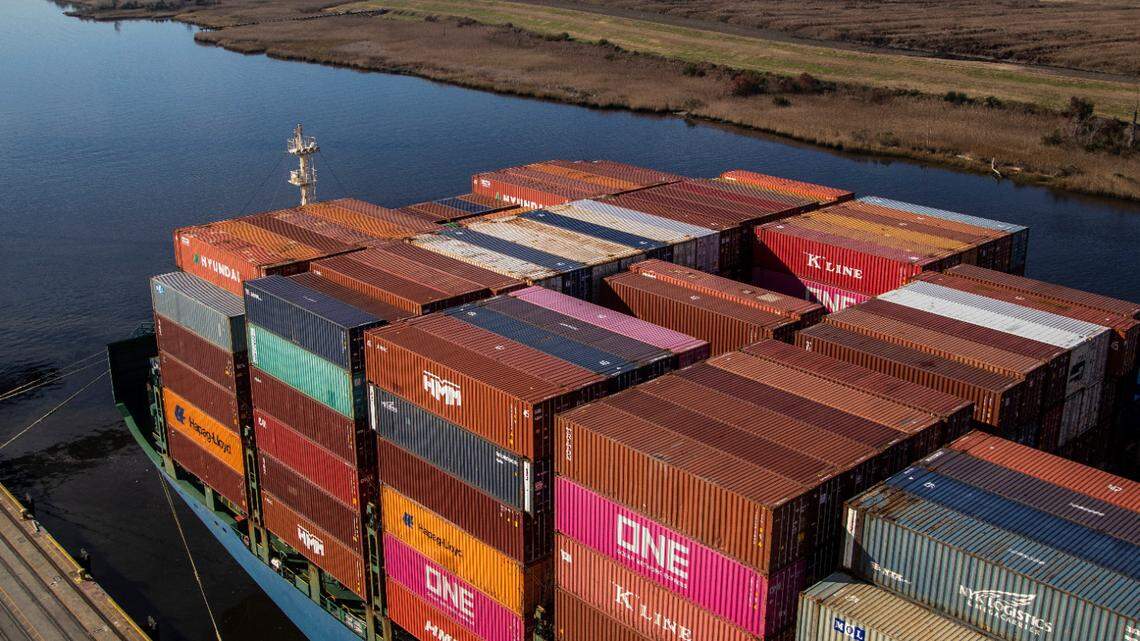
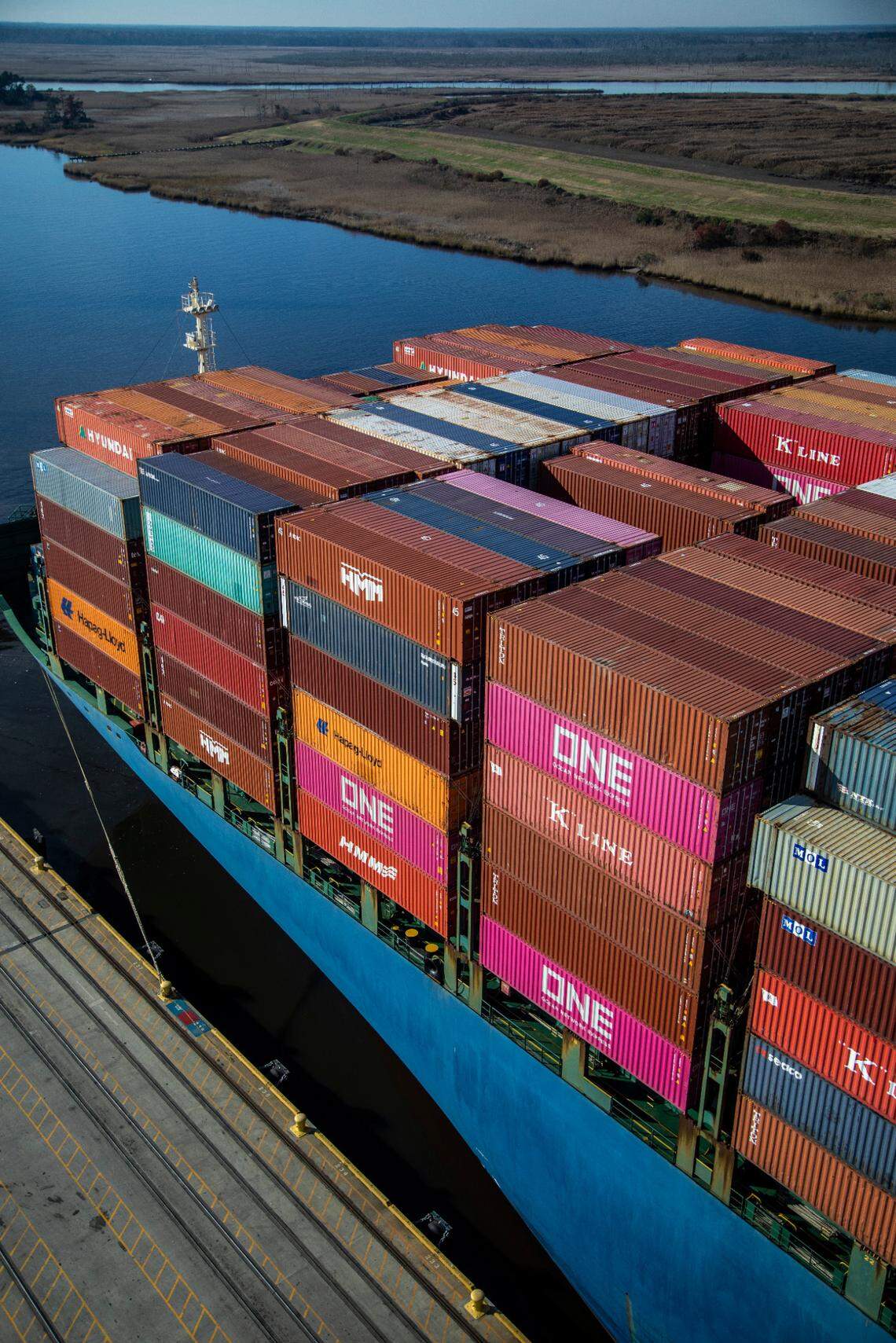
Now the port gets regular visits from ships that can carry more than 14,000 TEUs, and Clark says he’s confident it can handle the largest ship to call on the East Coast, with up to 16,000 TEUs stacked on a deck more than four football fields long.
In addition, the Port of Wilmington is about to begin using a new gate complex that will double the number of lanes for trucks to 13 — seven inbound and six going out. Companies relay information about each incoming truck in advance, which is then confirmed when it arrives using sophisticated cameras, sensors and scales to reduce the wait time.
When the gate opens, which is expected to be by spring, Wilmington will be able to move 1 million TEUs a year, Clark said.
That’s more than three times what it handles now. North Carolina remains a bit player when it comes to moving goods in and out of the U.S. by ship, handling less than 1% of imports and exports, according to IHS Markit, which compiles data on the industry.
Combined, Charleston, Norfolk and Savannah handle 21.6%.
But Wilmington is poised to grow, says Freddie Davis, CEO of Gulfstream Shippers Association of Lenoir, which arranges ocean transport for the furniture, building materials and manufacturing industries. Though North Carolina remains a hub for furniture design, manufacturing and warehousing, Davis says most of the furniture coming in and out of the state moves through ports other than Wilmington.
Davis is hoping to help change that. Gulfstream is looking for space to lease near the Port of Wilmington in anticipation of doing more business there, he said.
“Let’s be honest, Norfolk, Charleston and Savannah have been way ahead of North Carolina for many years. And the reason for that is there was no investment made in the port,” Davis said in an interview. “But we’ve seen a drastic change in that over the last several years. And what we’re seeing is a payoff coming from that.”
‘There’s a whole lot more ships’
It won’t be easy for Wilmington to win business away from other ports. Take, for instance, the case of Hooker Furnishings, one of the country’s largest furniture makers.
Hooker has its headquarters and manufacturing plants in North Carolina and Virginia but imports a lot of furniture from Asia. The company recently opened its largest facility, a mile-long warehouse with 265 loading dock doors, in Midway, Georgia, 35 miles from the Port of Savannah. Hooker said it wanted to be close to what it called the “fastest-growing container terminal in the country.”
The Port of Savannah handled 495,750 TEUs in November alone, a new record for the Georgia Ports Authority. Backlogs in Savannah’s container yard and ships waiting off the coast have forced the port to expand its berth and storage areas. The authority says it will increase its annual capacity by 25%, or an additional 1.6 million TEUs a year, by June.
Savannah has grown over the last couple of decades by specializing in Asian imports for big box retailers such as Home Depot, Target, Walmart and Dollar Tree. As the retailers built distribution centers nearby, the shipping companies offered more frequent service to more ports around the world.
Those offerings attracted companies in other industries, including furniture, Davis said.
“There’s a whole lot more ships,” he said. “That’s the key. It’s all about capacity. The capacity is what rules right now.”
Capacity is also measured by the number of places a company can send or receive a container without having to switch ships. On that measure, the Port of Wilmington has made significant progress. In 2014, Wilmington had direct connections to just 14 ports around the world; now it’s 90 ports in 60 countries in Europe, Asia and the Americas.
Shipping infrastructure a statewide effort
But decisions about where to import and export cargo depend on other factors as well, including truck and rail connections and nearby warehouse space. It’s not as easy as seeing a backup at one port and shifting over to another, says Gary Winstead, CEO of A.R.C. Transit, a Wilmington-based logistics company that uses four Southeastern ports.
“If you were a very large importer coming into Savannah and you said, ‘You know what? I’m going to Wilmington, and I’m starting in two weeks.’ Well there may not be trucking capacity, warehousing capacity,” Winstead said in an interview. “These things have to be carefully planned out.”
The state is working to improve those inland connections. NC Ports long ago established the Charlotte Inland Port, where containers are moved between trucks and trains. Freight railroad CSX runs trains between Wilmington and the Charlotte yard each day.
A similar container hub, the Carolina Connector or CCX, opened near Rocky Mount this fall, where a train loaded with containers leaves every day for the Midwest. CSX owns and operates the Rocky Mount yard; but NCDOT put up $118 million to get it built, and Gov. Roy Cooper and other state officials were on hand for a ribbon-cutting in November, hailing the yard as a critical piece of infrastructure to help the economy.
Containers from the port are now trucked to CCX, but Clark said in time they will be carried by rail as demand grows. With better connections to CSX’s inland rail network, the port expects the number of containers arriving or departing by rail will more than quintuple by 2026, to 50,000 a year.
Wilmington offers other advantages
Clark says the ultimate mission of NC Ports is to help grow North Carolina’s economy. The ports authority says activities at both ports support more than 87,700 jobs in the state.
To help the state’s agricultural industry, the port has expanded its ability to handle refrigerated shipping containers. Three years ago, the port had special electrical outlets for fewer than 300 refrigerated containers; now it has about 740, including more than 500 in special racks that allow it to stack refrigerated containers three high, with plans to install another 720 plugs next year.
North Carolina companies use the containers to export poultry and pork to Latin America and Asia and sweet potatoes to Europe, among other products. But the added plugs and racks are helping attract importers as well.
In June, Sealand, a subsidiary of shipping giant Maersk, began making weekly stops in Wilmington bringing fresh produce from Columbia, Panama and Costa Rica that ends up in North Carolina grocery stores and restaurants.
New services like Sealand’s are ultimately what will attract new business, said Ekaterina Fefelova, a network coordinator for EasyFresh, a Spain-based logistics company that helps move refrigerated food around the world. EasyFresh handles exports of poultry and pork from Wilmington, but not any imports, though it is still negotiating contracts for the coming year, Fefelova said.
“The port’s liner connectivity is paramount, meaning the range of liner or regular maritime connections to the receiving or production areas worldwide,” Fefelova wrote in an email. “Said liner connectivity has improved lately, though it is still far from other US ports.”
A balance of imports and exports
Clark said Wilmington is working to land more imports of frozen or refrigerated food, to offset the exports. The port sees its balance of imports and exports as an advantage that appeals to shippers.
“You’re not moving empty containers in or out of the market,” he said. “Any import that comes in and gets unloaded, that container has the opportunity to be reloaded with an export.”
Wilmington offers other advantages over larger ports, Clark said. While some ports go all in moving shipping containers, Wilmington continues to handle break bulk or general cargo, which goes on ships without containers. In addition, the port loads and unloads shipping containers near the dock, giving companies a wider option of shippers.
But the port’s main competitive advantage, besides its unused capacity, is its quick turnaround times for loading and unloading ships. Clark said Wilmington has the best “vessel productivity” of any port in the country, averaging just under 40 container moves per hour per crane.
The fast turnaround times also apply to trucks, which are averaging 31 minutes to drop off a container and pick up another, Clark said.
Winstead at A.R.C. Transit said the time drivers spend sitting at a port waiting to load or unload a container shortens their time on the road and how far they can go in a day.
“The turn times at the Port of Wilmington are far better than they are at the other ports,” he said. “Right now, that is one of Wilmington’s biggest competitive edges, is getting the drivers in and out of the terminals in a quick and efficient manner.”
How long will the ‘sugar high’ last?
If Wilmington hopes to cash in on congestion at other ports and on the seas, it’s not clear how long it has before supply chain problems start to ease. In early December, Davis at Gulfstream Shipping said he had several thousand containers stuck at or near foreign ports, waiting for space on a ship bound for the U.S.
“These are full containers. They’re sitting overseas. And then we probably have a couple thousand on the water as well,” he said. “So there’s as much business there as we want to do right now. That’s how busy things are. And we focus primarily on furniture.”
The demand has sent shipping costs soaring. Those costs are being passed on, eventually helping fuel inflation and price increases that consumers haven’t seen since the early 1980s.
“But it hasn’t slowed furniture purchases down, which is crazy,” Davis said.
Winstead calls what’s happening to the economy now a “sugar high,” fueled in part by government stimulus payments and a shift of spending from travel, services and entertainment to online shopping for stuff that comes in shipping containers. When all that will wear off is anyone’s guess.
“I don’t have a single client whose business is not absolutely off the chain right now,” he said. “Their inventory levels are at historic lows, and they cannot get on a ship in Asia. And if they do they’re paying four times what they did a year ago. It’s really an amazing market condition, and I don’t know when it’s going to stop.”
This story was originally published January 9, 2022 at 6:00 AM.
