Apple still plans to build an RTP campus. The company just won’t say when.
In April 2021, Apple unveiled its plans for Research Triangle Park. Over the next decade, the world’s richest tech company pledged to invest $1 billion in the state, with more than half going toward establishing an RTP campus. The planned site, on the Wake County side of the research park near Morrisville and Cary, will have a million square feet of office space and employ at least 3,000 people at a robust minimum average salary above $187,000.
The announcement culminated a multiyear state effort to recruit the tech giant, one that included setbacks (Apple chose Austin over the Triangle in 2018) and a covert nickname (Apple named its search for another campus “Project Bear”).
Landing “Project Bear” was the area’s most significant economic development since IBM arrived in 1965 said William Rohe, a city planning professor at the University of North Carolina-Chapel Hill and author of the 2011 book “The Research Triangle: From Tobacco Road to Global Prominence.”
“Maybe the most important impact is that Apple is Apple,” Rohe said. “Them making the decision to come will boost the reputation of the RTP and the Research Triangle metropolitan area substantially. It’s not only about Apple’s Apple impacts, it’s also about Apple’s spillover effects with attracting a different caliber of businesses.”
But when will Apple arrive?
In a way, it already has. The Cupertino, California-based company has begun leasing a seven-story office building on MetLife’s Global Technology campus in Cary. But when Apple intends to open its main campus, or even begin building it, is something the notoriously secretive company isn’t divulging.
An Apple spokesperson, who requested to speak on background, told The News & Observer the company has nothing to add beyond its original April 2021 press release that includes two paragraphs — but no dates — on its North Carolina project.
Apple is known for keeping a tight lid on its public relations messaging.
In 2020, the media relations blog PR Superstar ranked “use secrecy to fuel speculation” as Apple’s top press relations strategy. The U.K.-based marketing firm Harvard wrote, “Apple is famously disciplined (some might say secretive) in every aspect of what it does, and PR is no exception.”
The N&O reached out to other RTP stakeholders to ascertain specifics on Apple’s future development in the area.
“Apple has not released a construction timeline for its new RTP campus at this time,” emailed Wake County spokesperson Stacy Beard. The Research Triangle Foundation, which manages the surrounding 7,000-acre business community, declined to comment through a spokesperson.
The North Carolina Department of Commerce said no modifications have been made to Apple’s Job Development Investment Grant (JDIG) agreement with the state, which could provide Apple with more than $800 million in payroll tax relief through the year 2061 if the company meets its hiring and investment targets.
In its JDIG application, Apple proposed spending $552 million to construct a campus on parcels of land abutting N.C. Highway 540 between Louis Stephens Drive and Little Drive. The land is owned by Acute Investments, which is described as a “holding company” on its most recent annual report to the North Carolina Secretary of State.
Apple’s yearly job targets are public
In the 20 months since Apple announced its arrival, workplace dynamics have shifted.
Coming out of the pandemic, employees’ enduring preference for remote options has led many business leaders to rethink physical office spaces. This summer, the health care company Centene exited its 3,000-job commitment with North Carolina, which had included a new East Coast headquarters in Charlotte, with company executives citing the evolving demand for remote work.
Unlike other major tech firms, which have refrained from return-to-office mandates, Apple has required some employees to work in-person since it reopened its corporate buildings in the spring.
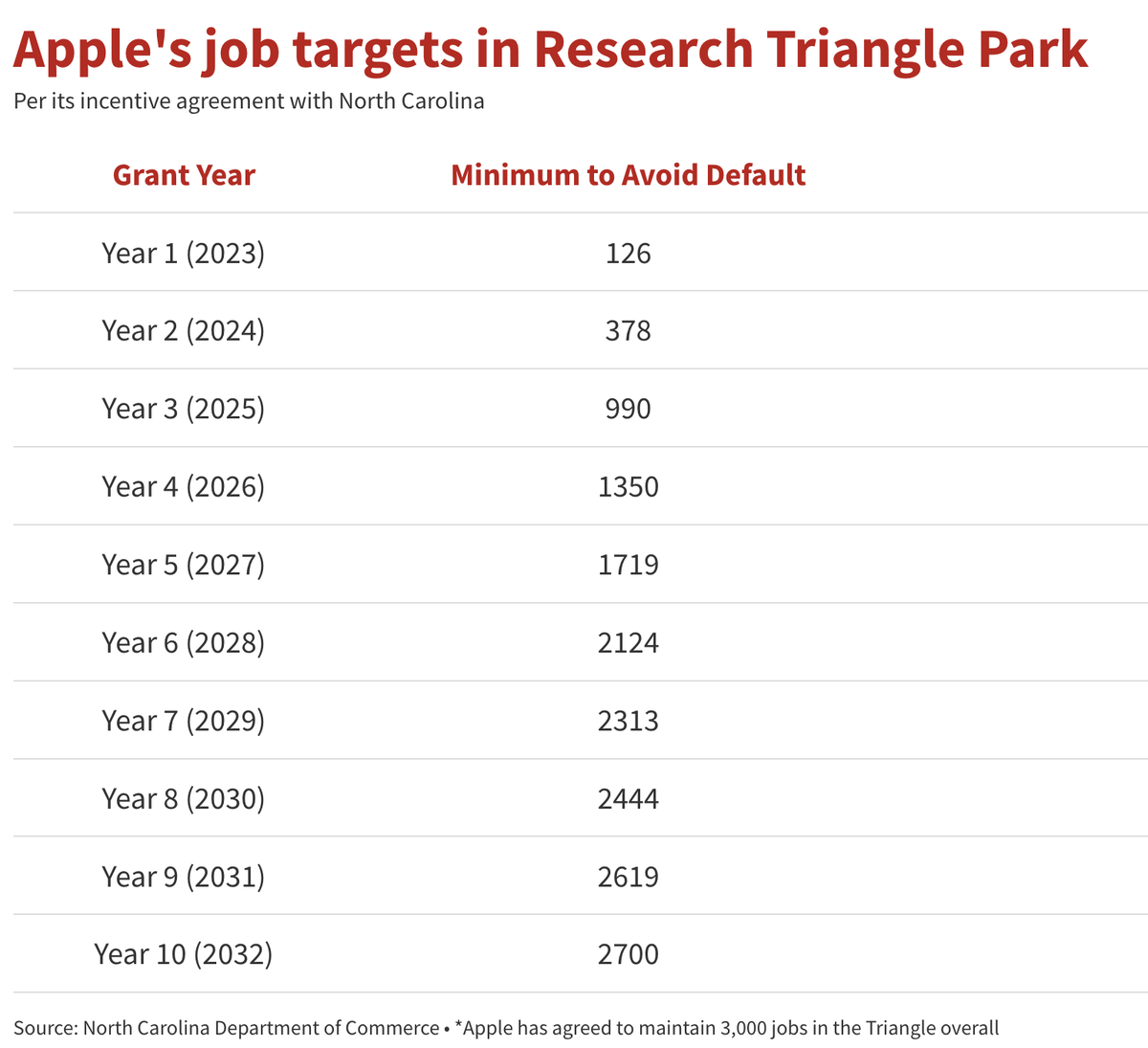
Though its RTP campus timeline is murky, Apple does have explicit job creation benchmarks to meet in order to remain eligible for state incentives. According to its JDIG, Apple must create at least 126 new positions by the end of 2023, and its hiring targets will then accelerate over the next few years, eventually reaching 2,700 total jobs by 2032.
Rohe said it is this influx of jobs, more than a physical campus, that will leave the greater long-term effect on the Triangle. Still, he said the campus is important, both as a symbol of Apple’s local commitment and for what it logistically means for the nearby communities to have a massive centralized office complex in their backyards.
“It has an impact obviously on transportation and on schools,” Rohe said. “So, all the sudden, a ton of new kids (coming to the Triangle) put tremendous pressure on the school system.”
This story was produced with financial support from a coalition of partners led by Innovate Raleigh as part of an independent journalism fellowship program. The N&O maintains full editorial control of the work.
This story was originally published December 15, 2022 at 12:57 PM.