Open Source: IBM was all about discussing diversity 5 years ago. Things have changed.

I’m Brian Gordon, tech reporter for The News & Observer, and this is Open Source, a weekly newsletter on business, labor and technology in North Carolina.
To glimpse the recent course of American history, one could do worse than IBM’s annual reports. Specifically, open these yearly updates and search for “diversity.”
IBM had mentioned the word intermittently prior to 2017. But beginning that year, the first of President Donald Trump’s first term, the global tech company (and major Triangle-area employer) started to use it often.
Six times each between 2018 and 2020. Then, after the murder of George Floyd and a summer of social justice protests, IBM included “diversity” in its 2021 report nine times.
Accompanying this language, were new policies; in 2021, IBM introduced a “diversity modifier” to financially credit managers whose hiring efforts better reflected their communities’ demographics. IBM also began to share overviews of its “diversity, equity and inclusion efforts.”
This week, IBM released its latest annual report, and the word “diversity” doesn’t appear once. It is the first such instance since 2016. “It’s important to underscore that diversity is not a metric for compensation,” company spokesperson Sarah Minkel told The News & Observer in a follow-up email.
Gone were references to DEI and the diversity modifier. IBM acknowledged that “an inclusive workplace serves as a catalyst for heightened innovation, agility and overall performance” but stopped short of using the d-word.
This shouldn’t be a total shock. Back in power, President Trump has railed against diversity, equity and inclusion efforts. He signed an executive order his first day banning DEI initiatives from the federal government. Since his inauguration, corporations like Bank of America, Amazon and Target have walked back their diversity practices and vocabulary.
Like many large technology companies, IBM has several U.S. government contracts. So its choice to erase “diversity” from its report links to a direct financial factor.
But ditching “diversity” also comes amid a broader change in how many — though certainly not all — view corporate DEI. Less than five years ago, businesses raced to proclaim their social justice bona fides. The contrast is stark.
Such pivots have been common through U.S. and world history, says David Zonderman, a history professor at NC State.
“Broadly, history is often a series of pendulum swings where culture and society move one way and then there’s a reaction that pushes it a different way,” he said.
The progressive 1960s were followed by the more reactionary 1970s. Prohibition in the 1920s sparked a transgressive response that defined Roaring 20s culture (think flappers, jazz and bootleggers) noted Erik Gellman, a history professor at UNC-Chapel Hill.
But both historians say the speed of the current backlash is special.
Last year, IBM submitted its workforce demographics to the U.S. Equal Employment Opportunity Commission. Women were about 30% of its staff, including at the IBM-owned Raleigh software provider Red Hat. Only 8.1% of IBM’s workforce was Black and this percentage was lower at Red Hat, where more than 70% of workers were white.
Is this something worth trying to change? Is this something IBM can, or will, even still discuss?
Clearing my cache
- Following mass layoffs last fall, the Durham semiconductor company Wolfspeed said it will cut another 180 positions in North Carolina as it aggressively seeks to reduce costs.
- The global drugmaker Merck added a $1 billion vaccine plant to its north Durham campus.
- For the second time in 12 months, General Electric has committed to spending tens of millions of dollars at its North Carolina engine production sites, including its plant near Research Triangle Park.
- FHI 360, a Durham-based global research nonprofit, has indefinitely furloughed almost half its U.S. staff due to freezes in U.S. foreign assistance. More than 60% of the organization’s revenue comes through the beset U.S. Agency for International Development.
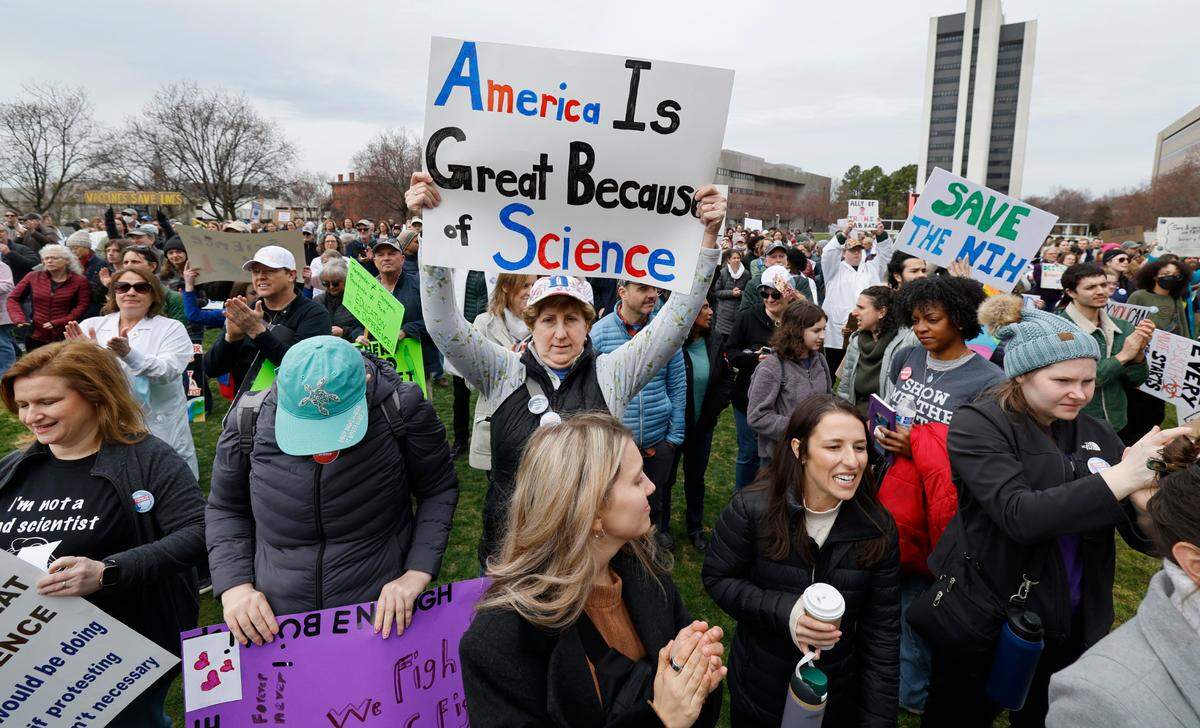
- Hundreds gathered last Friday in downtown Raleigh to promote scientific research and protest the Trump administration’s cuts to the National Institutes of Health, among other agencies. More local anti-Trump/Musk rallies took place Sunday and Wednesday.
- Serial Triangle entrepreneur Scot Wingo is back entrepreneur-ing. Along with three fellow ChannelAdvisor alums, Wingo has formed ReFiBuy, which he explained will create AI agents to “help retailers and brands solve some of their hardest problems.”
- New HQ destined for Raleigh. The precision tech company Ralliant, recently born out of the industrial conglomerate Fortive, selected North Carolina’s capital for its main corporate office, promising around 170 jobs at a robust average salary. (But what about the median wage, North Carolina?)
National tech happenings
- Tough week on Wall Street as ping-ponging tariff policies have investors skittish. The Nasdaq is 13% below its all-time high from a month ago.
- New administration, same request: The Department of Justice still wants Google to sell its Chrome browser to resolve a long-running antitrust case.
- Thousands of federal workers terminated by the Trump administration have to be offered their jobs back after a U.S. district judge in California ruled they were unlawfully fired. The White House has appealed this decision.
- Quantum supremacy has been reached again… depending on who you ask. In a recent scientific journal, the Bay Area startup D-Wave said its quantum computer performed a materials simulation in less than 20 minutes that would take a top-end supercomputer one million or so years to complete. As with past quantum supremacy claims, this one has inspired both optimism and doubt.
Quantum computing research is big in the Triangle, especially at Duke and NC State. Will be curious to track if federal funding cuts impact this work.
Thanks for reading!
This story was originally published March 14, 2025 at 9:36 AM.