Can a North Carolina town sue Duke Energy like it’s a tobacco company in 1998?
I’m Brian Gordon, tech reporter for The News & Observer, and this is Open Source, a weekly newsletter on business, labor and technology in North Carolina.
In 1998, the four largest U.S. tobacco companies agreed to pay billions of dollars annually to 46 states — including North Carolina — to compensate for decades of tobacco-related health care costs. This Tobacco Master Settlement Agreement lasts in perpetuity and has been credited for accelerating North Carolina’s transition from tobacco toward tech.
Today, one North Carolina town is trying to draw a similar parallel between a corporation’s long-running policies and alleged damages the town has incurred. Carrboro in Orange County has sued Duke Energy for what it claims was a knowing effort to deceive the public about the threat of climate change. It is the first time a municipality has sued its local electricity utility for this reason, the town and company both believe.
Carrboro says it is poised to face higher future climate-related costs, from road repairs, to stormwater protections, to cooling public buildings on increasingly hot days. It believes Duke Energy should help pay.
The two sides met in N.C. Business Court for the first time Thursday to debate Duke’s motion to dismiss the case. Several legal concepts were discussed over the five-plus-hour hearing, but a key one revolved around whether Duke Energy could be treated like a tobacco company in the 1990s. Duke’s lawyers, obviously, said no and contended the contrast lay in the link between alleged actions and damages.
“The difference in tobacco cases was saying Lucky Strike ... told me that tobacco wouldn’t kill me or give me cancer or wouldn’t cause these problems. I then went out, I bought cigarettes, I smoked. I kept smoking a cigarette. Now I have cancer,” Hunter Bruton of the law firm Smith Anderson said. “So, you can trace it right back. There’s never a, Philip Morris lied to the public about the dangers of cigarettes, and then that caused somebody else to smoke cigarettes, and then that person was smoking cigarettes and caused us municipal harm because it smells bad in Carrboro.”
In a May filing, Carrboro compared Duke’s alleged climate change deception to cigarette companies paying scientists to undermine the connection between tobacco use and cancer. And its lawyers fought Duke’s framing of the case as one that tries to regulate the emissions of an already state-regulated monopoly.
Even a highly regulated company can be held liable for deception, attorney Matthew Quinn argued. “We’ve seen that in the various climate cases throughout the country,” he said. “We’ve also seen that in American jurisprudence, from the tobacco litigation, (methyl tertiary butyl ether) litigation, opioid litigation.”
Carrboro wants to make its case before a jury. Duke wants it to go away immediately. A judge will decide what happens next.
Who wants to talk about H-1B visas?
H-1B work visas are a sensitive topic. I’ve spoken to one major corporation who would only discuss their usage on background. And this week, a retail chain asked me if its name could be removed from an article on how the state’s largest employers use or don’t use the popular program, which pairs educated foreign workers with U.S. employers big and small. (We didn’t remove it.)
I’ve gotten few personal threats as a journalist, but one was in my inbox after we published a series a few years ago on H-1B workers in the Triangle and their families.
The H-1B debate reemerged last Friday when President Donald Trump ordered employers to pay a $100,000 fee on all future visa applications. Smaller companies in the Triangle said the price was a nonstarter. Larger companies either said they needed more time to understand the policy — which is likely to be challenged in court — or they said nothing at all.
North Carolina schools use H-1B visas to fill teacher vacancies, with some telling my colleague T. Keung Hui they will need a fee exemption or face greater staff shortages. Most H-1B visas go to the tech sector, not education, making the issue particularly relevant to the Triangle. We’ve put together a list of which North Carolina companies hire the most H-1B workers, though the data comes with a huge caveat, which you can read about in that story.
While you’re here, I encourage you to click on some of my past H-1B reporting. There are weird classified job ads that exploit green card loopholes and local visa workers who considered moving to Canada, only to see that country also become less welcoming.
What’s it like to be the spouse of an H-1B worker? What’s it like for their children? And why did IBM begin ‘scaling back’ its use of these visas long before Trump retook office?
Clearing my cache
- What is vibe coding and what does it mean for the future of work? Let Pendo’s CEO explain.
- The Triangle has gotten a lot of really big drug manufacturing facilities in recent years, but the biggest of them all partially opened this week in Holly Springs (where all the pharma projects seem to go.) Stop thinking of Fujifilm as just a camera company.
- Jobs lost: In North Carolina’s second-biggest layoff this year, an Asheville solar energy firm will eliminate 517 positions across its home city and Fayetteville. It cited recent regulatory and market changes as the reason why.
- Jobs announced: Two months after cutting around 3% of its U.S. workforce, Lenovo has unveiled plans to hire 420 workers within the next three years as it expands its server production site east of Greensboro.
- Durham Technical Community College broke ground on a new biotech center Monday supported by $6 million from Novo Nordisk, which operates a site in north Durham and a larger campus in Johnston County.
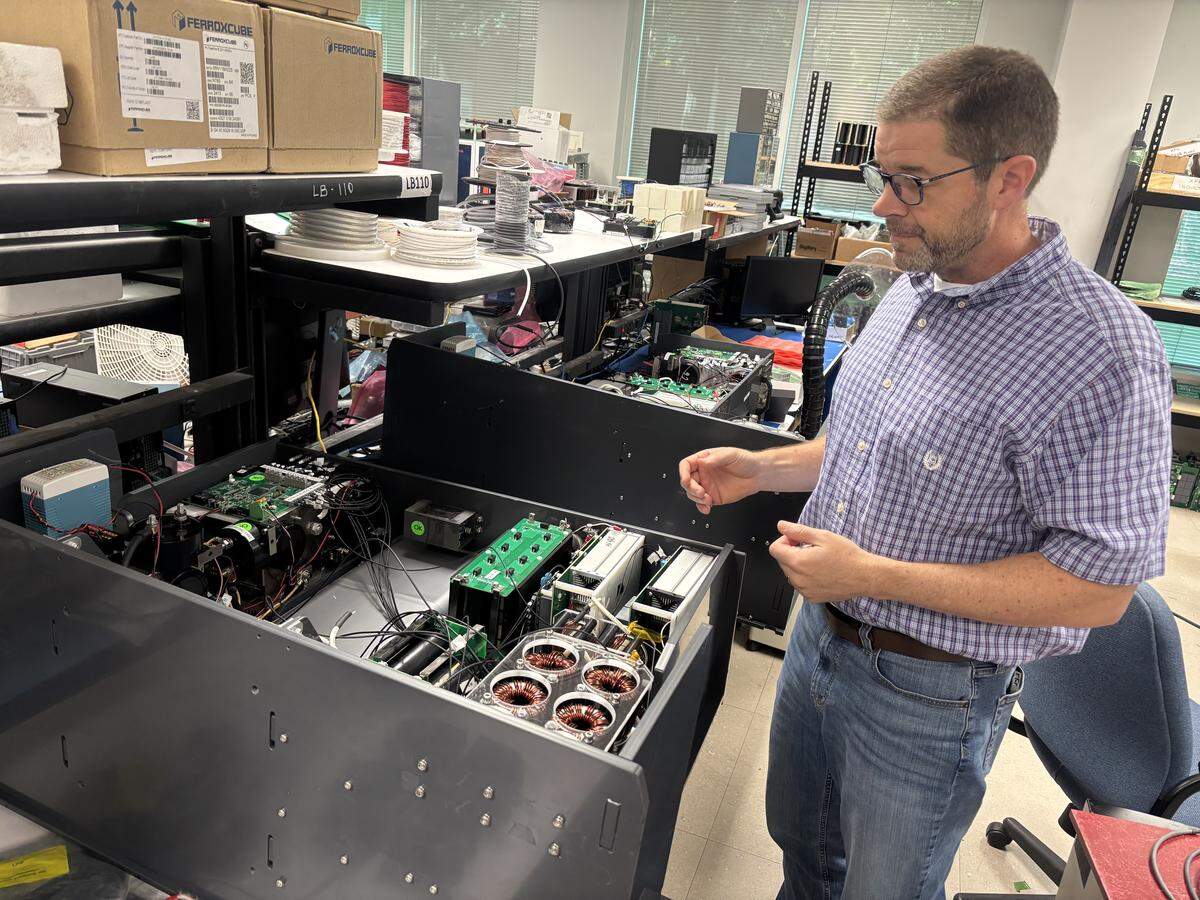
- Kempower, which makes fast-charging EV stations in Durham, is partnering with NC State University’s FREEDM System Center to study charging systems. FREEDM aims to improve renewable energies through academic research. Its industry and innovation director Ken Dulaney gave me a tour this summer.
National Tech Happenings
- Jimmy Kimmel is back, though two local station operators continue to boycott his show.
- Amazon will pay $2.5 billion to settle Federal Trade Commission allegations that it tricked customers into getting Prime subscriptions and made it difficult to cancel. For context, Amazon made $59.2 billion in net income last year.
- In a marriage of arguably the two most influential tech companies of recent years, Nvidia will invest $100 billion to buy equity in OpenAI, which will lease Nvidia chips.
- Meta has started a super PAC to fight AI regulation.
- Starbucks will close stores and lay off around 900 North American employees.
Thanks for reading!
This story was originally published September 26, 2025 at 10:36 AM.