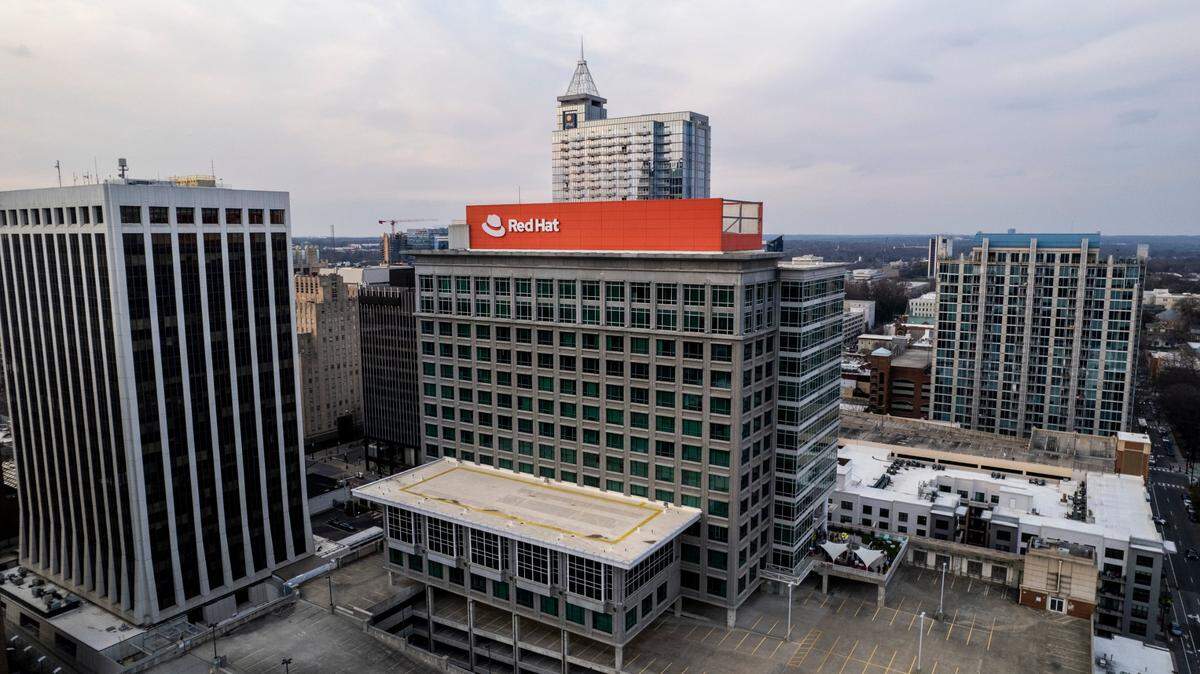
IBM moves Red Hat back-office workers into parent company. Why some are watching.

I’m Brian Gordon, tech reporter for The News & Observer, and this is Open Source, a weekly newsletter on business, labor and technology in North Carolina.
Red Hat would remain an independent unit of IBM, then-IBM CEO Ginni Rometty said the day after her company announced it would buy the Raleigh open source software provider for $34 billion.
IBM publicized this deal in late October 2018, and ever since, believers in free, accessible open source software have watched to see if the company nicknamed Big Blue would keep its word and leave Red Hat alone.
Simply put: Within the distinct world of open source, free access to information is paramount. Yes, Red Hat was a giant company before the IBM sale, but it was also the plucky North Carolina underdog who had taken on Microsoft and forged a future where open source software reigns supreme over siloed code behind proprietary ownership (Red Hat makes money off its service, not its products).
IBM is one of the most valuable corporations on earth, and the most valuable corporations tend not to give things away for free. It has thus been a kind of boogeyman to many in the open source software community, especially when any disruptions hit Red Hat.
After Red Hat announced 4% layoffs in April 2023, some reacted by blaming the parent company. “It was inevitable that IBM would eventually turn Red Hat blue,” a commenter said on Facebook. “Welcome to IBM!” another posted underneath The N&O article on the layoffs. A few months later, Red Hat announced it would begin to reserve the source code of its flagship product, Red Hat Enterprise Linux, to paying customers only. Red Hat vice president Mike McGrath said people online accused him of being sent by IBM.
“No one from IBM came to talk to me about this decision before, during or after it,” McGrath told The N&O at the time. “I’m always amused by people that think IBM execs have meetings about CentOS and rebuilders. I don’t think they really know what it is.”
Now another change is coming to Red Hat. Early next year, IBM will move most of Red Hat’s back-office personnel — finance, HR, legal, accounting and some IT support staff — into IBM. “This will create a stronger, more dynamic team with new capabilities, enhanced collaboration, and expanded career opportunities,” an IBM spokesperson wrote in a statement to The N&O.
This reorganization was first reported in September by the online tech outlet The Register but had not yet been confirmed by IBM.
Companies post-merger frequently consolidate back-office staff. These divisions are essential, but they aren’t what open source software advocates feared IBM would strip from Red Hat. “This all makes perfect sense in the context of running a big company efficiently,” Bob Young, Red Hat cofounder and former CEO, told me over the phone Thursday.
Red Hat has thus far been a huge success for its parent company, spearheading IBM’s swing toward software services by providing consistent double-digit revenue returns. “IBM are no fools,” Young said. “The senior executives at IBM made the right call for IBM, and they’re not going to kill the golden goose. They’re interested in making IBM more like Red Hat.”
Still, a sizable number of current Red Hat employees (IBM did not share a figure) will soon report directly to IBM. As of late 2023, Red Hat specifically had more than 2,000 workers in the area. It had 13,360 employees worldwide shortly before the sale to IBM.
People will keep monitoring the situation. Ultimately though, only one company is steering the ship. Perhaps evidence: I had reached out to both Red Hat’s and IBM’s media teams for this story. Only IBM responded.
Will NC land the Vulcan factory? Here are some signs.
Will it be in North Carolina? In an email Monday, the rare earth magnets startup Vulcan Elements said it is concluding a “multi-state search” for its first major facility, with a site announcement expected “in the coming weeks.”
Founded in 2023, the Research Triangle Park company has blasted past milestones. It opened its first site in the spring, raised $65 million in the summer, and this week, announced a $1.4 billion partnership with the federal government and a refiner to fund a large-scale, 10,000-metric-ton magnet factory.
The government will take equity in Vulcan Elements, a move the Trump administration has done with other companies it perceives to be critical to national interests.
So, what are the signs Vulcan might choose North Carolina for its next big magnet site? One, its headquarters is here. Two, we have a significant military presence, which Vulcan CEO John Maslin has cited as a reason his company is here in the first place. And three: For a young startup that hadn’t yet made magnets at scale, there was an impressive lineup of state and local leaders at its RTP facility opening in March.
U.S. Rep. Pat Harrigan, Durham Mayor Leonardo Williams and, importantly for reading the factory recruitment tea leaves, N.C. Commerce Secretary Lee Lilley and Economic Development Partnership of North Carolina CEO Christopher Chung. We should know soon where Vulcan goes. It will then be longer to see if they can break China’s rare earth magnet dominance.

Clearing my cache
- Another Amazon union campaign has launched in the Triangle — this time at four Durham facilities. Will it have more success than the failed Garner drive?
- Two days after his economic trip to Asia, Gov. Josh Stein spoke to me by phone about the Japanese companies eyeing North Carolina for expansion, how their business leaders discuss tariffs, and what edge NC has over our southern neighbors/rivals. For context: Japan is our state’s largest source of direct foreign investment. For fun: Tokyo and Raleigh share the same latitude.
- North Carolina residents will lose the option to file state and federal taxes through a free direct IRS program after the Trump administration informed participating states it won’t be available in 2026.
- Raleigh cloud services management firm RapidScale is opening a second downtown office as it seeks to add to its roughly 600-person workforce. “We intend to hire about 100 people a year,” company president Duane Barnes told me.
- One of the country’s top approvers of SBA loans is headquartered in Wilmington, NC. And as the government shutdown continues, Live Oak Bank cautions small businesses their funding could be delayed.
- Politico wrote about the EPA’s search for employees who signed a letter of dissent against Trump administration policies. These workers, including some in Research Triangle Park, were put on administrative leave.
- What’s a tech newsletter without a data center development? Eastern North Carolina’s Edgecombe County has paved the way for a major data center campus, The Triangle Business Journal reports. Meanwhile, I’m still trying to figure out how much energy Amazon’s 20-builiding data center in Richmond County is projected to use.

National Tech Happenings
- Kenvue, the embattled maker of Tylenol, is being acquired for $40 Billion.
- Microsoft is the latest tech behemoth to pursue superintelligence, AI that can meet or top what the human mind can achieve.
- Burrito blues: Chipotle is struggling to connect with younger customers. Fellow fast-casual eateries Cava and Sweetgreen are lagging, too.
Thanks for reading!
If you enjoyed this newsletter, share it with a friend. If it was forwarded to you, sign up here to receive it every Friday.
This story was originally published November 7, 2025 at 10:05 AM.