Did NC get hosed in PFAS settlement? And why was everyone crazy about SAS M&M’s?
I’m Brian Gordon, tech reporter for The News & Observer, and this is Open Source, a weekly newsletter on business, labor and technology in North Carolina.
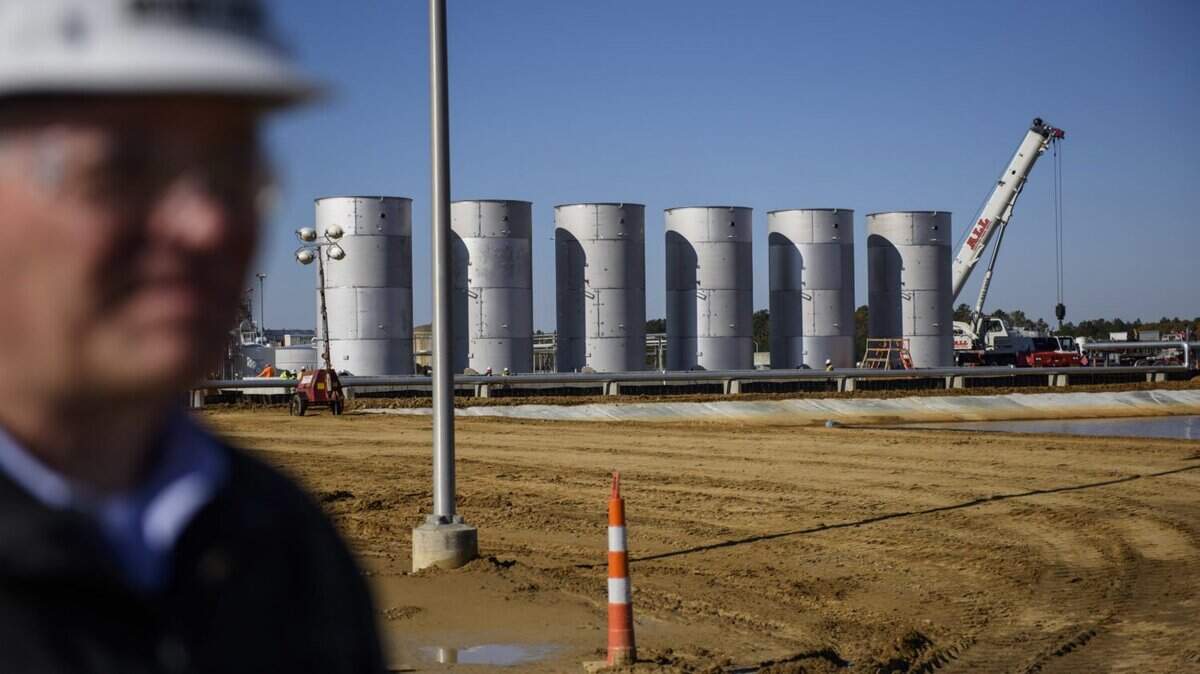
On Wednesday, the U.S. Department of Justice announced a settlement with the Delaware chemical giant Chemours for polluting per- and polyfluoroalkyl substances, better known as PFAS or “forever chemicals,” at three principal sites across three states — including the Fayetteville Works plant in Fayetteville.
From the early 1980s to 2017, the company (part of DuPont for most of those 37 years) discharged wastewater that contained GenX, a chemical now used to make plastics. GenX got into the Cape Fear River, which flows southeast from Fayetteville and supplies drinking water to hundreds of thousands of North Carolinians.
The state was not included in the settlement negotiations, N.C. Attorney General Jeff Jackson told The N&O. The deal was instead worked out between Chemours and two plaintiffs — the U.S. Environmental Protection Agency and the State of West Virginia.
So, is this settlement a fair deal for North Carolina? Let’s do a little point, counterpoint:
It’s a good deal: The consent order requires Chemours to pay a $22.5 million penalty and spend $90 million to reduce PFAS discharges across North Carolina, West Virginia and New Jersey over the next 15 years.
It’s a bad deal: If split evenly between the three states, that would mean $2 million a year in North Carolina to reduce “forever chemical” pollution, which top North Carolina Democrats and several environmental non-profits said is far too low. Plus, Chemours gets a dollar-for-dollar reduction (up to 40%) for any cleanup work the states mandate. So future money North Carolina charges Chemours could get deducted from the $90 million fine.
Good deal: Chemours will spend $280 million to “supply clean drinking water for more than a decade” to communities near its facilities in West Virginia and New Jersey. Asked why North Carolina isn’t seeing this money, a DOJ spokesperson told me, Chemours already has to provide clean drinking water to the area surrounding the Fayetteville site under an existing settlement with the North Carolina Department of Environmental Quality.
Bad deal: Chemours doesn’t admit to violating federal law, including the Clean Water Act. “If you have health impacts from drinking 40 years worth of PFAS, then you know this consent order does nothing to consider what Chemours’ responsibility might be there,” Kemp Burdette, the Cape Fear Riverkeeper, told me.
Good deal: Chemours will establish further PFAS pollution controls at Fayetteville Works for 15 years “based on recommendations from a third-party engineering firm.” The company must also prevent the release of the chemical compound GenX in Fayetteville at a 99% efficiency rate or higher.
Bad deal: 15 years is a fairly long time horizon for Chemours to spend $90 million to mitigate PFAS discharges, some may argue.
Good deal: “This first comprehensive federal settlement against a major PFAS manufacturer delivers on the Trump administration’s promise to make polluters pay and stop PFAS contamination at the source,” said Jeffrey Hall of the EPA’s Office of Enforcement and Compliance Assurance.
Bad deal: “Our state is ground zero for GenX contamination, but under this deal, North Carolina would receive practically nothing,” Jackson said in a phone interview Wednesday. “And Chemours gets to decide how any little cleanup money we do receive is spent.”
Questionable deal?: In April, EPA Administrator Lee Zeldin selected two Chemours employees to the agency’s 36-member Science Advisory Board. The EPA negotiated the settlement with the company.
Not a done deal?: The public now has at least 30 days to comment on the settlement. Then, it needs court approval. The case was filed in a U.S. District Court in West Virginia.
Fighting the federal settlement might be tough, but the agreement doesn’t preclude North Carolina from taking future actions against Chemours at the state level. “These folks are going to see me in court,” Jackson said.
50 years of SAS M&M’s
SAS institute is about to mark its official 50th anniversary. On July 1, 1976, the software company took over a deep roster of corporate and academic customers from North Carolina State University in an arrangement that almost certainly wouldn’t happen today.
A lot has changed in the past half century — including just last week when SAS cut 300 positions companywide. Its CEO has, over five decades, gone from an ambitious 30-something to the state’s richest resident. SAS, for a time, was the most valuable software business on the planet. It still reports generating north of $3 billion each year. But instead of shipping reels of magnetic tape and thick user manuals, it now strives to keep pace in the age of cloud computing and AI.
The town of Cary had fewer than 22,000 residents when SAS established its local campus in 1980. Today, Cary has (checks math) a lot more people.
But through this journey, there have always been M&M’s. Going back to the company’s very first office on Hillsborough Street in Raleigh, there were M&M’s.
“Two administrative assistants would weekly go to pick up goodies for us,” recalled Michael Camp, one of the first SAS executives. “So on Wednesdays, when they came back, they had a treat, which was M&M’s.”
This Wednesday tradition carried over to the Cary headquarters. Free M&M’s came to represent the broader workplace benefits SAS was known to offer. Yes, there was free childcare. Chef-cooked daily lunches with a pianist playing easy listening tunes. Most employees had their own offices, with doors. No cubicles. Racquetball courts. A bucolic campus with a pond. A 35-hour work week.
But people still bring up the multicolored candy, often. “I’m kind of glad I’m away from those,” said Larry Noe, a retired SAS software engineer whose mother, Jane Helwig, was one of the company’s four founders. “They would disappear pretty quickly.”
In a 2000 article on the company’s vaunted culture, Bloomberg News wrote that “there is more to please employees: a 35-hour workweek and free M&M’s, plain and peanut.” Working five fewer hours every week and getting free candy shared equal footing in that sentence.
From a 2026 perspective, reverence for M&M’s as evidence of an office utopia seems strange. The N&O stocks a candy bowl in our office. Google provides free, catered lunches. I’ve visited Pendo’s downtown Raleigh tower when they’ve had a coffee cart. Several major tech companies offer workers sleeping pods for midday naps.
On-site childcare remains a fairly rare perk of SAS employment, but many of the benefits that are now common at other companies appear to have been pioneered at SAS. Google founders Larry Page and Sergey Brin reportedly reached out to SAS CEO Jim Goodnight when they were starting to build their California campus.
Has SAS retained its workplace charm? “It pretty much stayed consistent as far as the benefits go,” one recently retired employee told me Thursday. He couldn’t recall ever working on a weekend or super late at night.
The 35-hour work week no longer appears to be official policy, with company spokesperson Trent Smith emailing this week that “with more than half of our employees and revenue based outside the U.S., our approach to work is grounded in flexibility, trust and accountability. We empower employees to work in ways that support their teams, customers and business goals while giving them the flexibility they need to do their best work.”
On the M&M’s front, the company switched during COVID from offering them in bulk to having individual packages. And they’re in every break room on campus, Smith said.

Clearing my cache
- From 18% to 11.6%, Duke Energy lowered its residential rate increase request after months of public criticism. The N.C. Utilities Commission will ultimately approve, modify or reject Duke’s proposal before new rates go into effect Jan. 1, 2027. The commission is scheduled to begin hearing expert witnesses in the case on July 7.
- Pullets are girls, cockerels are boys: American pharma giant Merck will expand its Triangle presence by acquiring Raleigh AgTech startup Targan, which uses software to gender young chickens.
- Maybe that battery factory will come after all: Following delays at its dormant Morrisville site, Colorado startup Forge Nano announced a partnership with South Korea’s Samsung SDI to make battery cells in the Triangle. Forge said local manufacturing should begin in 2028.
- 100 jobs to Raleigh? Apex-based video communication provider LiveSwitch says it will hire that many new local workers to support growth. These jobs will be open to employees who have experienced the justice system; LiveSwitch founder Brian Hamilton also started a nonprofit called Inmates to Entrepreneurs.
- JetZero cut the ribbon last week on what promises to be a 14,500-worker (!) manufacturing hub in Greensboro. Can the company disrupt the Boeing-Airbus duopoly and attract defense contractors with a unique airplane design?
- Raleigh’s Aston Power raised $20 million to develop a power delivery model for data centers. “AI is changing infrastructure requirements faster than the traditional power industry can keep up,” the startup’s CEO Greg Robinson said in a statement.
- Already a big Granville County employer, Altec Industries this month began a $100 million, 200-job expansion at its Creedmoor industrial equipment campus. Altec is the second-largest private hirer in the rural county north of Raleigh, after Food Lion.
- One more startup exit: Durham healthcare tech company Validic is getting bought by South Carolina chronic care management provider ChartSpan. Founded in 2010, Validic counted Mark Cuban as a prominent early investor, The Triangle Business Journal noted.

National Tech Happenings
- The indie, hipster-loving movie studio A24 will see a $75 million investment from Google to study AI film and distribution tools.
- China has the world’s fastest computer, reclaiming the title for the first time since 2017. Its winning supercomputer notably only uses standard microprocessors, not graphics processing units.
- Quantum computing will change our lives… if it ever comes to be. A new peer-reviewed paper in the journal Nature cast doubts on breakthrough claims Microsoft made last year about the theoretical scalability of “topological qubits.” Microsoft pushed back on the paper’s findings.
Thanks for reading!
This story was originally published June 26, 2026 at 10:02 AM.