COVID vaccine live updates: Here’s what to know in North Carolina on Sept. 13
We’re tracking the most up-to-date information about the coronavirus and vaccines in North Carolina. Check back for updates.
More than 5,300 new cases reported
At least 1,303,390 people in North Carolina have tested positive for the coronavirus, and at least 15,247 have died since March 2020, according to state health officials.
The N.C. Department of Health and Human Services on Monday reported 5,346 new COVID-19 cases and added 172 coronavirus-related deaths. State health officials don’t specify the dates on which newly reported deaths occurred.
The state health department said it experienced a technical issue on Thursday that “prevented some laboratory data files from being processed in the NC COVID reporting system.”
“As a result, cases and test data are lower for Friday, Sept. 10 than they would have been had all data been processed,” the health department said. “Data reported on Monday, Sept. 13 will be higher as it will incorporate cases that were intended to be submitted on Friday, Sept. 10.”
At least 3,514 people were hospitalized with COVID-19 as of Sunday, the latest date for which data is available, including 894 who are being treated in intensive care units, health officials said.
As of Saturday, 11.8% of coronavirus tests were reported positive. Health officials say 5% or lower is the target rate to slow the spread of the virus.
Roughly 67% of adults in North Carolina have received at least one dose of a coronavirus vaccine, and about 62% have been fully vaccinated. State officials round vaccination numbers to the nearest whole number.
Parents buy air purifiers for NC schools
Parents are buying air purifiers for Wake County schools because the district won’t shell out for them, The News & Observer reported.
The air filtration systems have been put in classrooms and cafeterias to help combat COVID-19. But some think Wake should take responsibility for installing them so less-affluent schools won’t be at a disadvantage.
“There are parents that are not going to be able to provide funds to do this,” Rebecca Schuster, a parent at Buckhorn Creek Elementary School in Holly Springs, told The N&O. “There are schools that are not going to be able to afford this. What happens to those kids?”
UNC’s Rex hospital puts up tent outside ER
UNC Rex hospital has put up tents under a vestibule outside its emergency department to be used when the waiting areas fill up amid an influx of hospitalizations.
“I’m hoping that we don’t have to use them,” said Kim Boyer, director of emergency services. “But we want to be able to take care of the community. When we’re so backed up and overflowing, it’s hard to do that. We just need some extra space.”
The so-called triage tents were first erected in the spring of 2020 but came down after demand died down, The News & Observer reported. Now they’re back as hospitals struggle to juggle both COVID-19 patients and regular patients.
“For the times when we suddenly have an influx of patients, we really just need more capacity, more space, so people aren’t out in the waiting room for hours waiting for help,” said Dr. Lisa Pickett, chief medical officer at Duke University Hospital.
Duke put up two tents in its ambulance bay early last month.
Harris Teeter changes shortens hours
Harris Teeter announced Monday it will shorten its hours as the coronavirus pandemic continues.
All stores will operate from 6 a.m. to 9 p.m. starting Wednesday. The service, meat and fish counters will close at 8 p.m., The Charlotte Observer reported.
The grocery chain said the move was spurred by a labor shortage during the pandemic. A company spokesperson said closing early will help “manage labor in this difficult employment environment.”
Charlotte zip codes see lower COVID rates
Coronavirus case rates in nearly all Mecklenburg County zip codes showed a decrease for the first time since early June, according to an analysis of local data.
The countywide average number of new cases per 100,000 residents fell from a rate of 693.8 to 618.1 from Aug. 26 to Sept. 8, The Charlotte Observer reported.
Just two zip codes saw an increase in case rates, including uptown (ZIP code 28202) and an area of West Charlotte (ZIP code 28208). Another two zip codes saw no change in case rates.
Davidson, or ZIP code 28026, has the lowest concentration of new cases.

Madison Cawthorn brings anti-mask campaign to Johnson schools
U.S. Rep. Madison Cawthorn plans to protest at Tuesday’s Johnston County school board meeting, where members are expected to vote on a continuation of its current face mask mandate in schools.
Some critics of the mandate hope Cawthorn’s presence will help convince the board to reverse its earlier decision, The News & Observer reported.
“Any time a high-profile person comes in and stands behind a large group of citizens, if you don’t listen you’re making a mistake not paying attention,” said Dale Lands, co-founder of Citizen Advocates for Accountable Government. “Madison Cawthorn is not going to just show up. This is an issue of personal freedom.”
Raleigh cemetery offers chance to mourn
Oakwood Cemetery in Raleigh created the Grove of Remembrance to allow families and loved ones a place to mourn those who died during the COVID-19 pandemic.
Four crepe myrtle trees stand side-by-side in the grove. Families have tied colored ribbons to the trees with the names of those they lost with a message, The News & Observer reported. But not all of them died from the virus.
“Families who’ve experienced a loss this year, whether it was COVID or not, were not really able to come in large numbers and remember,” said Robin Simonton, the executive director of Oakwood. “We wanted to give families, whether you were buried here or not, whether you died of COVID or not, their families a chance to come and remember.

How effective has SlowCOVIDNC app been?
North Carolina’s contact tracing app SlowCOVIDNC was introduced more than a year ago, but few who downloaded it have reported a positive case.
The app was designed to notify close contacts if they were exposed to the coronavirus. About 9% of the entire state’s population had downloaded it as of Sept. 9, and just 1,176 people reported a positive case using the app.
Health officials said that led to about 3,153 exposure notifications.
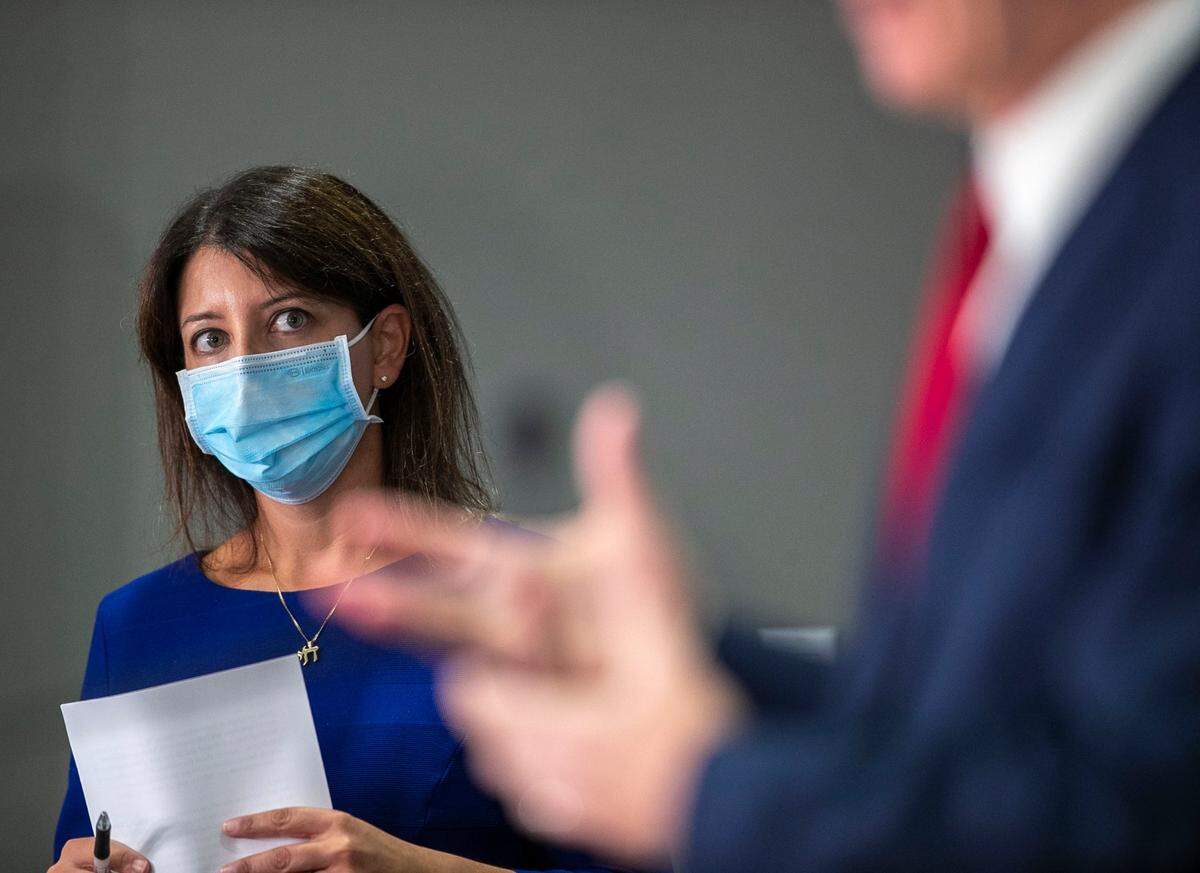
“It’s definitely more limited in terms of its effectiveness because of how many people have downloaded it,” said Dr. Mandy Cohen, secretary of N.C. Department of Health and Human Services.
Charlotte parents unhappy with mask exemptions
Dozens of parents with children who attend Catholic schools in the Charlotte area have filed complaints with the Mecklenburg Health Department about how school leaders are implementing the county mask mandate.
Gibbie Harris, Mecklenburg County Public Health Director, and county commissioners said at a meeting last week they have received numerous emails from concerned parents, The Charlotte Observer reported. Some are upset their child’s school is permitting exemptions to the mask requirement without a doctor’s note or medical excuse.
The head of local Catholic schools has said campuses are following the mask order and allowing exemptions in accordance with the county’s rule, The Observer reported.
“(We’ve had) conversations with several of the different principals,” Harris told commissioners at the meeting. “We continue to work with them. Some are more receptive than others — I’ll put it that way. But we do feel we have the support of the (Catholic) diocese at this point.”
More than 60 outbreaks, clusters ongoing in Triangle
Counties in the Triangle continue to report COVID-19 outbreaks and clusters sparked in part by the delta variant.
Wake County, the most populous county in the region, had 24 ongoing coronavirus outbreaks and 21 clusters as of Thursday, the latest date for which data is available, according to the state health department. In Durham County, 12 outbreaks and three clusters were ongoing. Orange County reported three ongoing outbreaks and two clusters.
The state health department defines an outbreak as two or more positive tests among staff or residents in a congregate living center and a cluster as five or more cases in a child care or school setting that can plausibly be linked together over a 14-day period.
More information on where the outbreaks and clusters were reported can be found here.
School district ends contact tracing, most quarantines
The Union County school board voted 8-1 early Monday to immediately stop COVID-19 contact tracing and significantly loosen coronavirus quarantine requirements, The Charlotte Observer reported.
The district will not require students to quarantine if they’ve been in contact with someone who is sick. Students must stay home only if they’ve tested positive for COVID-19 or if they have clear symptoms of the virus. The change is effective immediately, Melissa Merrell, the board chairperson, told The Observer.
Recently, thousands of Union County students were in a proactive quarantine after being possibly exposed at school.
Parents reacted to the vote with “anger and fear,” according to The Observer.
“So they’re doubling down on the entire mess they’ve let their schools become,” one parent tweeted. “No better way to show you care about the health and safety of children by making them (even) more unsafe.”
Vaccine requirements for Triangle first responders
Local governments and employers have started adding COVID-19 testing and vaccine requirements for employees.
But in the Triangle, municipalities have varying requirements for first responders. Many are leaving coronavirus vaccination optional for police officers, EMTs and firefighters, while some departments require their employees to be vaccinated or tested regularly, The News & Observer reports.
A list of what different agencies throughout the Triangle require can be found here.
Julie Swann, an N.C. State University professor, told the N&O that first responders are at an inherent risk of exposure to the virus, due to interacting closely with the public, and that there are many reasons why first responders should get the shot to protect themselves and those they interact with.
“First responders do not get to completely choose with whom they interact on a given work day,” Swann said. “So they are at greater risk of being exposed to infectious or communicable diseases.”
This story was originally published September 13, 2021 at 12:36 PM.