
On Night 5 of protests, Raleigh police chief comes out to hear protesters’ concerns
Raleigh’s fifth straight day of protests against police brutality started early Wednesday afternoon with peaceful marches and speeches, and ended with a few dozen people voicing frustrations with Police Chief Cassandra Deck-Brown more than hour after the city’s 8 p.m. curfew.
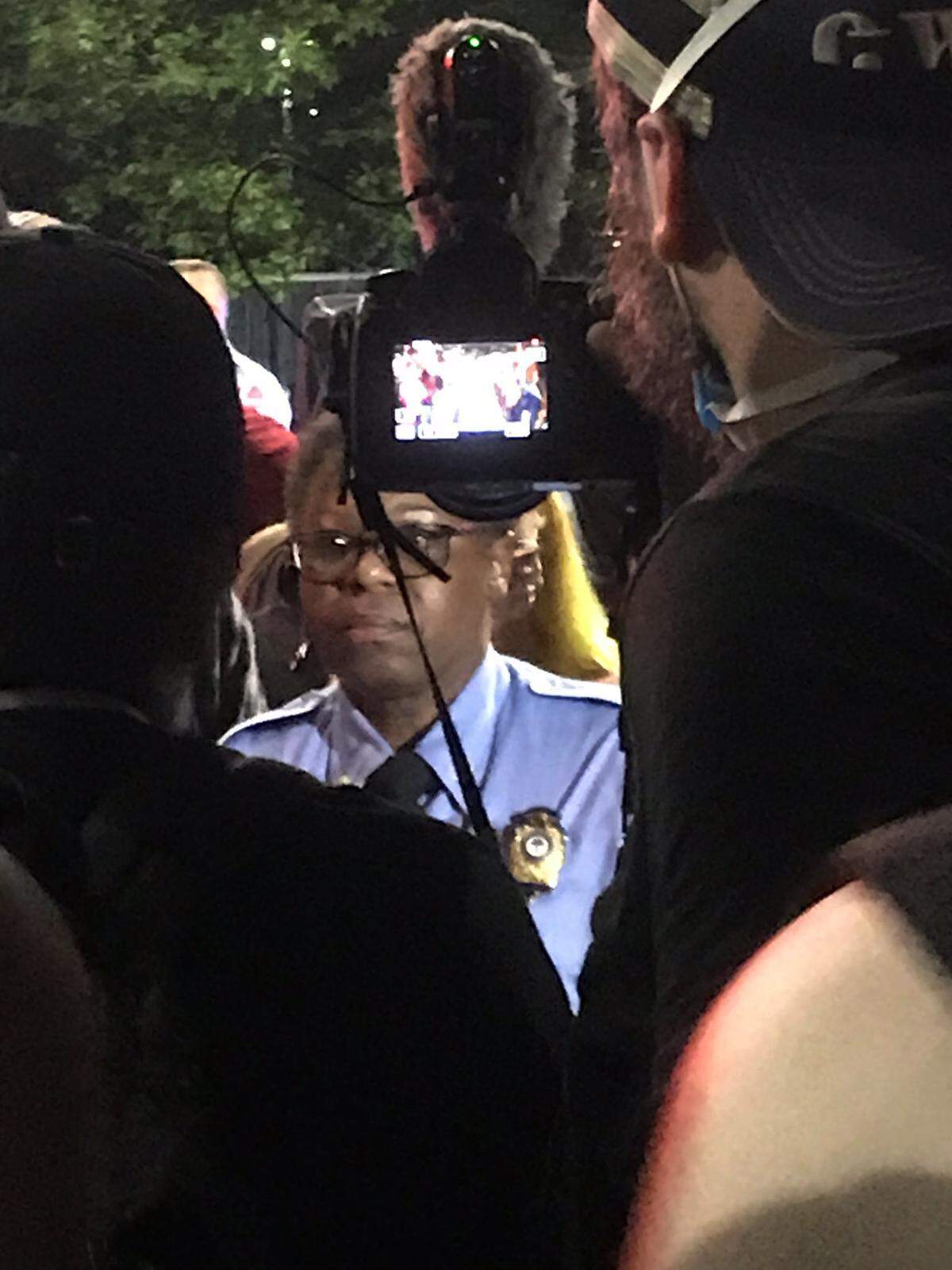
As Deck-Brown approached Capitol Square with both hands raised, the group of young people surrounded her to ask for leniency on the curfew and for more accountability from the police department.
The group repeatedly — and loudly — asked to be able to finish their protest, to be allowed to march until 10 p.m. At one point Deck-Brown told them that, “walking around and yelling doesn’t get us anywhere.”
“We’re not trying to go to jail,” they said. “We want justice.”
Deck-Brown negotiated with them and they compromised, agreeing to disperse at 9:45, heading off to march while chanting “No justice, no peace.”
It all started around 2 p.m., when about 150 protesters gathered at Nash Square before marching several blocks through downtown with a police escort, heading to the Governor’s Mansion. There they called on Democratic Gov. Roy Cooper to hear their concerns.
A crowd gathered there and continued to grow as they asked Cooper to speak with them outside.
Wednesday was the third day of Raleigh’s citywide curfew, which came after a weekend of peaceful protests turned destructive and police used tear gas, pepper spray and rubber bullets to try to disperse crowds.
Marches were held in Durham and Chapel Hill on Wednesday as well, making sure to honor George Floyd, who died after a Minneapolis police officer kneeled on his neck. The officer who kneeled on Floyd has now been charged with second-degree murder. Three other officers at the scene also were charged Wednesday.
In Raleigh, groups chanted through downtown, but also used other ways to express themselves.
In Moore Square, near City Market, a group called Young Americans Protest organized a demonstration centered around using art to speak out against injustice.
And social media posts showed that hundreds of people also lined Hillsborough Street from Pullen Memorial Baptist Church to Capitol Square earlier in the day, forming a silent protest chain along the sidewalk and from front porches.
Protesters placed signs around the Confederate Monument at the capital and said a prayer for change.
Conversation with police chief
After Deck-Brown agreed to allow protesters keep marching, most went on their way. But the police chief continued to speak with Joseph Mbemba of Durham and Bryan E. Riddick II of Johnston County about the importance that everyone follow rules if they want a seat at the table.
Deck-Brown said they had leadership qualities and urged them to use that “for the right cause” instead of protesting.
“If you want to have a voice at the table, you gotta recognize what the rules are,” she said.
“We just want to work together,” Mbemba told Deck-Brown.
Mbemba, however, said later that while he understood the chief’s point of view, he said there was no chance the two of them ever would have had that conversation if people hadn’t been marching.
“We’re just feeling like the people who hold the positions of power, positions of leadership, weren’t listening,” he said in an interview.
In general, the vocal but peaceful tone was similar to Tuesday’s protests, when most of the crowd left downtown around 8 p.m., as the curfew took effect. Tuesday, about 100 stayed behind to sit in front of the Governor’s Mansion. They marched through downtown, eventually dispersing by 10 p.m.
The Wake County Sheriff’s Department reported one arrest Wednesday night. Nicholas Barker of Cape Carteret was charged with RDO (resisting, delaying or obstructing an officer) and impeding the flow of traffic, for refusing officers’ commands to move his motorcycle out of the middle of the intersection at Salisbury and Martin Streets.
Two arrests were reported for Tuesday night, both for curfew violations — one from Raleigh Police and one from Wake County Sheriff’s Department.
Demands for the governor
Wednesday’s gathering, organized by N.C. B.O.R.N (North Carolina Building Our Revolution Now), aimed to express concern over Cooper’s decision to mobilize the North Carolina National Guard earlier this week at the request of city officials.
One of the stated goals of N.C B.O.R.N. is to “create and support and prioritize a new generation of North Carolina leadership that reflects and represents the interests of North Carolina communities, especially those that are disproportionately affected by racism.”
More than two hours into their sit-in Wednesday on the street in front of the mansion, protest organizer Taari Coleman took to a megaphone to accuse Cooper of being a coward for tweeting his support for marchers but not coming to talk to them in person.
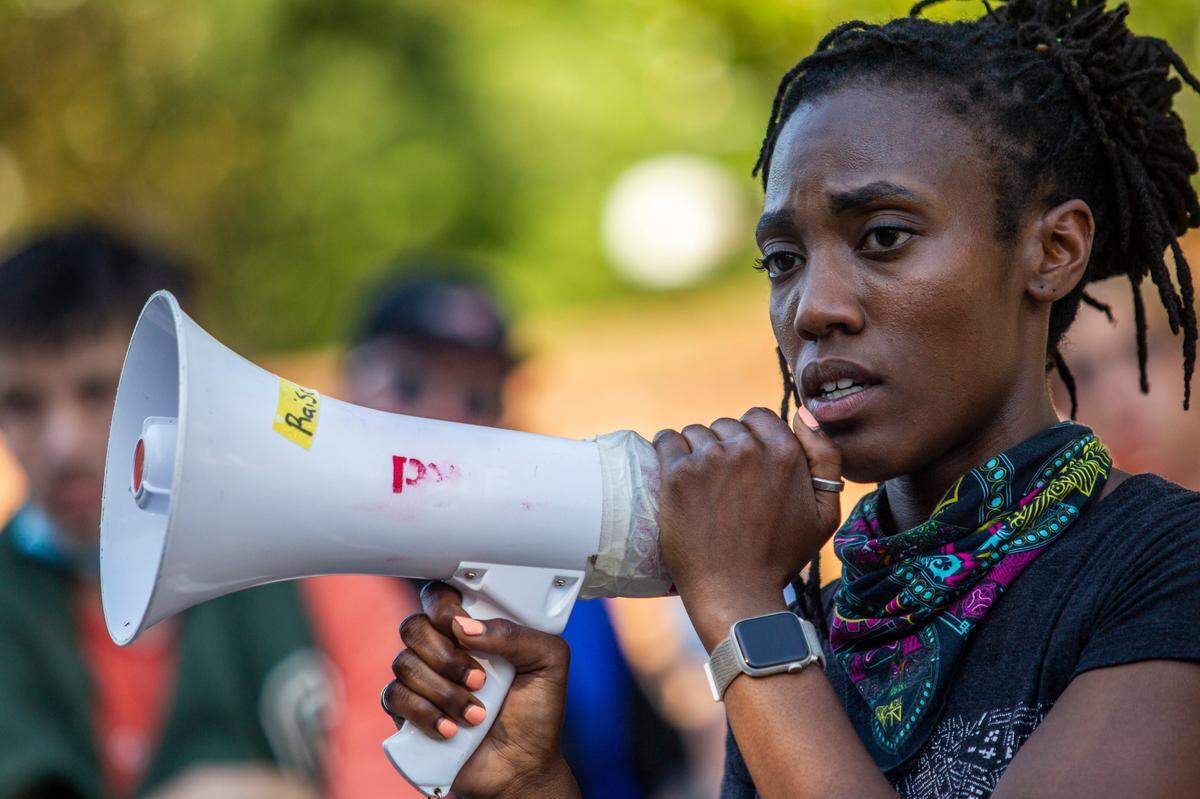
“You would rather talk to Twitter than talk to your constituents, when we’re literally the people who put you in that house,” Coleman said. “But you would rather type 100-240 characters for strangers than listen to us. What kind of justice is that? It’s not.”
Another protester then led the crowd in a call-and-response chant: “What do we want? Roy! When do we want him? Now! If we don’t get him? Kick him out!”
Monday evening, Cooper marched and spoke briefly with some protesters outside his residence before Raleigh’s curfew went into effect, thanking them for coming out. Republicans criticized him for partially removing his face mask to address the crowd, and for not following six-foot social distancing guidelines.
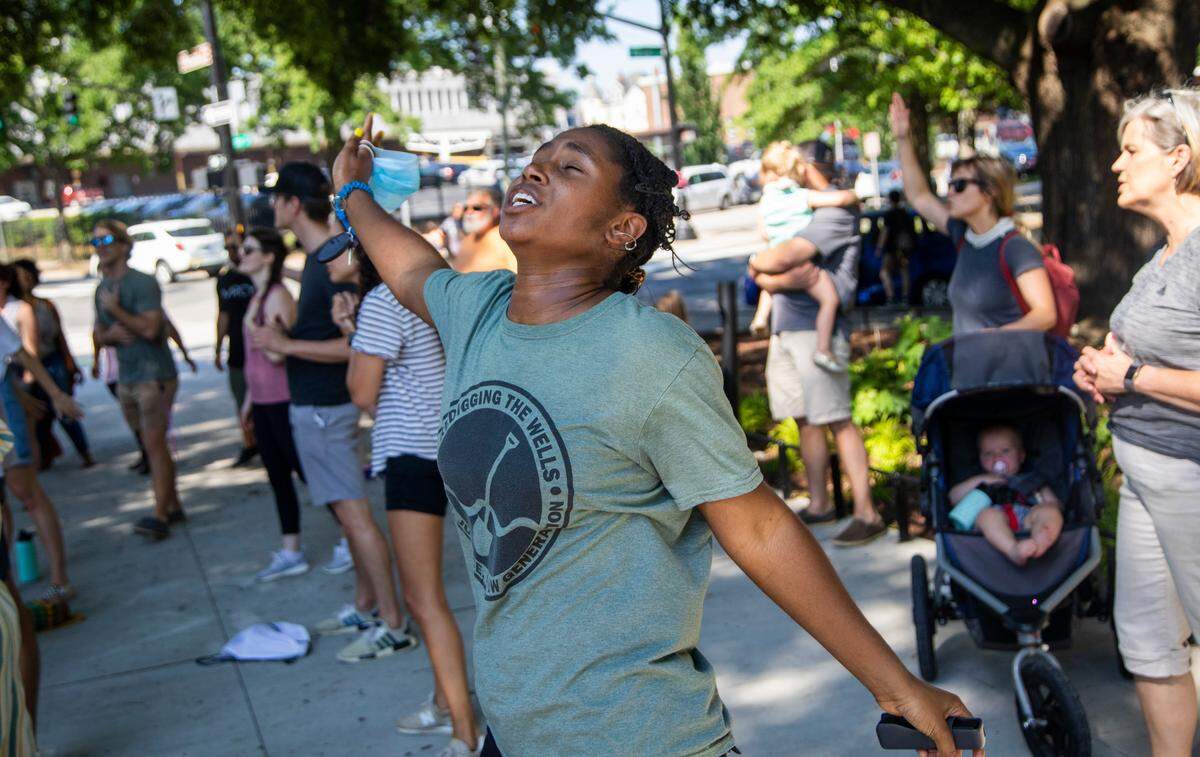
Around 5 p.m. Wednesday, Coleman asked protesters to check in with themselves and their neighbors. She encouraged them to introduce themselves to those alongside them.
“Know who is standing next to you,” Coleman said. “Know who is fighting with you. Know who is sick and tired of this nonsense too.”
When Coleman finished speaking, protesters turned to each other, asking each other about their names, pronouns and why they were there.
Coleman talked individually with the protesters, specifically those who have lived in Raleigh for more than eight years.
“I wanna know what you’ve seen,” she said. “I wanna know what you want to do. If you have aspirations of going into politics, come find me.“
After leading the group to Nash Square around 7 p.m., Coleman said they’d be back Thursday afternoon to do it again. Coleman headed home before 8, but others walked to Capitol Square, where they said they intended to break curfew.
A fight for justice
Brian Bullock, a pastor at World Overcomers Christian Church in Durham, told the crowd that they would keep fighting and pushing for justice.
“We are not asking for special treatment,” he said. “We are asking that when we go in for a job that we are seen beyond the color of our skin. That when we go to a bank and ask for a loan that you see beyond the color of our skin. We ask that when we commit a crime that you would try us in a courtroom and not on a sidewalk. We are asking just to be treated equal.”
Bullock’s church brought out a contingent of a few dozen people in matching shirts. He said some have been protesting on their own individually, but they wanted to come out Wednesday as a unified group.
One young woman in the group was carrying a sign that said, “I am not a thug.”
Bullock said people need to stop using that word. To some people, he said, it makes it seem like police brutality against these protesters, or anyone who looks like them, is warranted.
“When you call someone a thug, you dehumanize them,” Bullock said. “It justifies brutality. It justifies mistreatment.”
Vance Haywood, pastor at St. John’s Metropolitan Community Church in Raleigh, attended protests on Sunday, Monday and Wednesday.
“The protests I’ve been at have been largely moving, seeing young people unifying their voice to demand change,” he said. “I come in support. They asked me to speak today and I did ... They are clearly putting together some demands and requests. They are asking for real change.
“We as clergy come out to say the church is behind this,” Haywood continued. “We demand justice for black people, brown people, LGBTQ people, justice for everybody.”
Tony Bumba, one of the protesters at the Governor’s Mansion, said that he has attended every protest in Raleigh since Saturday.
“It is heartbreaking,” he said. “We’re sitting at home watching videos of these murders. Americans are experiencing grief right now. We cannot sleep as long as this continues.”
Dianna Dames said she thought about going to the weekend protests but was afraid of getting tear-gassed. But she said couldn’t just keep doing nothing. She emailed her boss and asked if their company might consider donating to Black Lives Matter causes, and then she headed out to the protest Wednesday.
“I’m not confrontational, but here I am at a protest, and I emailed my company,” said Dames, who is black. “It’s time.”
Jamaal Lutes of Raleigh also protested Wednesday, saying he was marching for his friend Akiel Denkins, killed in a police shooting in Raleigh in 2016.
“They killed an innocent man because he was running,” said Lutes, after he and other protesters carrying Black Lives Matter signs stopped in front of the governor’s mansion. “I seen it.”
According to Raleigh Police Chief Cassandra Deck-Brown at the time, Officer D.C. Twiddy had attempted to arrest Denkins for failing to appear in court on a felony drug charge. A report from the department said Denkins pulled a gun during a struggle with Twiddy. A preliminary autopsy showed Denkins was shot in the chest, arms and shoulders, and Twiddy was cleared.
Lutes said he doesn’t think there should be police at all, and that local communities can police themselves.
Lutes, a young black man with tattoos covering his arms, said he has been stopped by police many times just because of how he looks.
“I’m here to march to tell them I hate them,” he said. “... The police were created to go after African-American slaves back in the day, and they still hunting us.”
Using art to speak against injustice
At Moore Square, people sat on the lawn in circles drawn on the ground, spaced for social distancing. Some members of the group did interpretive dance and others sang “Lift Every Voice and Sing.”
Jasmine Stanley, one of the organizers, said the purpose of holding the event in Moore Square was to reclaim a public space and to give community members a place to use artistic expression as a form of protest.
“I’m a firm believer in movements like these to fuel social change,” Stanley said.
Stanley said she and others organized the protest through connections she had made through the Poor People’s Campaign.
The group listed their demands on a cardboard cutout. Among the demands, a call to defund the police and reallocate the funds to “community-led health and safety strategies.” Stanley said they formed the list from demands from other social justice groups.
Chapel Hill and Durham protests
Across the Triangle in Chapel Hill, a few hundred people — college students, young children and grandparents — gathered on the UNC campus for a peaceful Black Lives Matter protest before then marching through town.
The protest took place on McCorkle Place, the spot on campus where the Silent Sam statue stood for years. Protesters tore the statue of a Confederate soldier down in 2018.
In Durham, hundreds marched to the police headquarters as part of another night of peaceful protests there. The marchers said the protests of the past week had gotten the world’s attention, but that they need to keep pressing to make sure their message leads to action.
Durham mayor Steve Schewel said he has no plans to impose a curfew there.
This story was originally published June 3, 2020 at 6:42 PM.