
40 years of Pride in Durham: History of a moment that ignited a city’s LGBTQ movement
On April 12, 1981, Ronald Antonevitch was brutally attacked by a group who thought he was gay.
Antonevitch, known as Sonny, had been at a sunbathing spot with at least three others on Little River in North Durham. The attackers shouted homophobic slurs and beat him, causing injuries to his head and kidney, according to an LGBTQ history exhibit at the Durham County Library.
Three days later, Antonevitch, 46, died of his injuries in the hospital, and his murder ignited a movement that goes on today.
On June 27, just a few months after his murder, about 300 people marched through downtown Durham holding banners and signs for “Our Day Out,” a demonstration for gay and lesbian rights.
“This is a march that doesn’t get talked about a lot in the kind of memory, history and mythos of gay pride in Durham,” said Mab Segrest, one of the march organizers in an interview.
But the political events surrounding the murder at Little River helped precipitate “Our Day Out,” which eventually led to years of annual Pride events in the Triangle.
That first march, along with a political battle for gay rights in 1986, were key events in the beginnings of the state’s LGBTQ history, according to several long-time activists interviewed by The News & Observer.
With the 40th anniversary of Durham’s “Our Day Out” event this year, The N&O asked event organizers about their memories of the fight for gay rights in the ’80s and how those events became turning points for LGBTQ equality in the state.
The N&O spoke with:
▪ Mab Segrest, a lesbian activist and writer, was 32 years old when she helped organize “Our Day Out” in 1981. Now 72, she is the author of “Memoir of a Race Traitor” and other titles.
▪ Allan Troxler, a 74-year-old artist and writer, designed fliers, posters and buttons for the “Our Day Out” march. He is also a dance instructor.
▪ Jim Baxter, 67, was the publisher of the statewide, gay community newspaper, The Front Page. His paper covered the efforts to recall Durham mayor Wib Gulley, in 1986, for signing a proclamation in support of gay rights. He’s now an archivist at the University of Maryland.
▪ Mandy Carter, a co-founder of Southerners on New Ground, helped organize the Triangle Lesbian and Gay Pride March in 1986, one of the earliest official marches in the state. Now 72, she has been an LGBTQ and Black civil rights organizer for over 50 years.
▪ Durham Mayor Steve Schewel attended early Pride marches as an ally. He was a student at Duke University and activist, according to his website, before becoming publisher of Indy Week (then known as the North Carolina Independent), from 1983 through 2012.
Their recollections paint a picture of events that galvanized the fight for LGBTQ rights in the Triangle that continues today.
Interviews were lightly edited for clarity.
Little River attack spurs vigil
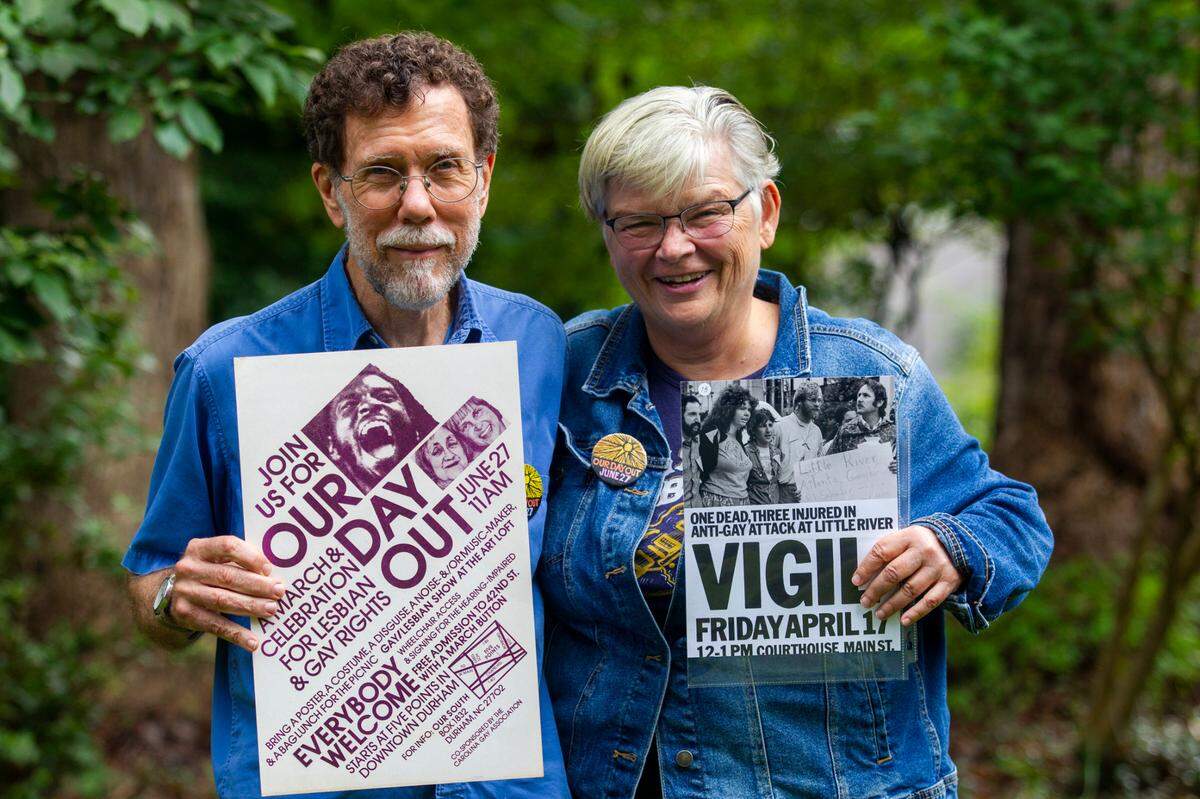
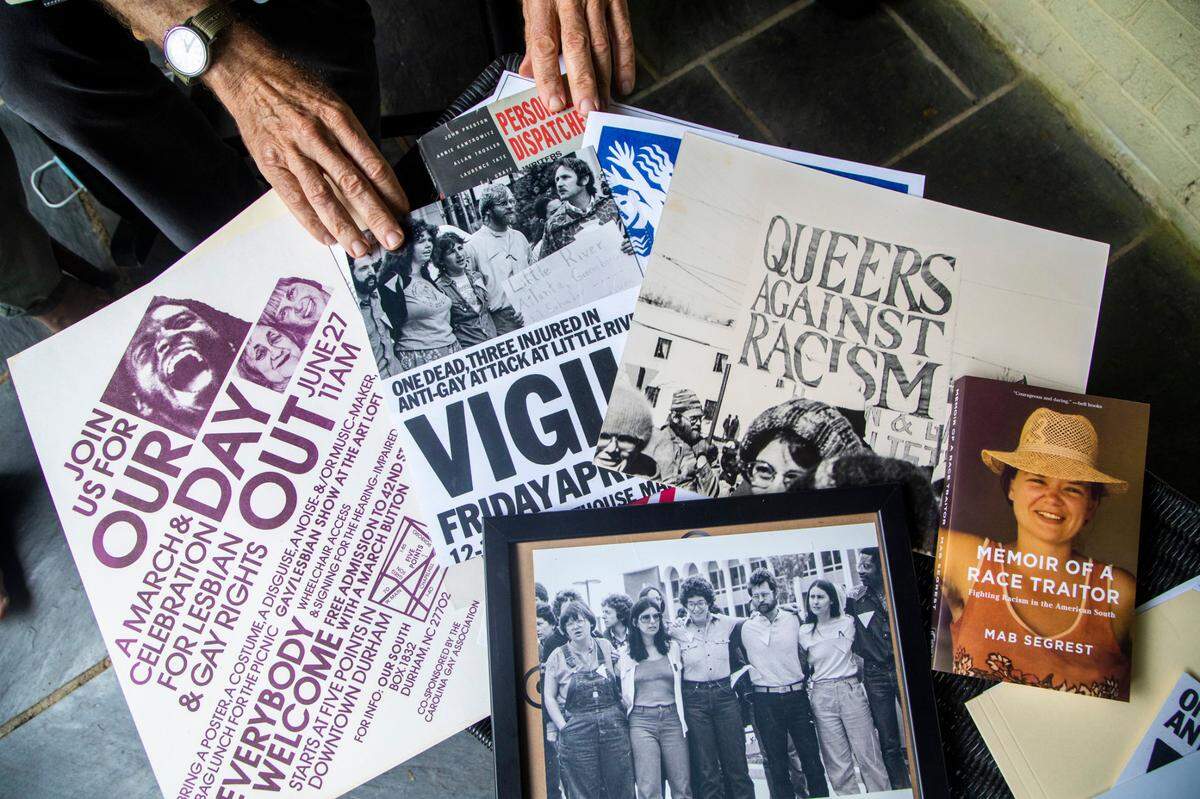
Antonevitch’s murder spurred gay men, lesbians, and allies to gather five days after the attack outside a Durham County judicial building to speak against violence. Segrest and Allan made a flier for the event, in which they connected the hatred leading to Antonevitch’s death to the hatred held by the Nazis and Klansman, who had murdered five members of the Communist Workers Party in Greensboro two years prior.
Mab Segrest: (Antonevitch) had been sunbathing naked, and probably it was a hangout place for gay sex. And so these guys came up and attacked him and beat him to death with a limb from a tree.
Jim Baxter: They assumed he was gay, but none of us knows for sure. None of us knew him. But apparently he wasn’t, you know, sufficiently masculine or whatever, and they beat him so severely.
Segrest: I think that we were making a very emphatic statement as queer people against the violence and conditions of our lives.
Allan Troxler: Within 12 hours, we had gathered friends for a vigil... between the old courthouse, between where the Confederate statue is not now, and then the newer building across the street.
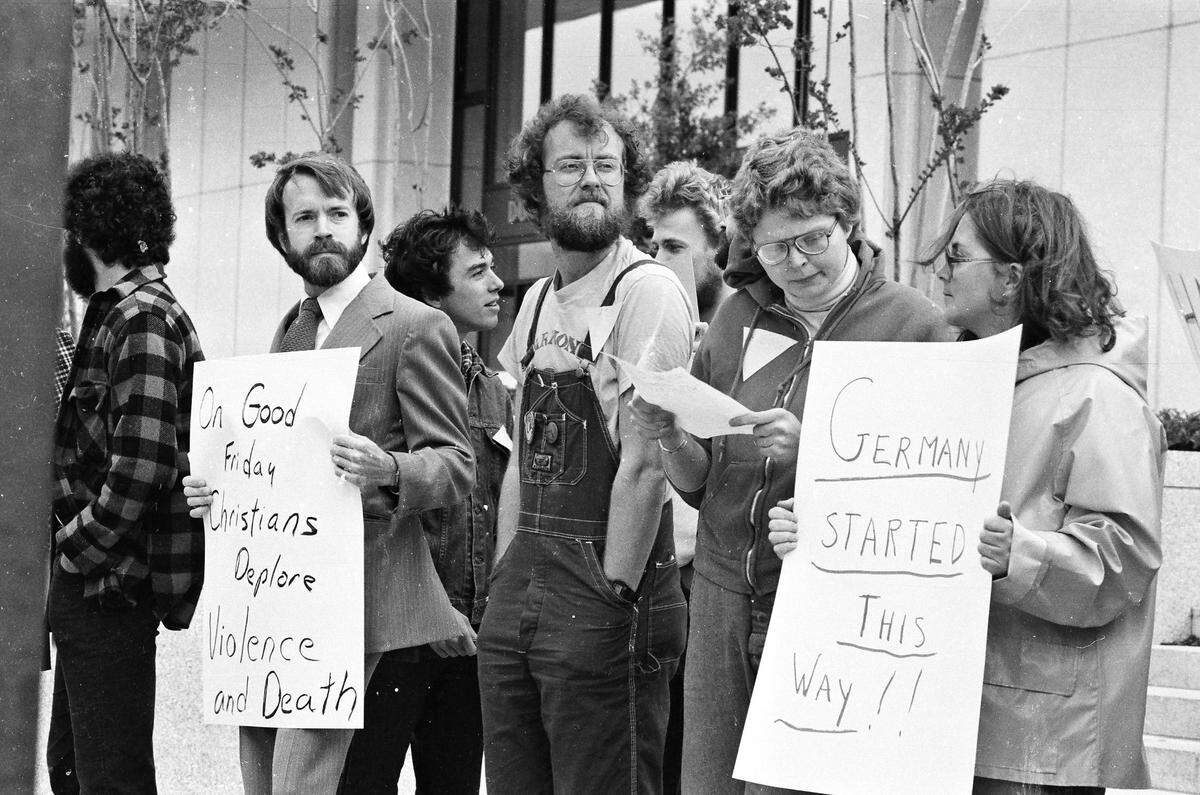
Segrest: There was stuff behind the scenes. There was a letter to the Sheriff expressing concern, that they would take this murder seriously. And then there were people in the courtroom, monitoring the trial when Chris Richardson, who was the person eventually convicted, came to trial.
Baxter: (Antonevitch’s death) had the kind of impact that just makes you look over your shoulder all the more.
Segrest: I think it was important in the context of 1979, the Greensboro massacre... Maybe three or four of them were from Durham and very well known by the community. It was a huge shock to the progressive community. That day, Nov. 3, the Klan rode into our an anti-Klan rally in Greensboro and open fire and killed those people. ...
There was all of this politicization in April around this attack and these murders, and then from that grew the desire to have a gay Pride march.
‘Our Day Out’
Two months later after the vigil at the courthouse, about 300 people marched the downtown Durham loop. Some of the city’s LGBTQ community members and allies say it was the first Pride march in North Carolina, though they called it “Our Day Out.”
Segrest: I think it was kind of a natural segue to go from lamenting a murder to a celebration of our lives. And gay Pride marches had been going on since ‘69, in Greenwich Village and Stonewall and all of that, when drag queens rioted against police brutality.
Mayor Steve Schewel: I was there as an ally. We didn’t have that term then, but my gay and lesbian friends — I just remember being horrified at the tragic event that precipitated the march. I remember it was a very defiant event also, in a good way.
Segrest: Here we were, like 300 people straggled out for one day out. Just give us a day out, you know? But it was a festival, we had art stuff, and it was a breakthrough.
Schewel: What I mainly remember, of all the things I remember, was a woman named Gloria Faley singing in a big, highly voice, a Holly Near song — I’m not sure if this is the title — “It Could Have Been Me.”
Troxler: We did a sort of, as I recall, a kind of ragtag downtown parade march. It wasn’t quite as grim as the vigil had been at the courthouse, but it was still pretty somber.
Segrest: And by then [U.S. Sen.] Jesse Helms was also using us as kind of scapegoats. And he would use that march, actually, to highlight the “dangerous homosexual menace” that was taking over North Carolina.
Mandy Carter: It was the first time that people realized that there was a collection of understanding: who are the citizens of Durham; why this mattered; that who they thought was gay, wasn’t, but he got brutally murdered because of it. But you also had Black folk in Durham that had been murdered. ...
So it’s just, you know how small Durham is. It’s just the size of it. You can’t have one thing happen and not have that reverberate in different parts of the community for different reasons.
First annual Triangle pride march, 1986
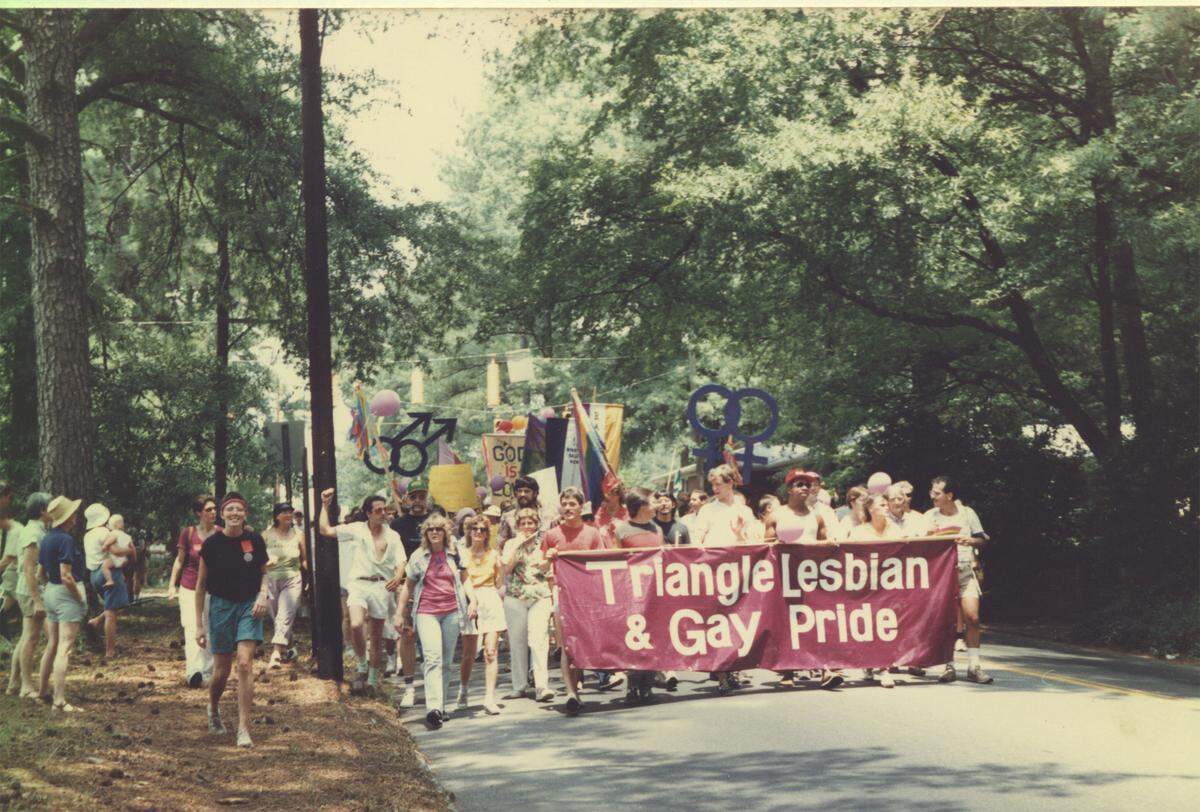
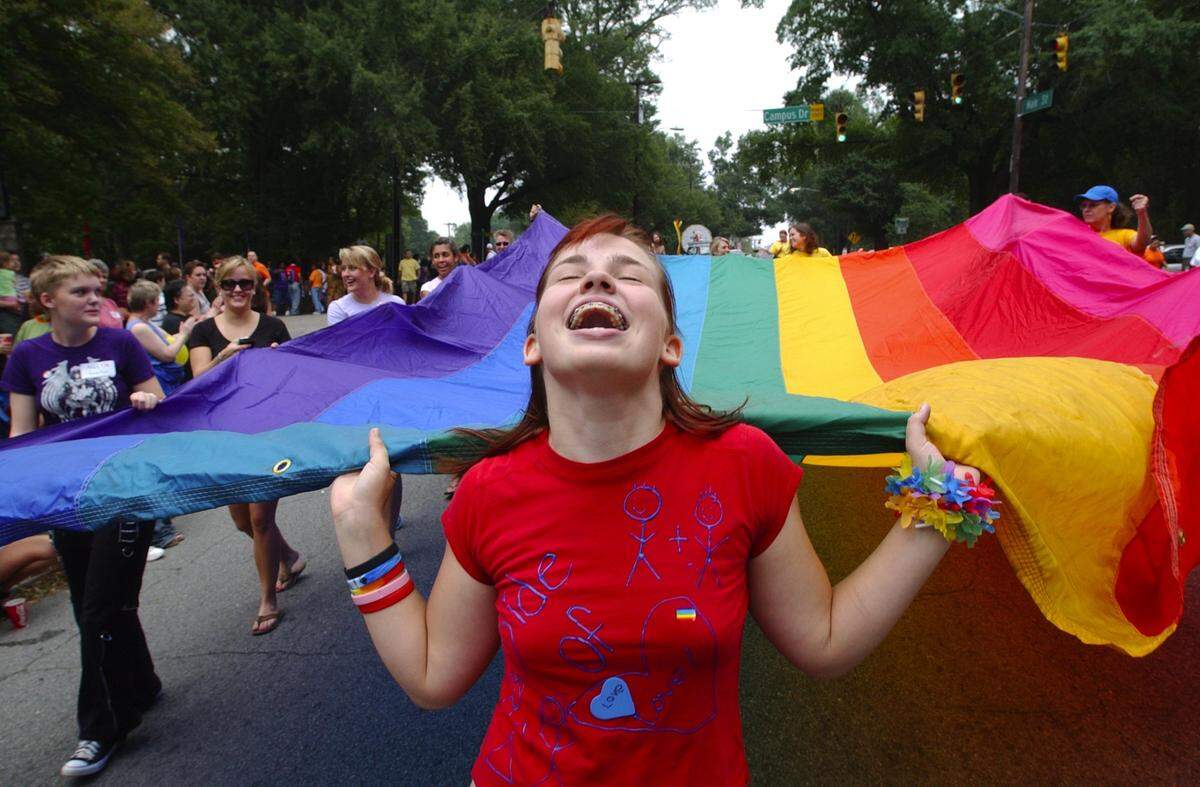
The first annual Pride march for the Triangle came in 1986, and was organized by the Triangle Lesbian and Gay Alliance. Between 600 to 1,000 people marched in the event in Durham on June 28, including straight allies, according to the Durham County library’s LGBTQ history exhibit.
Organizers of the event told The N&O the Ku Klux Klan had been arranging marches in the Triangle around the same time period, and the possibility of the Klan showing up weighed heavily on their minds. The Klan marched in Raleigh a year before, in 1985, The Herald-Sun reported.
Carter: So by the time that (Triangle) march happened — and remember, the Klan was in town the same time we were going to do that march in ‘86 — what one of the biggest concerns was: What would we do if we’re marching down Ninth Street and the Klan were to show up?
Baxter: When we were organizing the very last meeting we had before Pride in ‘86, in this building where Mandy Carter had her offices, the War Resisters League, a bunch of people were sitting around. And. [Pause] Pardon me, it just chokes me. Mab just said, “OK. This is good. We’re all planned. Everything is set up. We march on Saturday,” or whenever.
“What if the Klan shows up? What if they’re shooting? There’s a chance that could happen. Do we go forward?” And we all said, “Yep, we do.”
Carter: We had more police out to protect our march because of the Klan. I mean, it was just such a — you could make a movie about it. I’m getting chills around it now. Nothing happened. But that was a possibility.
Baxter: The Durham police, as I remember it, were very cooperative, and they had a SWAT team on some of the rooftops along our parade route, ready for trouble.
I didn’t carry the banner, that long banner that says “Triangle Lesbian & Gay Pride.” I was right behind it. And I do remember one of the people carrying the march was this very tall, willowy fella, who had his gold Lamé pumps in his back pocket because it was too painful to walk in them. But he planned on wearing them later.
Schewel: I remember it being just brutally hot. And I remember it being very celebratory. I remember being very excited to take my little baby to his first demonstration.
Troxler: When I called to Durham later that night, from upstate New York, I wasn’t surprised to hear about the sweltering heat. What brought unexpected tears was several reports about my folks, over from Greensboro, sitting on the front row in their folding chairs, listening respectfully as some drag queen lip-synced “Where the Boys Are.”
Effort to recall mayor
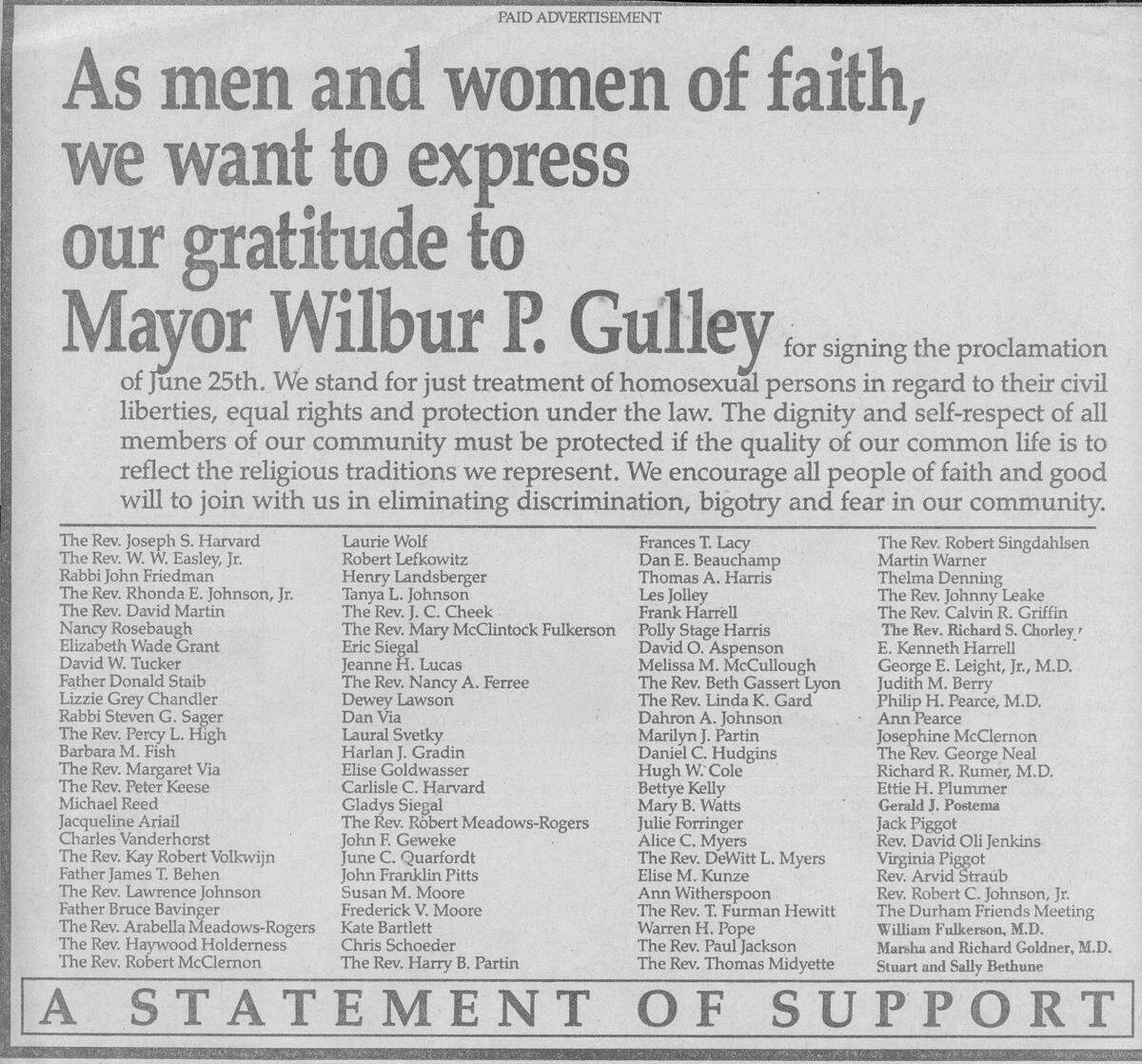
Wib Gulley served as mayor of Durham from 1985 to 1989. Segrest worked worked with Gulley on a public statement in 1986 for the city in support of gay and lesbian rights, which sparked a political battle across town.
Segrest: Wib and I were on the same floor, and we variously had the idea of having a proclamation, that he would sign, in honor of Durham’s lesbian and gay Pride march. So I wrote something up for it.
It basically said gay people are human beings and they’re part of the community and we appreciate that, you know. But in the immediate aftermath, though, there was a huge backlash with a couple of fundamentalist churches.
Carter: A Black church up on Fayetteville Street joined another predominantly white church, and they were going to try to recall Wib Gulley. And the big issue was: Would they get enough signatures in time to recall the mayor?
Segrest: They set up tables in the malls, you know, everything. So we kind of rallied to take that on.
Schewel: Once the recall campaign started against Wib, we started a counter campaign, where we were getting signatures. We were also getting people who had signed to take their names off. That was also part of our strategy.
Segrest: For the first time, I felt like progressive people in Durham embraced queer people, gay and lesbian people, and defended us, and had to defend us on the street corner. ...
They had to get 14,000 signatures, which they came very close to. But by the deadline, they turned them in, they didn’t get the signatures. The recall was defeated.
What’s next in LGBTQ rights?
This year, several Triangle cities and counties expanded non-discrimination protections to include LGBTQ community members, including Durham.
But state lawmakers introduced anti-LGBTQ rights bills this year that, among other things, would have made it illegal for doctors to provide health care to help teenagers transition. The same bill would have also forced school employees to out teenagers to their guardians. The bill did not advance to a floor vote.
Organizers and allies with the Triangle’s early Pride marches told The N&O the battle for LGBTQ rights goes on.
Schewel: You can draw a line between the recall campaign against Wib and the attacks on transgender kids that we’re seeing now, and how those kids lives are being used as political fodder by conservatives in our state and around the country. I mean, to me it’s so disheartening.
Segrest: Gay people were a flash point then and trans people are a flash point now.
Baxter: One of the hardest things for me, is accepting the fact that our hard-won progress, or any hard-won progress across the board, not just the LGBT issues, can be so impermanent. And that hurts. I can’t tell you how much that hurts.
Segrest: One of those anti-trans bills was, this time, about being turned in. I mean, turned in by your parents, turned in by your teachers. Suicide has always been high risk, suicide for gay and now for trans, and also murder, especially for trans women, trans girls, and trans women of color. The struggles continue, as they say, and the stakes are still high.
Carter: I’ve had some people say, “Well, we don’t need Pride anymore, because we already have what we have.” Be careful, because it can come and get taken away, too.
.jpg "Mandy Carter (3).jpg")