Telling the stories of pandemic and protest: NC curators want items to interpret this time
READ MORE
The Long Shadow of Confederate Monuments
A century and a half after the end of the Civil War, the Confederate Army is back on the move, and strategists continue to disagree over where to place statue representations. At least 22 monuments have been taken down in North Carolina. Some have been reinstalled and others have been locked away. As the movement to remove the statues has grown in recent years, North Carolina officials face legal and ethical questions about what to do with them. This is The N&O’s special report.
Expand All
The long shadow of Confederate monuments and what NC should do with them
Do Confederate monuments fit with NC’s Museum of History mission? Not really
Telling the stories of pandemic and protest: NC curators want items to interpret this time
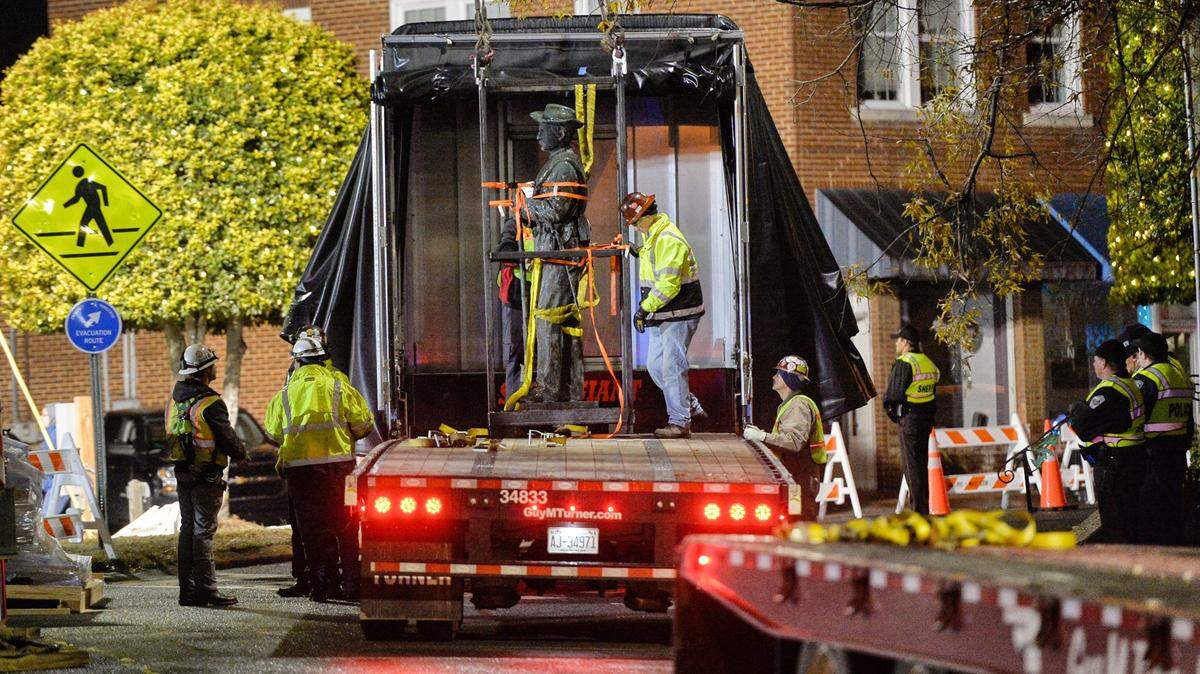
NC officials have taken down over 20 Confederate monuments recently. Here’s where
Future North Carolinians who didn’t live through the pandemic or the protests sparked by George Floyd’s murder will need to understand the experiences of those who did.
The Museum of History and the State Archives are gathering the narratives and the bits and pieces of daily life that will help tell the state’s big stories of 2020 and 2021: social unrest and the COVID-19 pandemic. Telling residents that “Your Story is North Carolina’s Story,” the two agencies are asking for personal accounts and oral histories, photos, audiovisual materials and other documents, along with everyday items that future curators might use to give a sense of what it was like to live through these times.
It’s called rapid response collecting, and it’s part of a relatively new curatorial movement that recognizes the value in saving items at the moment of their importance rather than hoping decades later that someone thought to save them.
“We’re looking for things that are indicative of the change that happened in 2020 and 2021, so that people who come after us will be able to interpret how life changed,” said Raelana Poteat, chief curator of the N.C. Museum of History. which typically deals in 3D kinds of artifacts. “We’re just trying to be good stewards.”
Traditionally, museums and archive repositories collected artifacts and documents from the past — often the dusty, far distant past — as gifts from people whose families passed them down, or from treasure hunters who found them in attic trunks or junk shops.
While the items might be rare, lovely or valuable, taken out of their context, they aren’t necessarily historically meaningful.
History in everyday items
In recent years, Poteat said, North Carolina curators have focused more on gathering items that were made or used in the state and can be directly connected with life here.
For instance, Poteat said, curators have wished their forebears had thought to stash away more artifacts and documents from the 1918 flu epidemic, which claimed the lives of nearly 14,000 North Carolinians. The first known case was in Wilmington on Sept. 19 of that year, historians say. In its collection, the Museum of History has the Red Cross head gear of Wilmington nurse Pauline Williams, along with a scarf and mask she wore, and a bottle of Vick’s medicine made in the state.
“We don’t have as many things as we would like to tell that story in more depth,” Poteat said. ”Thinking back to that has made us very aware of wanting to collect more and varied items for the future telling of the story of this pandemic.”
Those could be items that, at first, seemed foreign or unusual but over the course of the pandemic have become mundane. Disposable or homemade masks. Vaccination cards. T-shirts from virtual events. Tickets from canceled events. Signs from businesses telling patrons that face coverings are required — or prohibited — or that business has been suspended or curtailed because of illness. Images of the virus particle with its signature Frankenstein-style spikes. Photos of “Reopen NC” rallies.
“People in the moment are viewing these as very important and very much a part of their lives,” she said. “But if we wait too long, these are things that will be thrown away or not preserved.
“These are not beautiful heirlooms. These are everyday items. But it’s those everyday items that sometimes help us to tell the best stories.”
Documenting the social justice fight
Poteat said curators also have been collecting items that help document the protests that spread through the nation, including cities across North Carolina, after a Minneapolis Police officer killed George Floyd during an arrest in May 2020.
The protests sparked a push for racial justice across society that lasted throughout the summer, with groups seeking police reform and equity in education, employment, housing and healthcare.
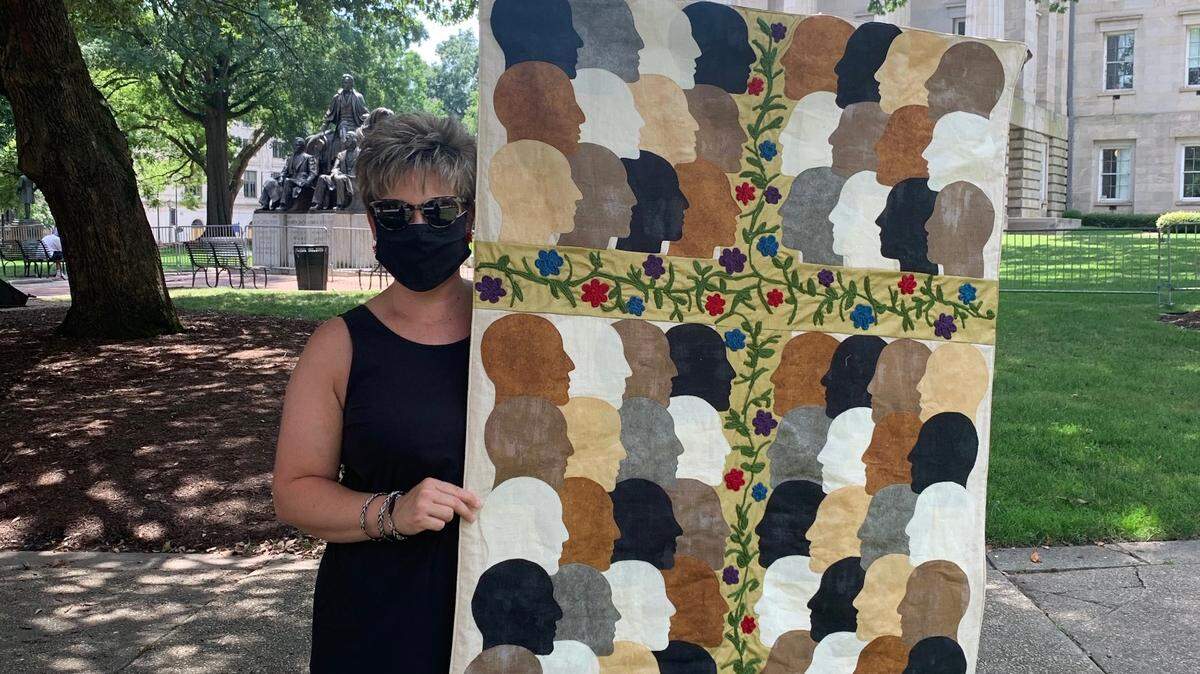
Jill Charville of Four Oaks, who was living in Raleigh during the protests, felt called to use her quilting skills to produce a liturgical banner to express her Christian belief that all people are created equal. The banner features a vine-encircled cross in the center flanked by dozens of faces in profile, identical except for their color. She calls it “Reflections of the Cross.”
After the banner was carried in a peaceful protest by the Young Clergy group of the N.C. Conference of the United Methodist Church, Charville offered it to the Museum of History, which accepted it through its accession process.
The banner will join Black Lives Matter protest posters, murals that were painted on plywood sheets covering the windows of downtown businesses that closed after, or in fear of, vandalism, and a program from the funeral service held for George Floyd in Raeford, where his family lived.
Having the banner taken into the museum collection was powerful, Charville said.
“I wanted my children, and my children’s children, to be able to look back on some of that and see that their parents stood up on the right side of history,” she said.
Poteat said finding relevant items to collect as future artifacts has been made easier by the unending news cycle and the way social media amplifies events.
“It just makes people realize that something big is going on,” she said.
One inherent risk in rapid response collection, Poteat said, is that it can take years of perspective to fully understand historic events and to know what artifacts are relevant. So today’s curators may store items that future curators cull down to the essence of the story.
At the office of State Archives, Division Director Sarah Koonts said curators are doing parallel work collecting photos, recordings and other documentary materials.
“We’re trying to be more out front,” she said, “not just waiting for you to deliver a box.”
As part of Your Story is North Carolina’s story, Archives has worked with two African American writers to craft blogs about living through the pandemic and the social justice movement: one by author and poet Gwen Starr and another by author and educator Lea Esther Williams.
Also new, Koonts said, is that Archives has amended its rules to accept items from people younger than 18, so it has the perspective of students whose lives have been transformed in the past 20 months.
“It is challenging,” Koonts said. “You aren’t really thinking about ways to preserve this moment in time; you are just trying to get through. But these stories matter. Your story counts for something. You might not think too much about it but we want to have it.”
This story was originally published October 27, 2021 at 6:00 AM.