The long shadow of Confederate monuments and what NC should do with them
READ MORE
The Long Shadow of Confederate Monuments
A century and a half after the end of the Civil War, the Confederate Army is back on the move, and strategists continue to disagree over where to place statue representations. At least 22 monuments have been taken down in North Carolina. Some have been reinstalled and others have been locked away. As the movement to remove the statues has grown in recent years, North Carolina officials face legal and ethical questions about what to do with them. This is The N&O’s special report.
Expand All
The long shadow of Confederate monuments and what NC should do with them
Do Confederate monuments fit with NC’s Museum of History mission? Not really
Telling the stories of pandemic and protest: NC curators want items to interpret this time
NC officials have taken down over 20 Confederate monuments recently. Here’s where
A century and a half after the end of the Civil War, the Confederate Army is back on the move, and strategists continue to disagree over where to place the troops.
It’s both a legal and philosophical question.
These are not live soldiers, of course, but a regiment of bronze and granite likenesses of the Boys in Gray poised on courthouse lawns and other public spaces across the South. At one time, some 140 Confederate markers and monuments were scattered over the North Carolina landscape, many of them in place so long that some passers-by had no idea of their connection to the Civil War.
But after Confederate-flag-toting white supremacist Dylann Roof told friends he wanted to start a “race war,” and then shot and killed nine Black people attending a Bible study at Emanuel AME Church in Charleston, S.C., in 2015, a movement grew around removing Confederate flags and monuments from public spaces.
That movement was further energized following the 2020 killing of George Floyd by a Minneapolis Police officer.
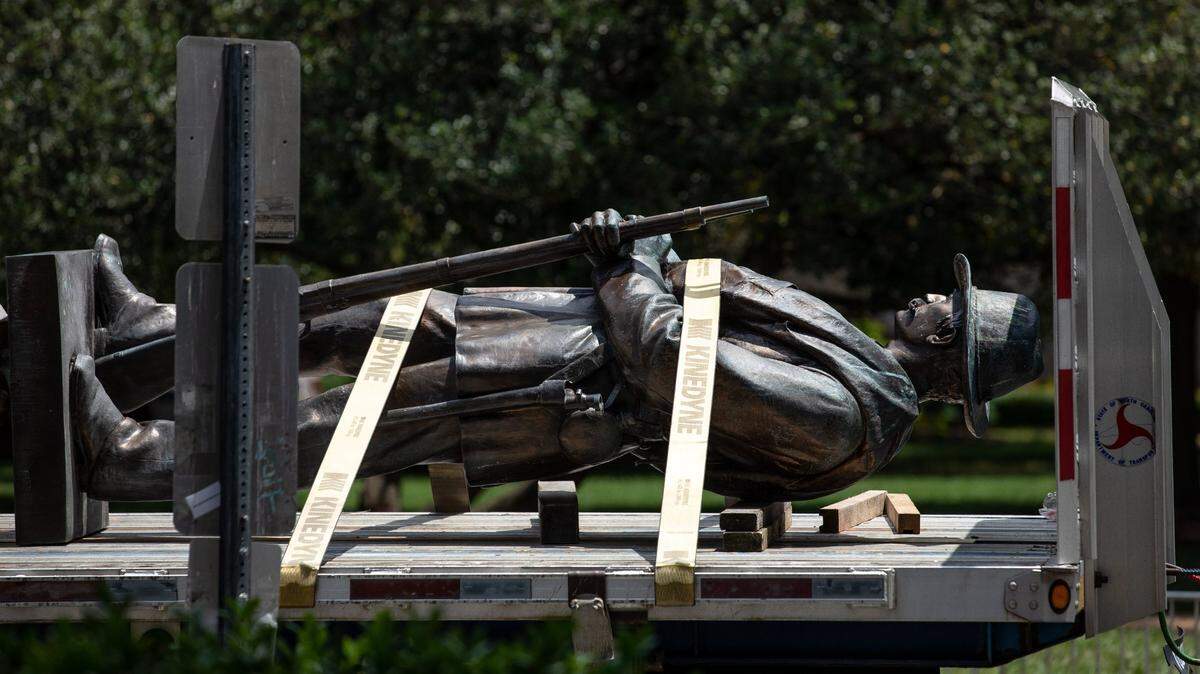
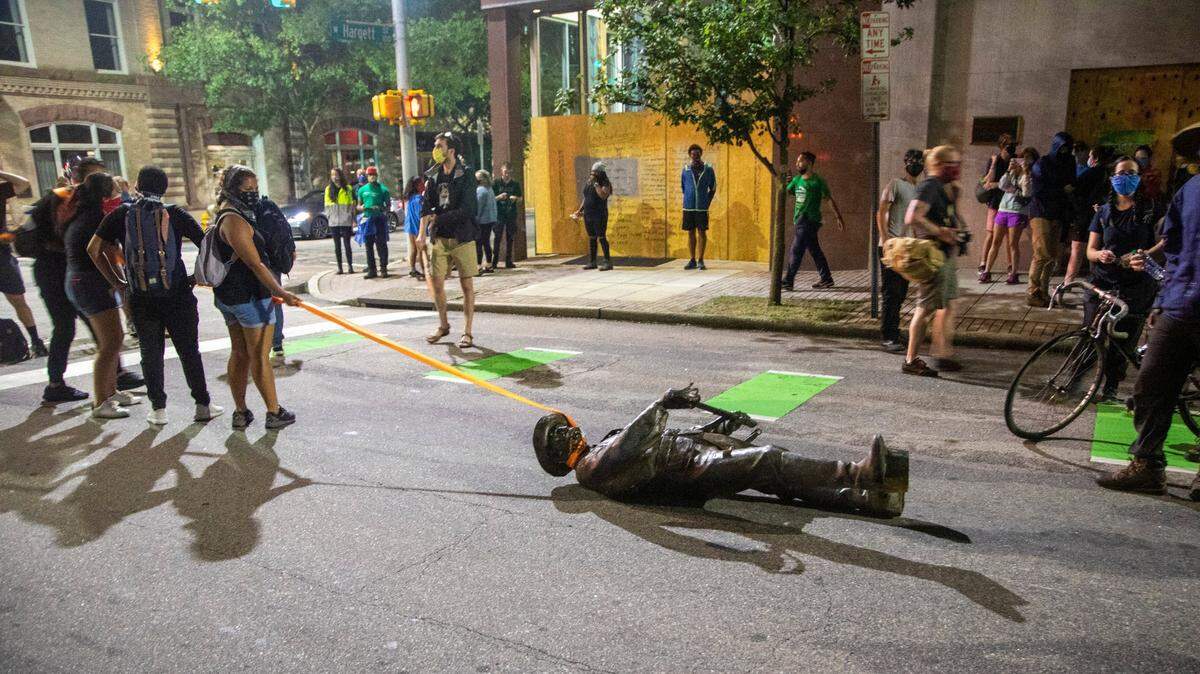
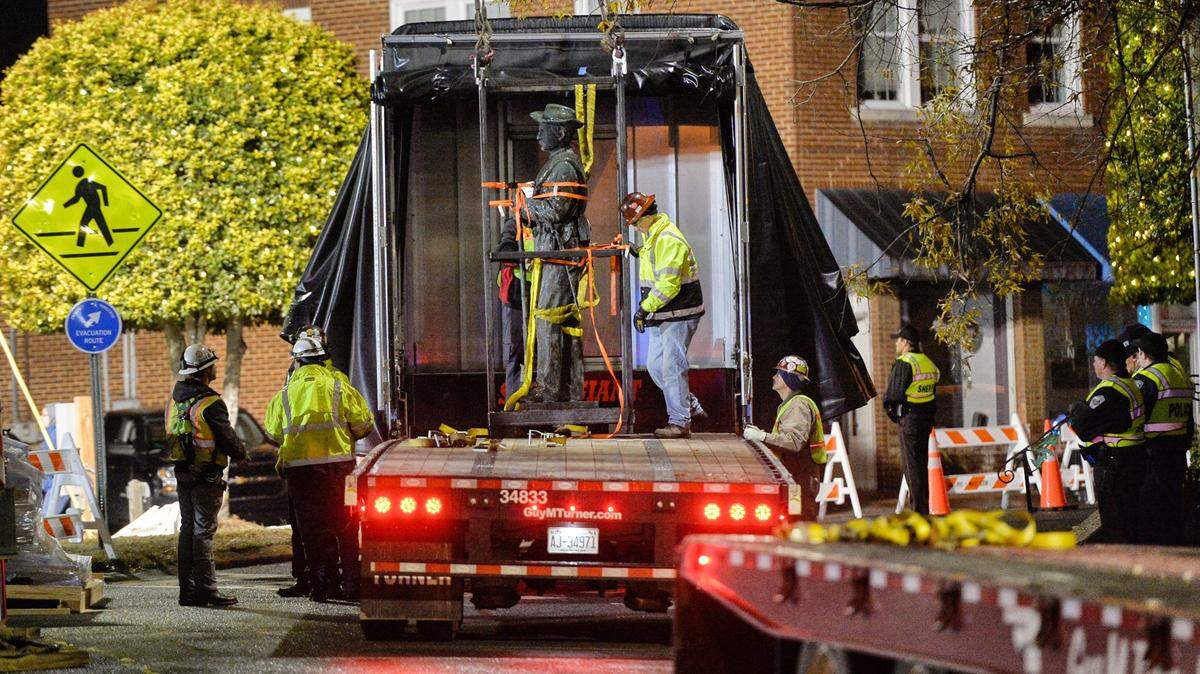
To date, at least 22 monuments have been taken down in North Carolina.
Some have been reinstalled in other places. Some are locked away in storage. Several are tied up in legal battles, including one that awaits a North Carolina Supreme Court ruling that could either clear the way for more removals or require city and county governments that took them down to put them back on their pedestals.
How most monuments came about
Most Confederate monuments in North Carolina were erected during two time periods — in the 1910s and ‘20s, or in the 1950s and ‘60s — according to the Southern Poverty Law Center, which compiled a database on them. They usually were sponsored by chapters of the United Daughters of the Confederacy, who raised money to buy the monuments from foundries and stoneworks and asked local governments to make space for them in front of courthouses, in parks or on islands in the middle of city streets.
The SPLC notes that these time slots coincided with the beginnings of the Jim Crow era of segregation and Black disenfranchisement and with the main thrust of the U.S. civil rights movement. The organization says the flurry of Confederate canonizations were symbols of hate intended to assert white supremacy and celebrate the Confederacy at times when Blacks were making political and social gains.
Frank Powell, spokesman for the Sons of Confederate Veterans in North Carolina, says the first round of monument installations happened about 50 years after the end of the war, when veterans were dying off in large numbers and families and communities wanted to recognize their service. The second round, he says, was inspired by the 100th anniversary of the war’s end.
“We call them monuments and statues, but they’re memorials,” Powell said. “They’re memorials to men who died defending their states. Many of them didn’t come home. Many of them lie in unknown or unmarked graves now. So these memorials are in effect their only gravestones.”
Powell said he thinks Confederate monuments are “low-hanging fruit” for communists, socialists and Marxists who, if they’re successful, will then go after monuments to Founding Fathers, Vietnam vets and others.
Powell said he would like to see fewer monuments come down and more go up, “honoring Native Americans, African Americans and women,” in the same public places where Confederate monuments now stand.
Send them to cemeteries
If the Confederate statues are memorials, some say, they should have been placed in cemeteries to begin with or moved there now.
In July, the City of Salisbury and a local chapter of the UDC agreed that “Fame,” a monument of an angel supporting a Confederate soldier, could be relocated from a downtown intersection to a spot near Confederate graves in the Old Lutheran Cemetery in town.
Local officials justified taking down the monument from the intersection by saying its removal was necessary to protect it and the public after the statue was vandalized twice with paint and once with acid.
Gregory Lambeth II, who helped negotiate the move to the cemetery, said he understands some people now see in the monuments “reminders of the hard truth of slavery,” and object to their being kept in prominent places at public expense.
“Confederate monuments are centralized to one specific group of individuals from the overall community,” Lambeth said.
But he said he also believes that people who donated to the cost of erecting the monuments a century or more ago may have only wanted to publicly honor fellow citizens who had died in military conflict.
At first, Lambeth said, he was opposed to putting “Fame” into the cemetery where he worried vandals would destroy it. But the cemetery has infrared cameras and the city installed a high wrought-iron fence around the monument and aimed LED spotlights at it.
“I’m happy with it now,” he said.
Divisive legal debate
While Salisbury and the UDC were able to come to an agreement, other communities are facing litigation over the removal, or proposed removal, of Confederate monuments.
The legal debate over moving the statues is as divisive as the one around their symbolism.
In 2015, the same year as Roof’s massacre in Charleston, the N.C. General Assembly passed a law to protect “monuments, memorials and works of art” and prevent the removal of “objects of remembrance” from public property except under certain conditions. The law exempts ones that are owned by private entities and located on public land, and those that pose a threat to public safety. They also can be taken down for their own protection.
The question of ownership has created a legal tennis game in several cases, including one involving “Silent Sam,” the monument that long stood on the campus of UNC-Chapel Hill; and a monument that stood on the grounds of the Old Chatham County Courthouse in Pittsboro until the county took it down in 2019.
If city, county or state officials believe it’s in the best interest of the community to remove a monument, they may try to show that the government entity never owned the monument, only the land where it stood.
Or, if the monument was given to the local government by the group that paid for it so many decades ago, local officials may try to give it back.
Either way, the government would then argue that the monument is privately owned and standing on public property and therefore exempt from the monument protection law.
City councils and county commissioners also have used the public safety and object protection exemptions, saying they fear that vandalism of a monument is likely to lead to someone being injured or the monument being destroyed.
When Chatham County took down the monument in Pittsboro, it said the monument was a safety hazard and that it belonged to a local UDC chapter. The group says it’s the county’s monument and wants it reinstalled.
‘Symbols of white privilege’
Trying to figure out what will be the disposition of the Confederate monument standing in the shaded courtyard on the east side of the Pasquotank County Courthouse in Elizabeth City “has been one of the most challenging parts of my job,” said Sparty Hammett, who became county manager in 2018.
Once County Commissioners voted to take down the monument, they struggled to find another place to put it.
There is no Civil War battlefield in the county.
No cemetery wanted it.
The state-owned Museum of the Albemarle in Elizabeth City wouldn’t accept it, in part because of its 30-foot height and the fact that the base, pedestal and the soldier on top are all made of granite and together weigh several tons.
Finally, the county invited proposals from private property owners and accepted one from a man who wants to install the monument on his land in the Nixtonton area, outside Elizabeth City, where the public will be able to see it from the road and come visit it at specified times during the year.
“It will continue to be a historical marker, it just will not be supported by the public,” said John Morrison, an attorney representing the property owner, Warren Weidrick, who did not want to be interviewed.
Morrison said Weidrick “is not a racist. He’s not doing this to celebrate the Confederacy. He’s doing it to preserve the memory of the soldiers and the war and a piece of art.
“There will not be 50,000 Confederate flags flying around out there,” Morrison said. “It will be respectful, [with interpretive materials saying] here it is, here is how it came to be here, here are the arguments on both sides, you make your own decision on what to think about it.
“He’s not building a theme park around it.”
Keith Rivers, president of the Pasquotank County NAACP, who asked county commissioners years ago to move the monument, said he doesn’t care where it goes as long as it’s removed from public property.
“No other country in the world celebrates the atrocity of what was done to another race of people, except this country,” Rivers said. “These monuments are not a reminder of history. They’re symbols of white privilege.”
The county contracted with one of several crane companies that now specialize in disassembling monuments. But the company later reported that it received threats and increased its original bid of $28,000 to $75,000 for taking the monument down and delivering it to the new site.
Hammett took new bids, and signed a contract to have the work done for $50,000.
But before he could arrange to move the monument, the Sons of Confederate Veterans got a judge to grant a 30-day injunction on the relocation earlier this month.
Ed Phillips, an attorney in Franklin, Tenn., who represents the SCV in the case, said the injunction gives the state Court of Appeals and the N.C. Supreme Court time to rule in two Confederate monument cases that could set precedents for others, including the one in Pasquotank. They could settle the question of whether the monument protection law or its exceptions apply.
The injunction on the monument in Pasquotank County expires in early November, when it can be reviewed and extended another 30 days.
Meanwhile, the soldier atop the monument stands ready, rifle by his side, gazing South, awaiting orders.
This story was originally published October 27, 2021 at 6:00 AM.