Wake’s 14,000 red dots: See a century of housing restrictions on new searchable map
AI-generated summary reviewed by our newsroom.
- Wake County mapped more than 14,500 racially restrictive covenants from 1900 to 1950.
- Volunteers used AI and OCR to scan about 600,000 archived pages and identify covenants.
- The project published a searchable map, time‑lapse video and downloadable geospatial.
On Sanderson Drive in Raleigh’s Anderson Heights, a five‑bedroom home is back on the market — but its glossy listing photos don’t show the line in its original deed limiting who was allowed to live there.
That forgotten clause, buried for decades, is now one of more than 14,500 racially restrictive covenants lighting up a new Wake County map that reveals how discrimination spread across the Triangle, one subdivision at a time, from 1900 to 1950.
After nearly three years of painstaking work, the Wake County Register of Deeds’ Racially Restrictive Covenants Project has uncovered and catalogued racially restrictive covenants embedded in historic property records — and the results are now visible in a searchable, interactive map.
Although the Supreme Court ruled such covenants unenforceable in 1948, and the 1968 Fair Housing Act outlawed them, the painful, offensive language still exists in hundreds of deeds of homes, neighborhoods and cemeteries across the county. In nearly every deed that restricted race, the same clause also imposed religious exclusions — most commonly targeting Jewish residents.
“This project helps tell a fuller story about Wake County’s history,” Register of Deeds Tammy Brunner said in a release. “This was truly a community-driven effort,” she added, “to ensure that history is not forgotten.”
Residents can type in any address to see whether the property or surrounding parcels contain covenants. Users can zoom into areas like Five Points, Glenwood‑Brooklyn, or East Raleigh to see how covenants spread block by block.
Early mapping analysis reveals patterns that continue to resonate today.
Brunner said areas historically restricted to Black people often align with present-day neighborhoods that struggle with “lower income levels, limited access to services and fewer opportunities for generational wealth.”
“The underserved parts of Wake County then, are the exact same underserved parts of Wake County now,” she said. “It’s along racial lines. There’s just no denying it any longer. That’s what the map shows us.”
By making these records publicly accessible, “we hope to foster awareness and understanding about how discriminatory housing practices shaped our community and continue to influence.”
The launch follows the release of its time‑lapse video map, published in March 2025, that shows how those covenants spread across the county over four decades: first as a small cluster of red dots in Raleigh’s Glenwood‑Brooklyn District; then as a sea of red, mirroring the rise of “streetcar suburbs” and the rapid suburbanization north of the city limits.
The visual, and now the digital archives, make plain what historians have long documented: segregation in the Triangle wasn’t accidental — it was engineered into the land itself.
The project represents years of research and collaboration between the Register of Deeds office and nearly 200 community volunteers, led by husband-and-wife team Lisa Boccetti and Robert Williams.
“There were many rabbit holes,” Williams told The N&O in 2025. “We had no idea if we were going to find 1,000 covenants or 50,000 covenants. No one had really collected this information before.”
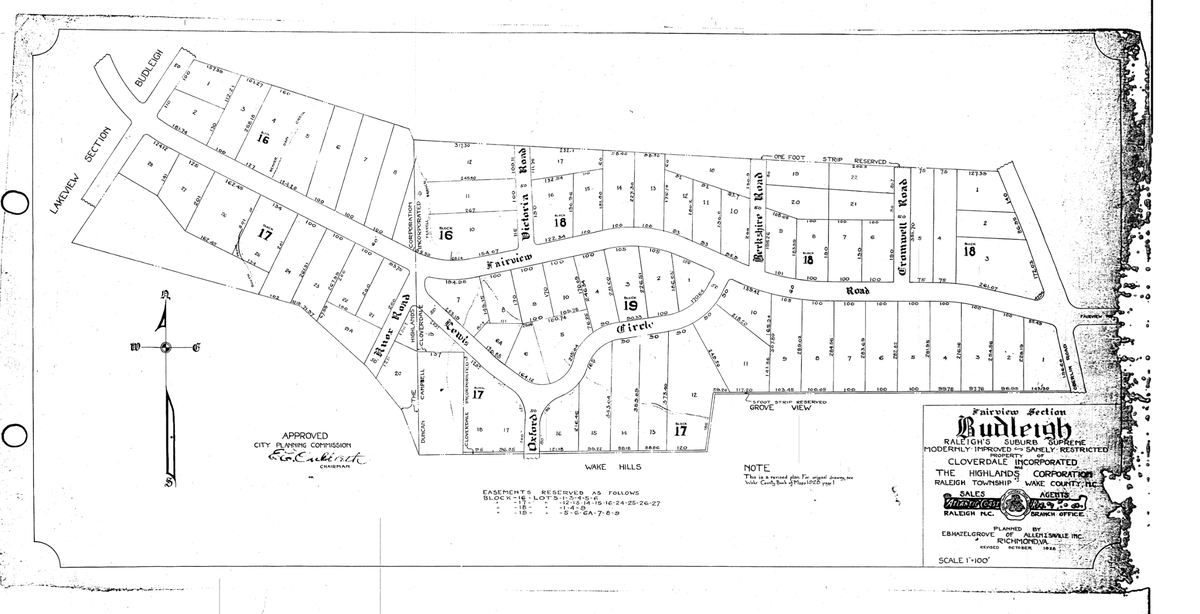
Using artificial intelligence and optical character recognition, volunteers scanned and searched approximately 600,000 pages of archived records, ultimately identifying the covenants that dictated who could buy, own, or occupy certain properties.
On the project’s website, the public can now view the earliest recorded deed with such restrictions dating back to 1906. Typed in a font written with an old mechanical typewriter, it reads: The Glenwood Land Company to Annie M. Wiggins “hereby covenanted and expressly agreed” that the premises “shall not be occupied by negros or persons of negro blood,” except if the person is “employed for domestic purposes solely.”
Adding further insult, the deed also prohibits “pigs and hogs” from being on the property in the preceding line.

Organizers have provided access to data files containing all the covenants identified, as well as geospacial data, like coordinates and addresses.
Beyond documenting discriminatory practices, they say the records offer a window into broader moments in local history — the Great Depression, both World Wars, and Wake County’s early‑20th‑century growth.
The Register of Deeds office has documented its methodology, so other communities can replicate the process — a “roadmap” for counties across the Triangle to “confront their own histories.”
Research from such projects has led to legislation in other states. In Washington, the newly enacted Covenant Homeownership Account Act compensates victims of restrictive covenants. It can also lead to reforms that ensure fair housing practices and prevent similar discriminatory policies in the future.
This story was originally published June 1, 2026 at 3:17 PM.