Raleigh officer fails to get excessive-force claims in motel encounter dismissed
AI-generated summary reviewed by our newsroom.
- Judge Louise Flanagan denied Robinson’s motion to dismiss the civil claims.
- Sanders alleges Robinson slammed him face-first into a tree root and kneed his back.
- Sanders filed the lawsuit in September 2025 seeking damages and attorneys’ fees.
A lawsuit accusing Raleigh police of using excessive force against a man who says he slept past a motel’s checkout time survived its first major legal challenge, moving the case one step closer to a settlement or jury trial.
In September 2025, Thomas “TJ” Sanders Jr. filed a lawsuit against the city of Raleigh and two of its two police officers.
Over time, the defendants have been narrowed to just Christopher Robinson, a Raleigh police officer who was also named in an excessive-force lawsuit involving Darryl Williams. Williams died in January 2023 after officers used a Taser on him multiple times. The city settled the lawsuit last year, agreeing to pay Williams’ family nearly $1 million.
In the ongoing case involving Sanders, he alleges that in December 2022, a month before Williams died, Robinson violated his constitutional rights by using excessive force when investigating a misdemeanor crime against a person who wasn’t a threat to officers. It also accuses Robinson of assault and negligence.
Sanders is seeking an unspecified amount of money to recover costs related to his injuries and attorneys’ fees, as well as punitive damages, a financial penalty meant to punish Robinson and deter others from repeating such actions.
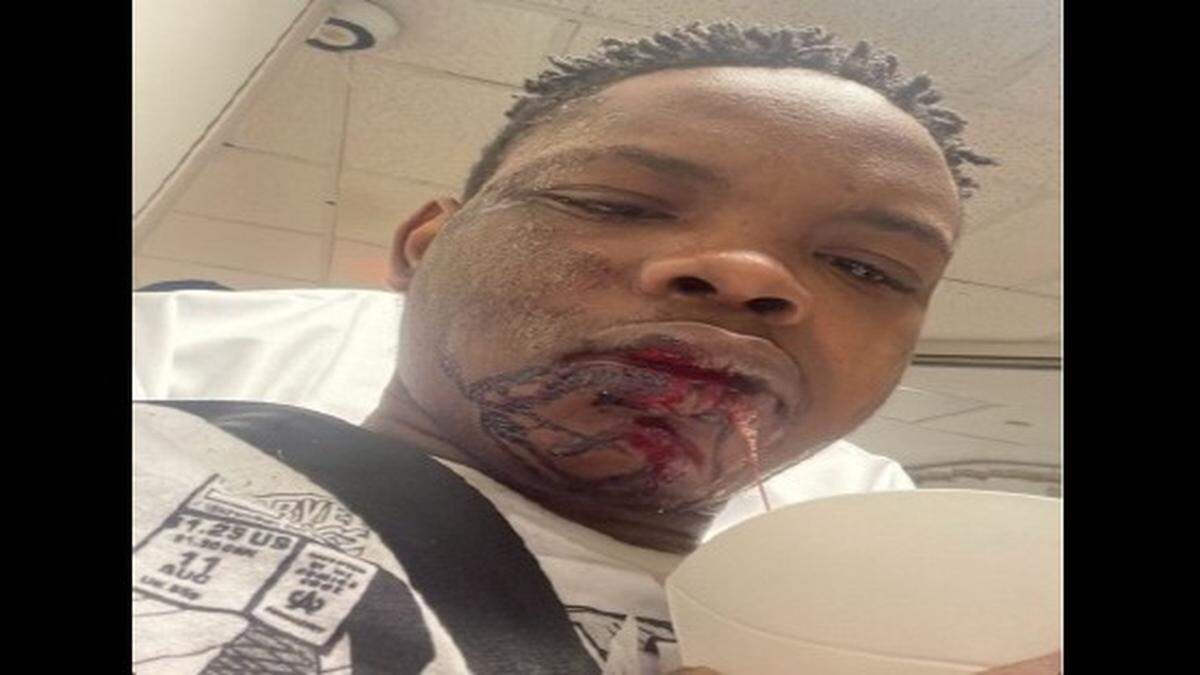
How Sanders says a Raleigh officer violated his constitutional rights
On Dec. 18, 2022, a then-20-year-old Sanders and his teenage cousin overslept their checkout time at a Super 8 Motel in Raleigh. A motel employee woke them up, told them to leave and called the police.
Sanders and his cousin were in their room holding their bags when police arrived, the complaint states. The police told them to leave, and the two men left the room, according to the lawsuit. But instead of letting them go, the officers followed them and demanded their names.
Sanders provided his name and birthday and explained that they had worked late delivering food and slept in, the lawsuit states.
Sanders’ cousin declined to give his name, and the officers handcuffed him and pinned him to the ground outside.
“Do what you’re [expletive] told,” Robinson told the teen, the lawsuit states.
Sanders, who is 5 feet 5 inches tall and at the time weighed 130 pounds, used his phone to record Robinson as he drove his elbow and knee into Sanders’ cousin’s back, the lawsuit states. Robinson stood up and turned his attention toward Sanders, the lawsuit states, shouting at him to back up, shoving him multiple times, and slapping the phone from his hands.
While Sanders pleaded with Robinson to stop, the officer pulled Sanders’ hands behind his back and slammed him face-first into a tree root on the ground and kneed him in the back, the complaint states.
“TJ never attempted to flee or resist arrest, and was always within Officer Robinson’s control,” the complaint states.
Sanders was charged with resisting arrest and assaulting a police officer. The charges were dismissed 10 months later.
Sanders was taken to WakeMed. Doctors noted scrapes on his face, including a roughly 3/4 inch cut on his chin, the complaint states. Sanders also reported his teeth were pushed in.
Why the Raleigh Police Department officer thinks the case should be dismissed
In court documents, Robinson’s attorney states that the officers’ body-worn camera footage shows the motel manager asking that the two men be trespassed from the property.
The recording shows that the men understood that they were being trespassed and why officers wanted their names, attorney Sonny Hayes wrote in a filing arguing that the lawsuit should be dismissed. Hayes works for a private firm, but the city of Raleigh generally pays for officers’ attorneys when they face lawsuits.
The recording also shows the plaintiff ignoring Robinson’s command to back up, but instead repeatedly stepping toward the officer, cursing and yelling and grabbing Robinson’s hand and wrist, Hayes wrote.
What the U.S. judge said about the request for dismissal
U.S. District Court Judge Louise Flanagan on May 22 denied Robinson’s motion to dismiss the civil claims.
Flanagan, who reviewed 40 video recordings, is obligated at this stage of the case to review the evidence “in the light most favorable to” Sanders, her order states.
In the order Flanagan, a judge in the federal Eastern District of North Carolina, says videos showing Sanders yelling and refusing to stand back contradict his contention that he was always within the control of the police.
Another video, however, shows Sanders was unarmed, briefly touched Robinson’s wrist, and never tried to flee or resist arrest.
“As explained above, based upon the allegations in the complaint, and drawing reasonable inferences in plaintiffs’ favor, defendant violated plaintiff’s right to be free from excessive force by “slamm[ing] [plaintiff] face-first into a large tree root on the ground, knee[ing] him in the back, and forc[ing] the side and front of [plaintiff’s] face down into the ground,” when plaintiff was suspected of a nonviolent misdemeanor, was unarmed, and had not attempted to flee or resist arrest,” Flanagan wrote in the order.
While the lawsuit survived the motion to dismiss, it will likely face an additional legal challenge that could get it dismissed before it can go before a jury.
NC Reality Check is an N&O series holding those in power accountable and shining a light on public issues that affect the Triangle or North Carolina. Have a suggestion for a future story? Email realitycheck@newsobserver.com.