Chapel Hill-Carrboro schools face hard choices, but superintendent has a plan
AI-generated summary reviewed by our newsroom.
- District lost 1,545 students since 2020; may consider closing a school.
- Board plans bond-funded construction of schools while assessing positions.
- Superintendent urges transparent master plan to guide cuts toward innovation.
The Chapel Hill-Carrboro school district faces tough choices — and will probably close a school — but a quality education is still possible through planning and innovation, Superintendent Rodney Trice said.
The 11,114-student district has lost 1,545 students since the 2020 pandemic, according to updated numbers shared at the school board’s meeting Thursday. Elementary schools have seen the largest loss, but the middle schools are starting to see declines, too, as students born since 2015 move through the system, preliminary data shows.
High schools could continue to get a bump from students returning for their final years.
The situation could leave six elementary schools — Carrboro, Morris Grove, Northside, Rashkis, Scroggs and Seawell — with a lot of vacant seats by 2035, said Nathan Dollar, director of Carolina Demography.
The school board already broached the idea of closing a school this year, as it prepares to build three new elementary schools with its share of a $300 million voter-approved bond. It will also have to take a hard look at positions and programs, Trice said.
A master plan is necessary to guide the district and should be transparent and flexible enough to adapt to changing conditions, Trice said. It should also give staff adequate notice about possible cuts so they can prepare, unlike previous cuts that caught many off guard, he said.
“People in our community need to know you’re making cuts for what,” Trice said “It is to thrive. It is to survive, in a sense, but we want to cut toward … innovation, and just kind of reinventing ourselves is going to be important.”
Enrollment pressures cutting budgets
Trice’s remarks followed an update from Dollar, whose team is still studying enrollment, economic growth and other factors in the Chapel Hill-Carrboro and Orange County Schools. The Orange County Board of Commissioners will get the final report next year.
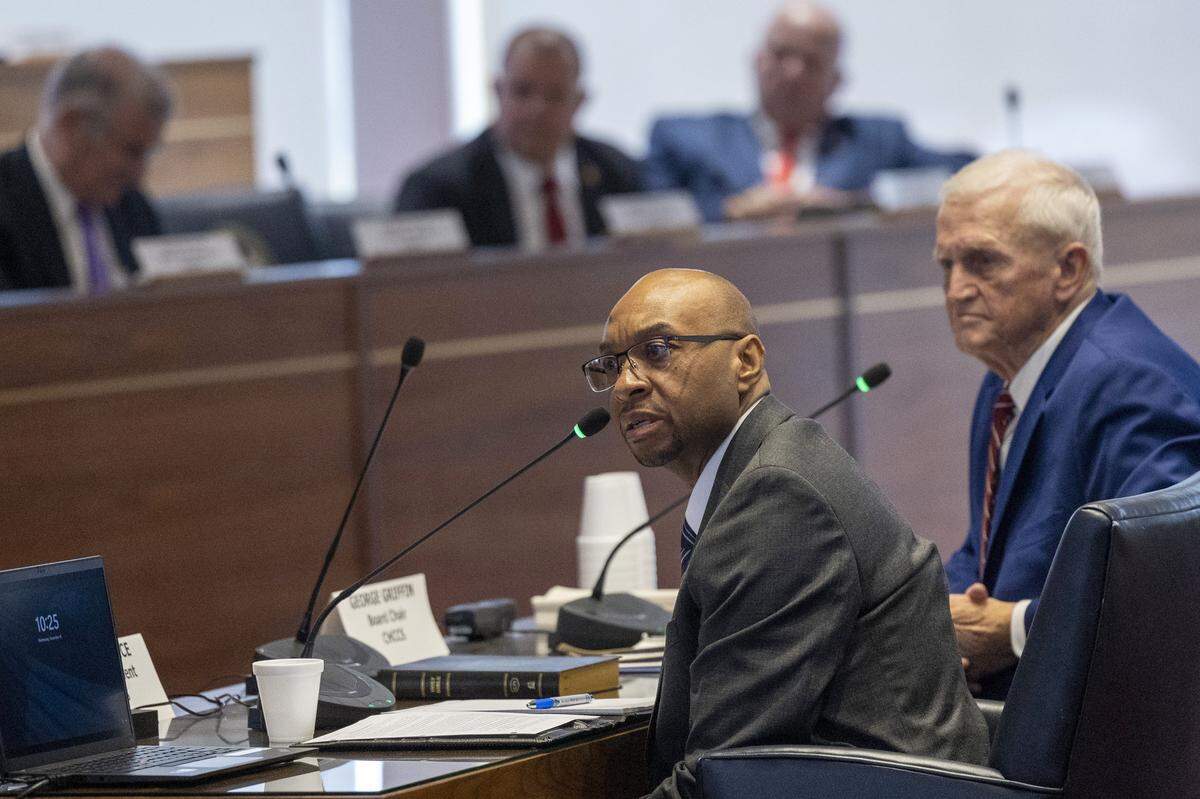
The conversation also followed a heated N.C. House committee hearing Wednesday at which Trice and former board Chair George Griffin were attacked for comments made when the district adopted Parents’ Bill of Rights policies in 2024.
Orange County is unique, because it has not seen the influx of working-age people to urban areas that Durham and Wake counties have seen, Dollar told the board Thursday. People in their prime working years are more likely to have children, he said.
The fact that Chapel Hill-Carrboro is also among the country’s most well-educated school districts also plays a role, because people with more education often have fewer children and at a later age, he said. A growing, older population staying in the home longer further limits the available housing for families who want to move into the district, he said.
Meanwhile, charter school enrollment has grown 39% since 2020, and private school enrollment is up 24%, he said. Homeschooling fell from its pandemic peak, but is still up 16%.
The trends will continue without an increase in the local birth rate or more students moving into the district than out of it, Dollar said. The district’s enrollment could fall to 9,448 students by 2035, he said.
That could cost the district $38 million in state funding over the next five years if nothing changes, said Jonathan Scott, the district’s chief financial officer. Local funding is also allocated per student, but the district expects that to keep growing, he said.
The cuts to save $5.2 million in 2024 may only hold until 2030, when the deficit could hit $2 million a year and start growing again. The district is already projecting a $2.1 million hit next year from declining enrollment.
The district gets about 37% of its funding from the state, 43% from Orange County, and 13% from a special school district property tax. The rest is federal or other sources.
State House Rep. Jeffrey McNeely, a Republican from Iredell County, warned Trice and Griffin at Wednesday’s hearing to “go home and do some serious housecleaning,” or there is “a good chance” state funds might not be available.
Next steps for schools, programs
Thursday’s meeting followed a series of public meetings this month at which Trice laid out the challenges and asked for feedback.
Falling enrollment is not just a local problem, he said.
The News & Observer reported Thursday that 105 of the state’s 115 school districts have lost students.
“I’ve shared with our community, this is not a crisis, it’s a crossroads,” Trice said. But “if we do nothing, in a couple of years, we would have erased all the important decisions and actions we’ve taken as a district.”
A master plan should push “excellence as an organization,” including short, intermediate and long-term “budget levers,” he said.
That includes how the district’s people, facilities and programs are organized, how resources can be used more efficiently, and how to take innovative steps and even increase funding for programs that are working. Dollar advised also looking at the age, condition and cost to maintain each building when deciding which schools to close.
Board member Rani Dasi noted the county’s Woolpert report on school facilities could help start the discussion, but emphasized that no decisions will be made without consulting the public, and that will take time.
The “elephant in the room” is the desire of staff and the community to preserve particular programs, Griffin said, even if those programs aren’t an efficient use of money. He suggested identifying core K-12 curriculum needs first, and then deciding what programs are needed to support that.
“We can either do something different and take some risks … or we can look [the same] and hope for better, and we’ll definitely be a little smaller,” Griffin said. “That’s what I’m afraid will happen.”
This story was originally published December 12, 2025 at 9:28 AM.