‘Take a bow.’ Record number of NC high school students took college courses.
AI-generated summary reviewed by our newsroom.
- 56% of NC graduates took at least one college-level course last year.
- 38% of graduates (44,436 students) enrolled in dual enrollment, up 2%.
- Career and College Promise enrolled 86,998 students, a 10% increase.
A majority of North Carolina’s high school graduates are now taking and passing college-level courses, state leaders said Thursday.
A report presented by the state Department of Public Instruction shows that 56% of graduates took at least one college level course and 54% of graduates passed at least one college level course while enrolled in high school last school year. State officials say those “historic highs” are worth celebrating amid criticism about the state of public schools.
“North Carolina public schools, take a bow,” State Superintendent Mo Green. said at Thursday’s State Board of Education meeting. “Historic information has been relayed over the last several months.”
College-level courses are defined as Advanced Placement, International Baccalaureate and Center for International Education courses taken at high schools and dual enrollment courses taken at colleges.
Green tied the new data with other recent figures showing North Carolina has a record high school graduation rate, and a record number of high school students earning job industry credentials and taking and passing Advanced Placement courses and exams.
“Perhaps it’s the case that North Carolina’s public schools have never been better,” Green said. “Go tell it on the mountain.”
Career and College Promise program
On Thursday, the State Board of Education received a report on North Carolina’s Career and College Promise (CCP) program that allows high school students to enroll in college courses.
Students at traditional high schools can take college courses through the CCP program. For instance, Cumberland County Schools transports high school students to Fayetteville Technical Community College.
Sa’Nai Lewis-Dewalt, a senior at Seventy-First High School in Fayetteville, told the state board that the CCP program has given her confidence and independence. Lewis-Dewalt has taken enough courses at Fayetteville Tech that she’ll be able to graduate from college two years early, saving her time and easing her financial burden.
“After completing my first class, I realized I’m capable of so much more than I thought,” Lewis-Dewalt said. “For example, I’m salutatorian for my senior class of over 300 students, and I was never someone who thought of being on the top of my class. I was just here to make good grades.”
Early college high schools
A major part of the CCP program is the state’s 138 cooperative and innovative high schools. These high schools, often called early colleges, partner with a college to allow students to receive a high school diploma and up to two years of free college credit.
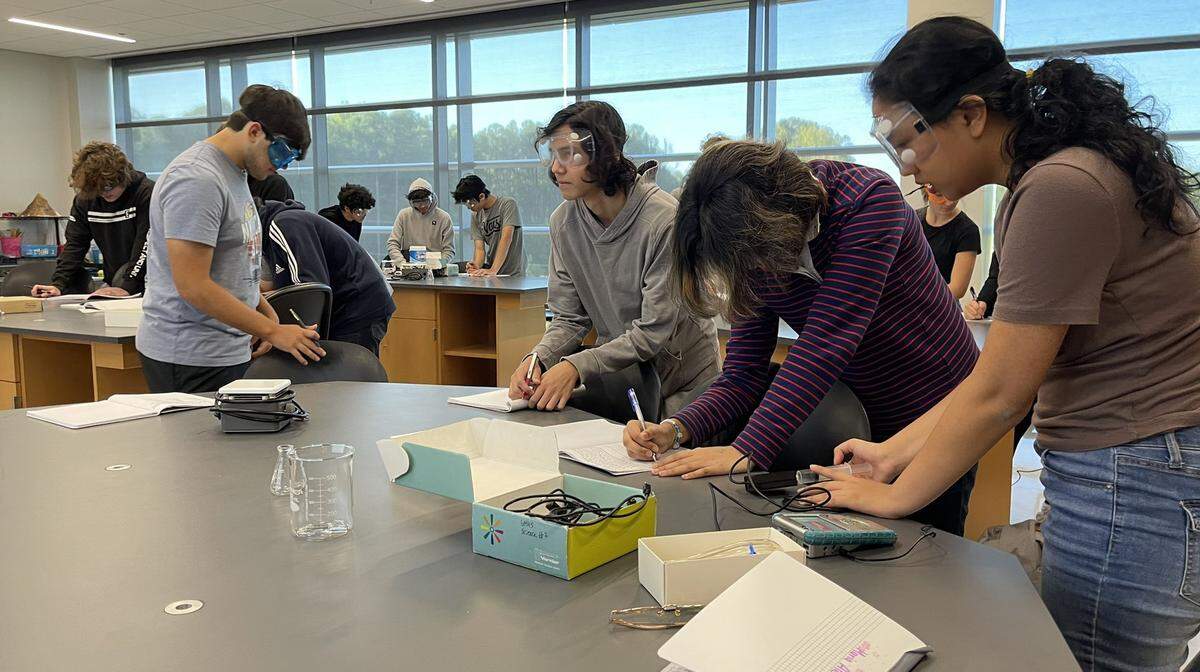
Students at J.D. Clement Early College in Durham take college classes at N.C. Central University. Lori Bruce, the school’s principal, said the partnership is helping give her high school students the skills they need to thrive in college.
One of the goals of the CCP program is to encourage participation by students who would be the first in their family to attend college.
Jose Aleman’s parents didn’t go past middle school. But they raised a son who is now a senior at J.D. Clement. He accepted a full-ride scholarship to attend Harvard University.
“The promise of over two years worth of college credits was the initial hook,” Aleman told the state board. “But what really stood out to me was the community. Through the rigorous education and adjustment, I came to form some of the strongest bonds that I’ve ever made.”
More students earning college credits
Several data points were presented on Thursday, including:
- 38% of all high school graduates enrolled in dual enrollment opportunities. This represents 44,436 graduates, a 2% increase from the prior year.
- 95% of high school graduates who enrolled in a dual enrollment course earned college credit.
- 86,998 high school students enrolled in college courses last school year, a 10% increase.
- The CCP program has a high diversity rate with 54% of Asian high school graduates, 36% of American Indian graduates, 31% of Hispanic graduates and 25% of Black graduates enrolled in dual enrollment courses.
“We are on our way as Superintendent Green reminds us to truly being best in the nation by 2030.,” said Sneha Shah-Coltrane, senior director of DPI’s Office of Advanced Learning and Gifted Education. “This shows us what our North Carolina public schools are doing, and most importantly what our students are doing.”
This story was originally published April 2, 2026 at 1:32 PM.