
What does the battle over government funding mean for NC and Helene relief?
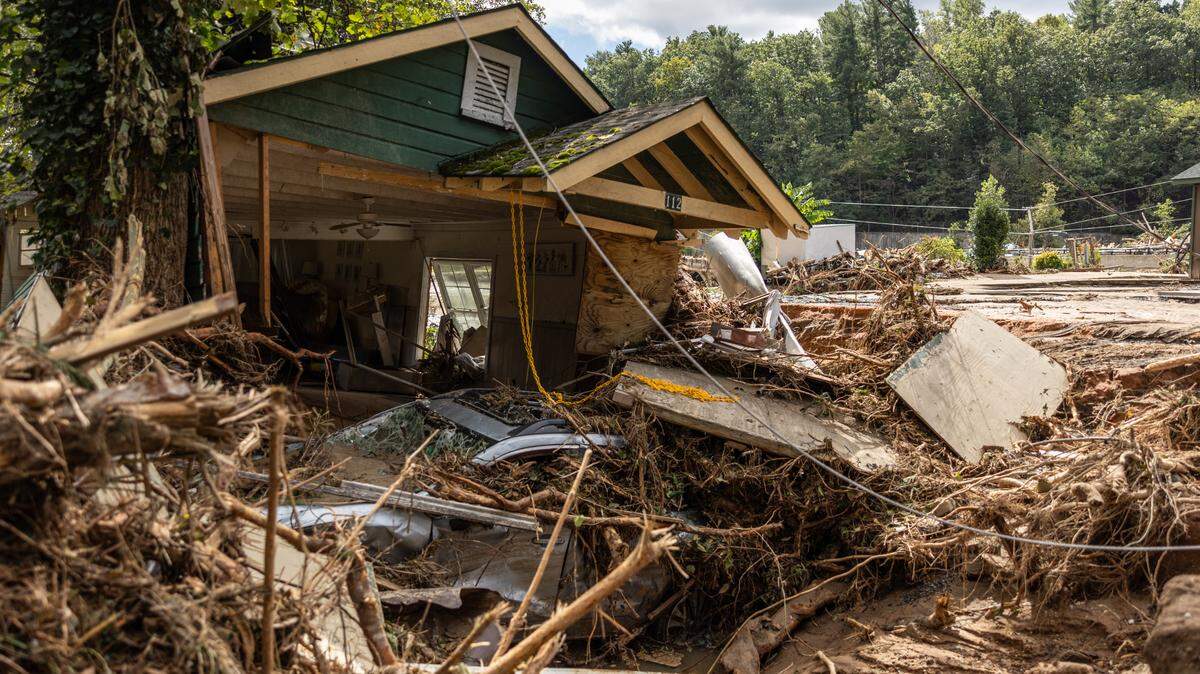
Congress has gone months without passing any disaster relief funding for Western North Carolina after Helene devastated the region.
Then this week, lawmakers put forward one bill, then another, that would provide more than $100 billion in disaster relief aid, not just for North Carolina but communities across the country trying to rebuild from their own calamities.
But Republicans abandoned the first bill, a bipartisan compromise, after incoming President Donald Trump called it unacceptable. Then Democrats, along with some Republicans, defeated a slimmed-down replacement backed by Trump.
Sen. Ted Budd, a Republican from Davie County, was on the House floor when the vote happened. He said he wasn’t certain if disaster relief would stay in future iterations of the bill, or if disaster relief would pass before the end of the year.
“I can’t promise that,” Budd said. “All I can promise is what my efforts are going to be for North Carolina.”
Budd and North Carolina’s other Republican senator, Thom Tillis, had said a day earlier they would not accept a stopgap bill that excluded disaster relief aid for Western North Carolina.
North Carolina was set to get around $9 billion in disaster funding under the original bill, according to Rep. Rosa DeLaura, the top Democrat on the House Appropriations Committee.
The government shuts down at 12:01 a.m. Saturday if lawmakers don’t pass a spending bill.
Disaster relief
The Biden administration had requested the money after responding starting in late September to the devastation in North Carolina and elsewhere caused by the remnants of Hurricane Helene. Within about a month, the Federal Emergency Management Agency had spent three-quarters of its annual budget, FEMA’s director said in early November.
There have been some concerns that because the stopgap measure failed, the disaster relief package could fall by the wayside.
But prior to Thursday night’s vote, the need for disaster relief seemed to be a consensus for most Republicans, with the exception of the ultraconservative House Freedom Caucus.
Trump posted on social media Wednesday night, “Republicans want to support our farmers, pay for disaster relief, and set our country up for success in 2025. The only way to do that is with a temporary funding bill WITHOUT DEMOCRAT GIVEAWAYS combined with an increase in the debt ceiling. Anything else is a betrayal of our country…”
Tillis and Sen. Lindsey Graham, a Republican from South Carolina, told reporters that their constituents have a commitment that they will filibuster, a maneuver used by senators to delay or block votes from going forward, if the bill goes forward without disaster relief.
“If Congressional leaders intend to leave DC before the holidays without passing disaster recovery, they should be prepared to spend Christmas in the Capitol,” Tillis posted. “I’ll use every tool available to block a (continuing resolution) that fails Western North Carolina communities in need of long-term certainty.”
At a news conference Thursday, Tillis displayed a large stack of correspondence from constituents who have reached out since Helene hit. Graham commented that the stack was taller than him. They said they would read the letters on the Senate floor to help delay any vote that didn’t include disaster relief.
“Everyone needs to understand we’re talking about a possible government shutdown here in Washington, while there are parts of this country that have been affected by the storm, who are effectively shut down and until we fund them they have no hope,” Tillis said.
Budd had been part of the news conference with Tillis and Graham but didn’t speak while they agreed to filibuster. As he walked through the Capitol after Thursday’s night vote, he still wouldn’t say specifically that he was agreeing to a filibuster, but he did say: “I’m going to put every maneuver I can to get disaster aid as fast as we can for North Carolina.”
“That I promise,” Budd said.
During the news conference, all three senators agreed they had a commitment from Trump that disaster relief would be in any future bill.
The bipartisan bill
Lawmakers originally agreed on a 1,547-page bill unveiled Tuesday that would keep the government funded until March 14.
But things fell apart Wednesday afternoon.
First, billionaire Elon Musk, a businessman who will soon oversee the Department of Government Efficiency, posted on social media his displeasure toward the bill.
Soon, Vivek Ramaswamy, who ran against Trump and will lead DOGE with Musk, joined in.
And then came Trump and Sen. JD Vance, the next vice president.
“If Republicans try to pass a clean Continuing Resolution without all of the Democrat, ‘bells and whistles’ that will be so destructive to our Country, all it will do, after January 20th, is bring the mess of the Debt Limit into the Trump Administration, rather than allowing it to take place in the Biden Administration,” Trump posted on social media. “Any Republican that would be so stupid as to do this should, and will, be Primaried.”
He added that negotiations should be done before he takes office.
Trump called for members of Congress to get rid of or suspend the country’s borrowing limit and strip the bill of any of the Democrats’ requests.
“The legislation will end up hurting many of the people it purports to help,” Ramaswamy posted on X. “Debt-fueled spending sprees may ‘feel-good’ today, but it’s like showering cocaine on an addict: it’s not compassion, it’s cruelty.”
Rep. Greg Murphy, a Republican from Greenville, pushed back.
“Disaster aid and Farm aid is not ‘Pork,’” Murphy posted on X. “It’s called governing. That’s what we were all ELECTED to do.”
The new bill
House Speaker Mike Johnson started working from scratch Thursday morning and by late Thursday released a new 117-page bill that would suspend the debt ceiling, or borrowing limit, as Trump demanded.
But Democrats objected to breaking the original bipartisan deal. Meanwhile, some Republicans demanded spending cuts, with lawmakers like Rep. Chip Roy, a Republican from Texas, saying that adding $110 billion just adds to their debts. Trump’s support for the new bill didn’t persuade all of them to get on board.
Republicans have risked a shutdown six times in two years, House Minority Whip Katherine Clark told reporters Thursday.
“Here we are once again in chaos, and House Democrats are going to stand together and make sure that American families’ voices are heard here because we shouldn’t even be in this situation of being on the verge of another shutdown,” Clark said.
Republicans took to the House floor Thursday night and blamed their Democratic colleagues for any potential government shutdown if they voted down the bill.
All seven of North Carolina’s Democrats voted against the bill, while the state’s seven Republican House members voted for it.
The National Republican Congressional Committee took aim directly at Rep. Don Davis, a Democrat from Snow Hill, for voting with his party, which isn’t always predictable.
“Shame on Don Davis who would shut down the government to please party bosses instead of standing up for North Carolinians,” said Jack Pandol, communications director for NRCC.
Davis was on their target list of seats they tried unsuccessfully to flip red during the 2024 election.
North Carolina impact
North Carolina lawmakers began calling news conferences Thursday afternoon, with Rep. Alma Adams, a Democrat from Charlotte, leading off at 1 p.m.
Adams told reporters that she had been so confident that the bill would pass on Wednesday that she was supposed to be on a plane back to her district Thursday afternoon.
Now waiting for a vote in Washington, Adams said she wants to make sure people understand what would happen if the bill failed to pass.
“That’s almost $9 billion … in funding for North Carolina that we would miss out on,” Adams said. “That we need desperately for rebuilding in the wake of Hurricane Helene.”
Adams broke down the money North Carolina stands to miss:
Federal highway emergency relief funds
Long-term housing, infrastructure and economic recovery funding
Funds to rebuild portions of the Blue Ridge Parkway
Economic assistance to farmers
Loans for small businesses
Clean drinking water funding.
Government shutdown
And there’s more at stake than just disaster relief.
In Adams’ news conference she talked about the effect a government shutdown would have on North Carolina.
“A government shutdown would have a tremendous negative impact and dire consequences for the economy, our federal employees, for our veterans, for families and really, anybody who would like to travel,” Adams said. “You know, we’re just a few days from the Christmas holidays.”
Government shutdowns typically force essential government workers to work without pay, cause national parks to shut down, and could affect government benefits, like food provided through the Supplemental Nutrition Program for Women, Infants and Children.
“At the last minute request of Donald Trump and Elon Musk, House Republicans have gone back on their word to keep the government open – putting in jeopardy the paychecks of millions of hardworking Americans right before the holidays,” wrote Rep. Deborah Ross, a Democrat from Wake County, in a news release. “An agreement is an agreement. If the government shuts down, Republicans will only have themselves to blame.”
