Trump may not love EVs, but they’re the future in NC, this group says
AI-generated summary reviewed by our newsroom.
- EV sales surged before federal tax credits expire September 30 under Trump law.
- Electrification Coalition highlights EV job growth, energy security and exports.
- North Carolina EV adoption climbs despite uncertainty around manufacturing plans.
The Trump administration may be pulling back federal support for electric vehicles, but EVs are still the future of cars and trucks in the United States and are of growing importance to North Carolina’s economy.
That’s the message of the Electrification Coalition, a Washington-based nonprofit that works to accelerate the adoption of EVs nationwide. The group is organizing a series of events across the country to highlight the economic and national security benefits of replacing gas-powered vehicles with EVs.
By year’s end, one of every five new light-duty cars and trucks sold worldwide will be electric, says Ben Prochazka of Chapel Hill, the coalition’s executive director.
“EVs are happening. The world will be driving electric,” Prochazka said at an EV charging station in Apex on Tuesday. “The question remains, what is the U.S.’s participation in that economic future, and that manufacturing future, throughout the supply chain?”
Electric vehicles are still relatively rare in North Carolina. Fewer than 100,000 battery electric vehicles are registered in the state, out of a total of nearly 9 million cars and trucks, according to the Division of Motor Vehicles.
But the number of EVs in North Carolina has quadrupled in the last three years, spurred in part by federal tax credits of up to $7,500 per vehicle. Those credits were scheduled to continue through 2032, giving former Gov. Roy Cooper confidence to set a goal three years ago of 1.25 million registered zero emission vehicles in the state by 2030.
But the “Big Beautiful Bill” president Trump signed into law in July ends the tax credits on Sept. 30, fulfilling his promise to eliminate “unfair subsidies and other ill-conceived government-imposed market distortions that favor EVs over other technologies.”
The coming end of subsidies has caused a spike in EV sales this summer. But that’s expected to be followed by a sharp decline that could result in millions fewer sold than expected in coming years.
Prochazka’s group emphasizes the economic benefits of EVs, in reducing dependence on oil and creating jobs and new technologies that will keep the country competitive with companies in China and other countries.
“We have to do a better job of defining the non-climate benefits of transportation electrification,” he said. “I’d say in some ways what happened at the federal level is a function of not making those arguments clearer.”
Prochazka says EVs are “superior technology” that will continue to draw more drivers as prices come down and battery range improves. He likens the transition to the one people made listening to music, going from cassettes and CDs to streaming. Changing habits takes time.
Joining Prochazka on Tuesday was Don Utberg-Hood of Gibsonville, retired from the U.S. Air Force. He got his first EV in 2012 and now drives a Tesla Y. The cars are cheaper to operate and maintain, he says, and a pleasure to drive.
“There’s a lot of misinformation about charging and range anxiety. I’ve never had a problem,” Utberg-Hood said. “I just came back from a trip to Oklahoma City to see my daughter out there. Never had a single problem all the way out and all the way back.”
A gas station that now sells electricity
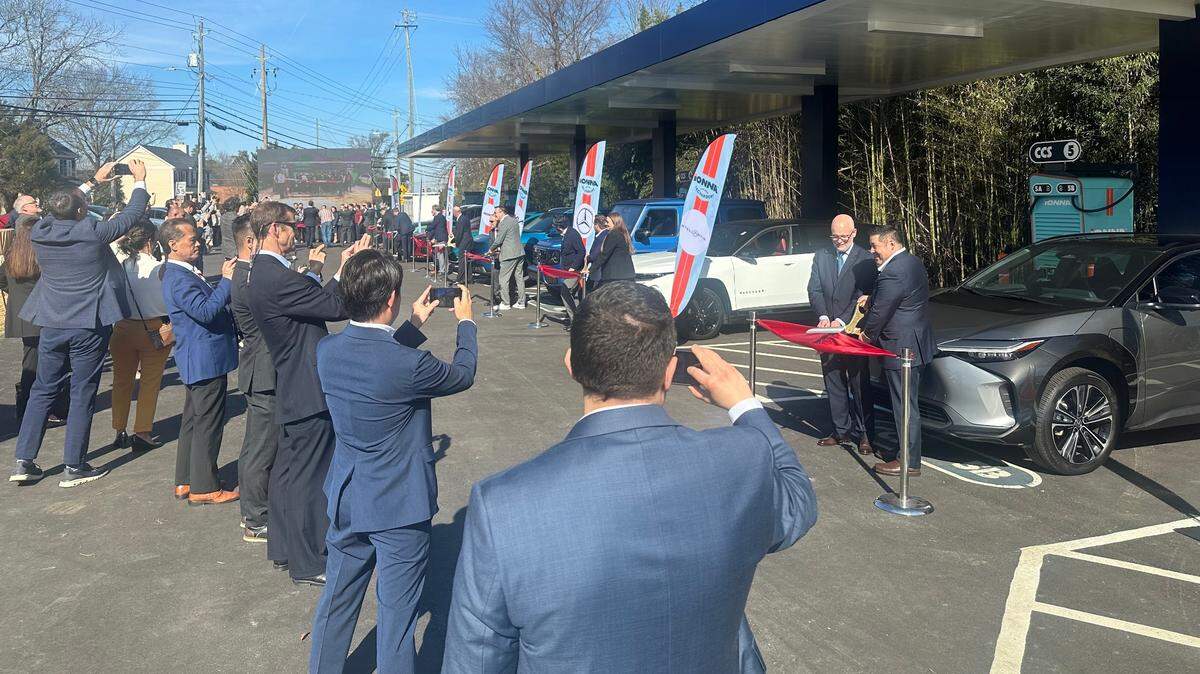
The Electrification Coalition held its event Tuesday at a former Phillips 66 gas station on North Salem Street that in February became the first EV charging station for IONNA, a joint venture of eight of the world’s largest car companies. Headquartered in Durham, IONNA hopes to open more than 2,000 stations like it nationwide by the end of 2030.
“As it stands, there’s not enough EV charging infrastructure for vehicles on the road today in the United States,” said Emily Belding, the company’s utility and policy engagement associate. “IONNA is on a mission to deploy infrastructure as quickly as possible to support demand dictated by the market.”
IONNA is an example of the companies and manufacturing plants the Electrification Coalition holds up to show the benefits of EVs to the state. Others include EV charger manufacturer Kempower, also in Durham, and the massive Toyota battery plant near Greensboro, which expects to employ 3,000 people by the end of the year.
Not all the promises of the EV future have come through for North Carolina. VinFast, the Vietnamese automaker, announced in 2022 that it would open a factory in Chatham County last year that would eventually employ 7,500 people and produce 200,000 electric SUVs a year. Those plans are on hold.
Prochazka says there will be other setbacks in the industry, whether because of tariffs or loss of tax credits. But EVs will continue to become more popular, he says, and local, state and federal governments should look to help a fledgling industry find its footing to compete globally.
“You don’t want to be in a position where suddenly we’re left holding the outdated technology nobody wants,” he said.