
Democrats lead fundraising for NC Supreme Court. See who’s giving to the candidates.
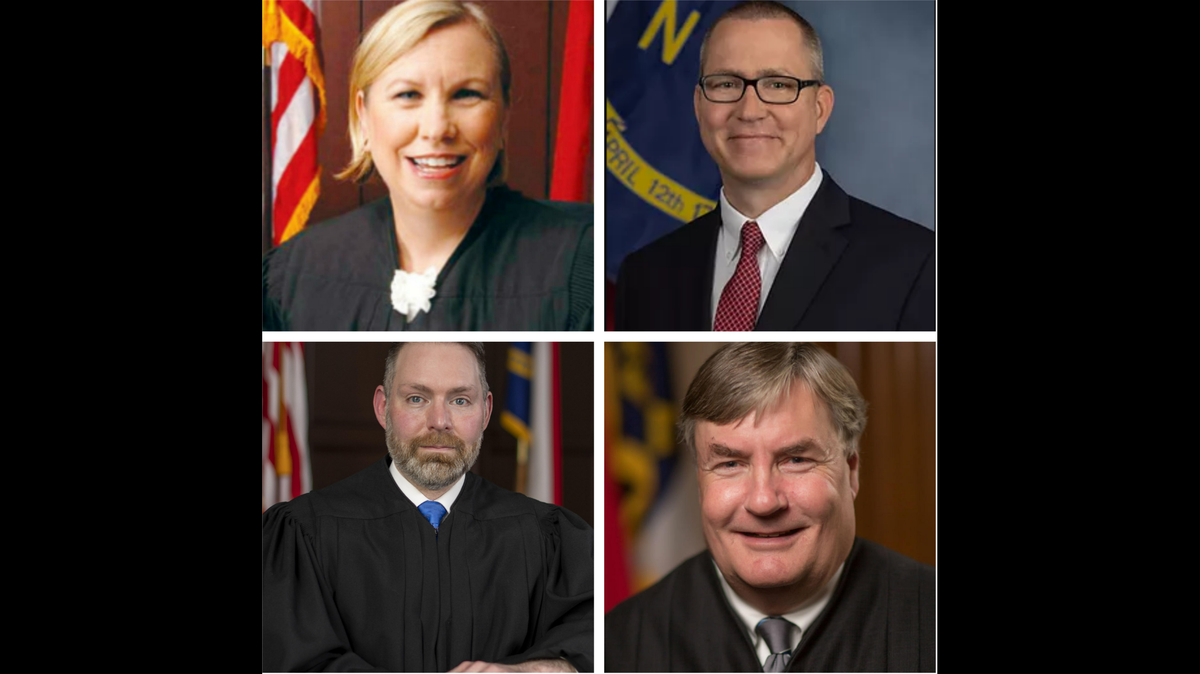
North Carolina’s Supreme Court races are shaping up to be expensive, with the four candidates for the state’s two seats raking in a combined total of nearly $3.2 million in fundraising.
Democrats have heavily outraised their Republican opponents, according to recent campaign finance filings. Current Court of Appeals Judge Lucy Inman brought in over $500,000 in May and June, much more than her Republican opponent Richard Dietz, another sitting Court of Appeals judge, who raised about $97,000. Inman also became the first candidate in the two races to raise over $1 million — coming in at $1.28 million in total receipts for the election.
“We need to continue raising funds and visiting people all across the state and doing everything we can to get our message out,” Inman said in a phone interview with The News & Observer. “Because the stakes are so terribly high this year for our state’s highest court.”
Given the U.S. Supreme Court’s reversal of Roe v. Wade, top Republicans in the state legislature have signaled their interest in passing further abortion restrictions — especially if they win a supermajority in the midterms. If they do, the state Supreme Court could be called on to determine the constitutionality of these restrictions.
The election could flip the partisan majority of the court, which currently has four Democrats and three Republicans.
Like Inman, Democratic Justice Sam Ervin IV, who is running for reelection, has significantly outraised his challenger, Republican Trey Allen. Ervin raised over $300,000 in May and June while Allen — who oversees the state court system — has raised about $143,000.
However, this is by no means a solid indicator that Democrats will win. In 2020, Democrat Cheri Beasley raised around double what her opponent, Republican Paul Newby, did for the state Supreme Court election but still lost the election in an extremely close race, decided by only about 400 votes.
“North Carolina is a big state — these races have gotten more contested,” Ervin said. “It takes lots of funds to communicate with voters.”
In 2020, North Carolina held its most expensive state Supreme Court race ever. The same was true in 2019, and the record may very well be broken again this time around. State supreme court races have become exceedingly expensive contests across the country.
Influence by groups, political parties
A report from the Brennan Center for Justice found that the 2019-2020 election cycle was defined by more special-interest spending than any previous judicial elections.
The Brennan Center found that, in addition to the over $7 million in candidate fundraising in North Carolina’s elections, interest groups spent over $3.4 million on the state’s Supreme Court race.
The Republican State Leadership Committee and the National Democratic Redistricting Committee are both listed in the report as interest groups that have contributed heavily to state Supreme Court races across the country.
The report posited that this much money from outside groups may pressure judges to decide cases a certain way. Bob Orr, a former North Carolina Supreme Court justice, told The N&O this is possible and certainly not helped by the fact that Supreme Court races are partisan.
“We all understand the realities of running a statewide election and being the nominee of a particular party,” he said. “It’s a very, very difficult balance to go through what you need to go through in order to be successful from a campaign standpoint and yet maintain that judicial mindset.”
The Republican-led legislature made state Supreme Court races partisan in 2016 in the last few days of Gov. Pat McCrory’s administration.
At a candidate forum in Wilmington in June, The N&O reported that all four candidates for the state’s high court affirmed their belief in a nonpartisan, objective judiciary and stressed that their party identifications would not affect their rulings.
“So many people think that judges’ political persuasions control the outcome in key cases — we really have to work to reverse that perception,” Allen said at the forum. “We will do that through opinions in constitutional cases that are based on the text and the history of the Constitution — something as objective as you can get in the law.”
Breaking down the funds
In addition to raising more money overall, the two Democrats have also garnered a significant number of out-of-state donors, accounting for nearly 40% of Ervin’s donations over the two most recent months and nearly 22% of Inman’s. Much of the out-of-state money comes from New York and California, as well as Oklahoma and Maryland.
“I think a lot of people within North Carolina and people outside of North Carolina care greatly about democracy throughout the United States,” Inman said. “Even if they do not live in North Carolina, I hope that they are people who have been persuaded that our independent judiciary in North Carolina is worth saving.”
Dietz brought in just $1,000, and Allen just $500 from out-of-state donors.
Democrats also brought in more small donations than their Republican opponents, with contributions of less than $100 accounting for over 12% of Ervin’s earnings in the latest period and over 7% of Inman’s.
Donations of the maximum allowed amount, $5,600, accounted for nearly 60% of Allen’s contributions and 46% of Dietz’s.
Notable donors
Candidates for the state Supreme Court got money from a variety of influential figures across the state and beyond. Below is a list of some of the most notable contributors to each candidate’s campaign.
Lucy Inman
- $5,600 each from Jeffrey Lawson, the CEO of a tech company in San Francisco, and his wife.
- $5,600 from Steve Laufer, a researcher at the Myers JDC Brookdale Institute, a Jerusalem-based social research group.
- $5,600 from James F. Goodmon, the CEO of Capitol Broadcasting Company, which owns WRAL and several other TV stations.
- $5,600 each from Lynn and Stacy Schusterman, members of a Tulsa family which runs a philanthropy group focused on the Jewish community.
- $5,000 from Fred J. Stanback Jr., a North Carolina billionaire who gives frequently to left-leaning candidates and causes. Stanback is also known for his anti-immigration views.
- Nearly $4,000 from Erskine Bowles, former White House chief of staff under Bill Clinton and former UNC System president.
Richard Dietz
- $11,200 from two employees at Kane Realty, a Raleigh-based real estate business.
- $5,600 from David Longo, president of CBI Workplace Solutions, a construction company.
$5,600 from John Stephen Vanderwoude, a venture capitalist and frequent donor to N.C. Republicans.
$5,600 from Stephen Zelnack, retired chairman of Martin Marietta, a Raleigh-based building materials company.
$4,000 from Bill Marsh, vice president of Gelder & Associates, a construction company.
$1,000 from Ed Petkovich, owner of the Walsingham Group, a defense contracting company.
$1,000 from Michael Vaden, a defense contractor with the Aryphon group.
Sam Ervin IV
- $5,600 each from Jeffrey Lawson, the CEO of a tech company in San Francisco, and his wife.
- $5,600 from Steve Laufer, a researcher at the Myers JDC Brookdale Institute, a Jerusalem-based social research group.
- $5,600 each from Lynn and Stacy Schusterman, members of a Tulsa family which runs a philanthropy group focused on the Jewish community.
- $5,600 from James Y. Kerr II, general counsel for Southern Company, an Atlanta-based utility company that is partnering with Duke Energy to create a new “Southeastern Energy Exchange Market.”
- $5,600 from Merle Chambers, founder and CEO of Axem Resources, an oil and gas exploration company.
- $5,000 from Fred J. Stanback Jr., a North Carolina billionaire who gives frequently to left-leaning candidates and causes. Stanback is also know for his anti-immigration views.
Trey Allen
- $11,200 from two employees at Kane Realty, a Raleigh-based real estate business.
- $5,600 from Macon Newby, wife of N.C. Chief Justice Paul Newby.
- $5,600 from David Longo, president of CBI Workplace Solutions, a construction company.
$5,000 from Bill Marsh, vice president of Gelder & Associates, a construction company.
$1,000 from Robert Barnhill, chairman of Barnhill Contracting Company, a Raleigh-based construction company.
For more North Carolina government and politics news, listen to the Under the Dome politics podcast from The News & Observer and the NC Insider. You can find it at https://campsite.bio/underthedome or wherever you get your podcasts.
This story was originally published July 26, 2022 at 12:19 PM.