NCDOT pledges to make Pisgah National Forest ‘whole again’ after mining for I-40
AI-generated summary reviewed by our newsroom.
- NCDOT will blast a 40-acre quarry in Pisgah National Forest to rebuild I-40.
- To compensate, NCDOT will buy land, build a bridge and create wildlife crossings.
- The forest quarry will cut costs and time in restoring I-40 in the Pigeon River Gorge.
To rebuild Interstate 40 through the Pigeon River Gorge, the N.C. Department of Transportation will blast a giant hole in Pisgah National Forest and haul away tons of rock.
To help make up for the damage done by the quarry, NCDOT has agreed to take several steps to help the national forest and the wildlife that lives there.
NCDOT will add 1,057 acres to the forest by buying three pieces of property sought by the U.S. Forest Service. It will also create nine new road crossings for wildlife and aquatic organisms and will build a new bridge into the forest to replace a ford that impedes the flow of the Pigeon River and is impassable when it floods.
The commitments are spelled out in an agreement signed by NCDOT and the Forest Service in September.
“The purpose of this is really to make the forest whole again after our activities,” said Marissa Cox, who leads the western regional team of NCDOT’s Environmental Policy Unit.
NCDOT and its contractors are rebuilding four miles of the eastbound lanes of I-40 near the Tennessee state line where the flooding Pigeon River washed them away after Hurricane Helene. The state needs an estimated 3 million cubic yards of stone to re-establish the highway roadbed.
NCDOT officials say mining the stone from the side of a mountain across the river will save tens of millions of dollars and shorten the construction time by up to three years by keeping trucks off I-40. Traffic moves at about 35 mph on the surviving westbound lanes, which were converted to two-way traffic separated by a low concrete median.
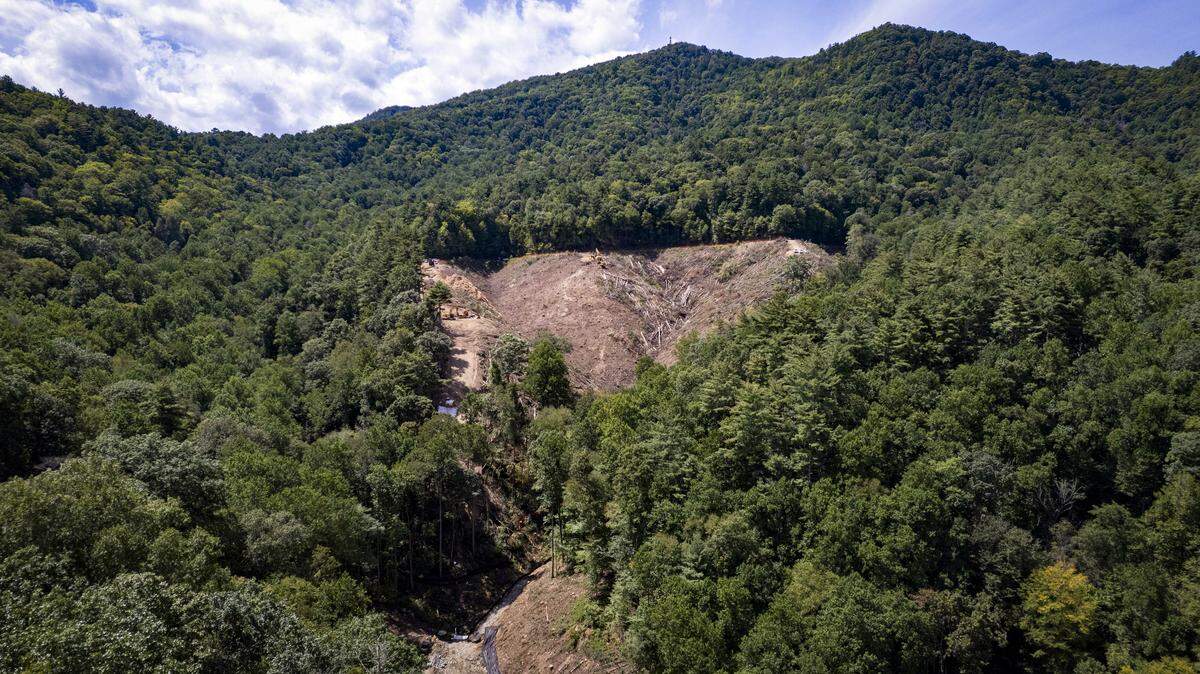
NCDOT is often required by law or environmental permits to make up for damage caused by building roads and bridges. But the agreement between the department and the Forest Service calls for additional measures meant to make up for creating a 40-acre quarry in a pristine section of national forest.
The two agencies began talking about it nearly a year ago when it became clear that a quarry in Pisgah was the best place to get stone for the highway, said John Jamison, head of NCDOT’s environmental policy unit.
“They would kind of toss out ideas along the way, and we would say, ‘Yeah, that makes sense,’ or ‘This may not be viable for us,’” Jamison said. “It was a natural back and forth that we worked through and ultimately started writing down some ideas.”
Altogether the measures are expected to cost $26.7 million. The Federal Highway Administration, which is paying for most of the estimated $1.36 billion I-40 rebuilding project, will cover those costs, according to the agreement.
James Melonas, supervisor of National Forests in North Carolina, announced the agreement during an event near the quarry site on Sept. 26, the anniversary of the storm.
“Not only are we working together with the DOT on the restoration of the borrowing area itself, but we’ve also entered into an agreement that will improve water quality and wildlife habitat throughout the Pigeon River Gorge,” Melonas said. “We’re very grateful and proud to play a part in this project, and the Forest Service stands shoulder-to-shoulder with our state and federal partners as we see this project through to the end.”
A new bridge with environmental benefits
NCDOT and its contractors initially looked at seven potential sites to mine stone in Pisgah National Forest. It ultimately chose one based on geology and the ease of moving stone to the construction site.
It’s also the site that will do the least harm to the forest, said Sam Evans, who heads the forest program at the Southern Environmental Law Center in Asheville.
“Obviously it would be ideal if we didn’t have to have a quarry on national forest lands,” Evans said. “That’s a really intense use of the land, and it will never be quite the same in that area.”
The agreement with the Forest Service is another way that NCDOT seems to be handling the environmental impacts of the project pretty well, Evans said.
Evans is especially happy to see the state build a bridge to replace the Buzzard Roost Road ford near Exit 7 from I-40. The bridge will not only provide safe, reliable access to the forest, but it will eliminate what has essentially been a dam on the river, he said.
“Historically, that low-water crossing has been one of the reasons that it’s hard to restore any amount of ecological flow to that river system,” he said.
Agreement aims to ease movement of wildlife
The planned wildlife crossings are welcome news to members of Safe Passage, a coalition of groups and individuals that advocate for measures that help animals safely get over or under I-40 and other roads in the region, said Ron Sutherland, chief scientist for the Wildlands Network.
The agreement calls for NCDOT to build or enhance four I-40 crossings for wildlife and five other crossings elsewhere in the forest for aquatic organisms, such as fish and amphibians.
But Sutherland would also like to see a crossing in the construction zone, where NCDOT plans to build a concrete wall up to 70 feet high to hold up the eastbound lanes of I-40. He wants the state to replace older pipes and culverts under the road with larger ones, both to handle future floods and to accommodate wildlife.
“It’s not just large wildlife, it’s everything else. The rattlesnakes, the spotted skunks, the salamanders,” he said. “Basically nothing is going to get across the combination of the wall, a median barrier and the interstate itself. It’s just going to be a lost cause unless we go ahead and fix it now.”
The culverts under I-40 survived Helene largely intact, except where the road disappeared, say Cox and Jamison. The Federal Highway Administration isn’t interested in replacing them, Jamison said.
“The focus of the conversation was to make the repairs necessary to make I-40 operational again,” he said. “And that meant really not doing anything on the non-river side of I-40, the mountain side so to speak, which is already a fairly steep mountain face and creates its own barriers already for wildlife passage.”
Sutherland counters that relying on the existing culverts may be short-sighted. They survived, he says, because the Pigeon River Gorge received less rain than other parts of the mountains.
“It doesn’t seem wise from a taxpayer standpoint to build a billion-dollar wall on top of rusting old pipes that might not survive the next major hurricane,” he said.
Contractors moved the first bit of rock from the Pisgah National Forest quarry last week, according to NCDOT. The department expects it will be late 2028 before the two eastbound lanes of I-40 are rebuilt through the gorge and ready for traffic.
This story was originally published November 11, 2025 at 11:10 AM.