Drones and tons of stone: How railroad rebuilt a historic NC line after Helene
AI-generated summary reviewed by our newsroom.
- Before and after LiDAR images identified the damage and what would be needed for repairs.
- Rebuilding required 140,000 tons of stone and 52,000 feet of steel.
- Work was split into 103 projects; only a handful of access points over 15 miles of track.
The remnants of Hurricane Helene silenced the railroads that normally echo through the mountains of Western North Carolina.
Flood waters and landslides destroyed the CSX line alongside the North Toe and Nolichucky rivers. More than a mile of track used by the short-line Blue Ridge Southern Railroad south and west of Asheville had to be replaced.
Meanwhile, the French Broad River inundated the Norfolk Southern yard in Asheville and washed the earth from underneath the tracks in Marshall and numerous other places. The flooded Pigeon River slammed so much debris into the railroad’s 107-year-old steel truss bridge in Newport, Tennessee, that it had to be replaced.
All of that track was rebuilt and put back in service last year, leaving just one section to go: 15 miles of Norfolk Southern’s AS Line between Grovestone and Old Fort, east of Asheville, that includes a series of remote tunnels and horseshoe turns as the tracks climb and descend the Eastern Continental Divide.
.png "image (2).png")
The remote, steep terrain that made this section of railroad difficult to build 145 years ago also made it difficult to restore.
Norfolk Southern spent months after the storm evaluating the line before announcing last May that it planned to rebuild it. The damage was both widespread and extensive, said Alan Johnson, who oversaw the rebuilding as the railroad’s chief engineer for design and construction.
“Think of a roadbed being completely washed out, nonexistent, the track maybe hanging in the air or not even present,” Johnson said.
Norfolk Southern’s engineers and contractors broke the work down into 103 separate projects — a bridge repair here, a new retaining wall there. The railroad used drones equipped with LiDAR lasers to map the route and compare it to LiDAR data it had collected before the storm, Johnson said.
“By bringing those two datasets together, we were able to have a much better understanding of the true impacts and the amounts of material that would be required for this rebuild,” he said.
And it was a lot of material. To rebuild the washed-out rail bed and shore up embankments, the railroad brought in 140,000 tons of stone, thousands of truckloads on narrow, winding roads. Nearly 52,000 linear feet of steel had to be driven or drilled into the ground for new retaining walls.
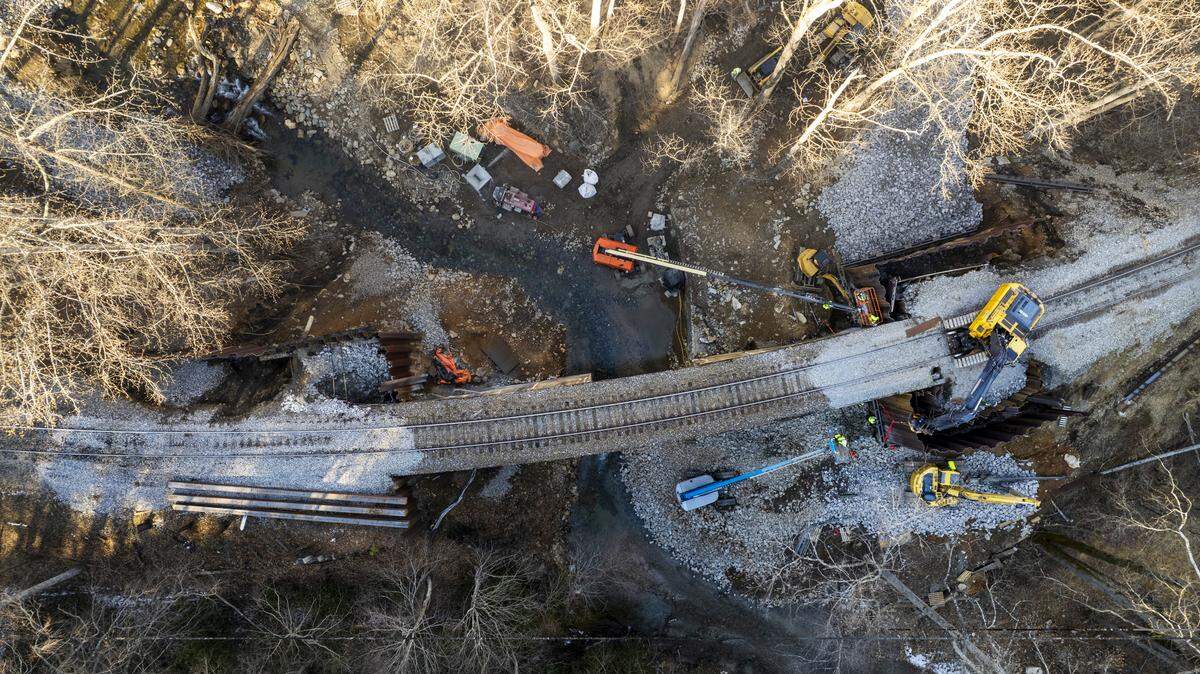
The mountainous terrain meant there were no “laydown” areas to store stone, steel or rails, so everything had to be trucked in when it was needed. And because the railroad snakes along the wooded mountainside, reaching it is difficult, Johnson said.
“Over this 15 miles, you can count on one hand the number of access points,” he said.
Johnson credits Norfolk Southern’s engineers with coming up with a strategy for not only putting the track back where it was but also adding new and more durable retaining walls and other structures that will make it more resilient during the next storm.
The railroad passes through seven tunnels in the Old Fort Loops, and all of them came through Helene unscathed. The tracks inside the longest tunnel, at Swannanoa Gap, were probably in the best shape of any 1,800-foot section of the line.
“It was a good feeling to go through those tunnels and see that we were not having to build any track through those,” Johnson said.
This story was originally published March 26, 2026 at 5:00 AM.