
NC university’s first response to DEI ban? Striking use of ‘race,’ ‘equality,’ ‘white’

Like all educational institutions receiving federal dollars, High Point University had two weeks to respond to a Trump administration edict last month that it cease diversity, equality and inclusion efforts.
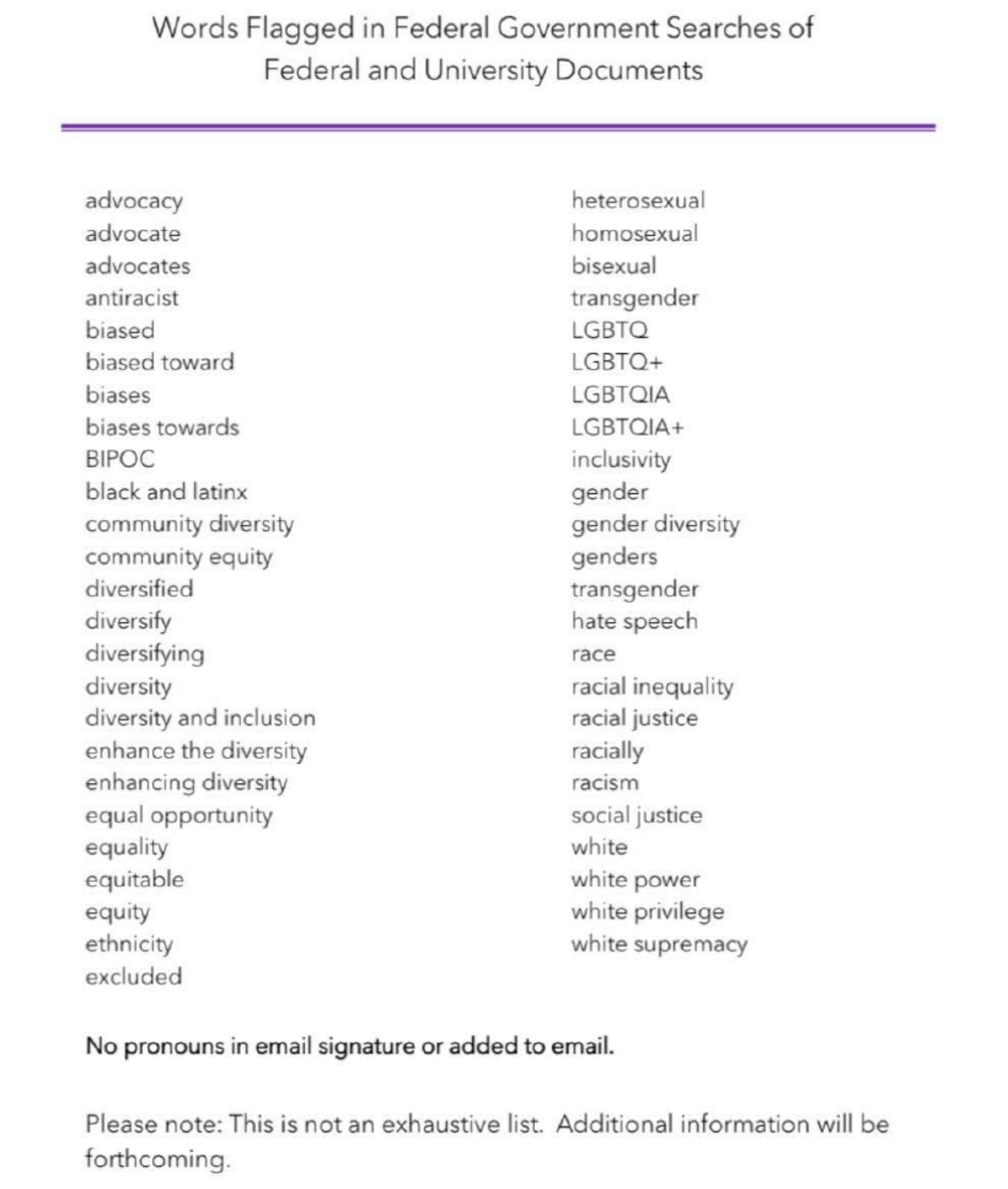
A week later the private university distributed a list of 49 banned words or terms, including “equality,” “gender,” “black and latinx,” “white” and “white supremacy” to be removed from all “documents, events and presentations.” Course descriptions, student handbooks, class syllabi and webpages were among the university publications listed for censoring.
A spokesman for the American Association of University Professors, which represents faculty across the country, said it was among the most extreme responses to a letter from the U.S. Department of Education that he was aware of.
After The News & Observer contacted High Point Provost Daniel Erb on Sunday about the list, Erb emailed text from an email he said he sent to deans that day backing off from the word ban.
“(O)ur legal counsel has helped clarify that our priority should be on ensuring all our program qualifications and requirements do not discriminate on the basis of race, ethnicity, gender, religious beliefs, etc.,” the text said. “Therefore, the concern about the language that is used is no longer a focus.
“You no longer need to conduct audits regarding the list of words that were originally identified as words that might lead to an audit by the federal government. There are no terms or words that you are required to change,” it stated.
The N&O reached out to numerous High Point faculty on Sunday, the last day of their week-long spring break, about the word ban. One faculty member was willing to comment but did not want to be identified, fearing retaliation.
“It gave me a sense of anxiety, and this is like ‘1984,” the professor said, referring to George Orwell’s classic dystopian novel about a “big brother” government that resorts to censorship, fabrication and surveillance to keep its citizens under control.
The ban list also included a prohibition on faculty providing pronoun preferences in their email correspondence. University spokesman Alex Abrams said the university has had a policy for at least a year limiting “email signatures” to “name, title, academic credentials and contact information.”
Battle over DEI initiatives
The aggressive efforts by President Donald Trump’s administration to eliminate diversity, equity and inclusion (DEI) programming from the federal government and beyond has drawn praise from his supporters. It’s also drawn lawsuits and harsh criticism.
The AAUP and other groups recently won a preliminary injunction from a federal judge stopping parts of two Trump executive orders banning DEI efforts. The “Dear Colleague” letter dated Feb. 14 that the U.S. Education Department sent out speaks to the department’s opposition to DEI initiatives.
Kelly Benjamin, an AAUP spokesman, said High Point’s list of temporarily banned words is among the most extreme responses he’s seen to the letter. He, too, referenced “1984.”
“That is a very Orwellian list of censored terms that should be concerning for anybody who cares about higher education, and to have that kind of guidance from an administration is incredibly troubling,” he said.
Craig Trainor, the acting assistant secretary for civil rights within the U.S. Department of Education, sent the letter to schools, universities and colleges directing them to remove all DEI programs or risk the loss of federal funding for research and student grants.
Trainor cited the U.S. Supreme Court’s 2023 decision in Students for Fair Admissions v. Harvard — a case that included UNC-Chapel Hill as a defendant — that struck down race-based admissions.
Erb, in his email Sunday to the deans retracting the word ban, said the federal letter left the university in a quandary.
“As you know, universities were given just 14 days to comply with the Dear Colleague letter mandates in order to maintain federal funding, and my initial communication with you came after the termination of several national Department of Education grants for local educators, of which our School of Education was a recipient,” he said. “None of us want to see our students or university lose funding.”
Erb said in the email that much of the now-abandoned list of words was patterned after one used by the National Science Foundation, which is also seeking to comply with the Trump administration’s directive, The Washington Post reported. The grant-making foundation used a list of keywords such as “biases,” “diverse backgrounds,” “female,” “male dominated,” and “minority” to search through thousands of ongoing science research projects, the Post said.
The foundation, however, did not require the elimination of every instance one of those words turned up, the Post reported. It gave reviewers the discretion to spare non-DEI projects.
Erb declined to be interviewed, referring questions to High Point’s public information office.
In a late afternoon email to faculty Monday, High Point President Nido Qubein sought to assure them “we believe in academic freedom and innovative teaching.”
The university took “swift” action to avoid the loss of additional funding, he wrote, but he acknowledged that it was “perhaps a bit over-zealous.”
“Our School of Education lost millions in funding overnight, and then a Dear Colleague letter was issued and put higher ed on notice and gave 14 days to comply to an executive order focused on discrimination,” he said. “Our responsibility is huge.”
Fast-growing university
High Point University was founded in 1924 by the city and the Methodist Protestant Church, according to the university’s website. It has grown dramatically in the 20 years since Qubein was named president, adding dozens of buildings and more than 400 acres while increasing the student population from 1,500 to 6,335.
Next year, incoming freshmen will be charged $49,146 in annual tuition and fees, the university reported. That’s higher than many private colleges, but substantially less than the $70,265 tuition Duke University will charge.
Qubein is an author and consultant whose self-help books include “How to Be a Great Communicator,” and he hosts an interview show on PBS North Carolina.
While national conversations about DEI have expanded nationally in the weeks since Trump took office, they have been going on much longer in North Carolina.
Last year, the UNC System Board of Governors repealed its former DEI policy, replacing it with a directive on ensuring “equality” across its 17 campuses.
The move resulted in the elimination or restructuring of dozens of DEI-related jobs, as well as DEI offices and other initiatives. In their efforts to comply with the restrictions on DEI, campuses have limited faculty’s ability to form committees on the topic and eliminated references to the topic in their mission statements.
The UNC system’s crackdown on DEI continued last month as it took action to comply with one of Trump’s orders that prevents federal agencies from contracting with entities promoting DEI.
In response to that order, the system directed its campuses to eliminate mandatory general-education and major-specific requirements related to diversity.
This story was updated to include information from an email High Point President Nido Qubein sent to faculty on March 3.
Staff Writer Korie Dean contributed to this report.
This story was originally published March 4, 2025 at 5:30 AM.