Meet the judges who could soon rule on North Carolina’s redistricting lawsuits
READ MORE
Maps Under the Microscope
At least once a decade, state lawmakers rebuild North Carolina’s election maps. This process of redistricting carries a set of rules. But those rules – and how well mapmakers follow them – get intense scrutiny from the courts almost as soon as the maps become law. This is The N&O’s special report: “Political Maps under the Microscope.”
Expand All
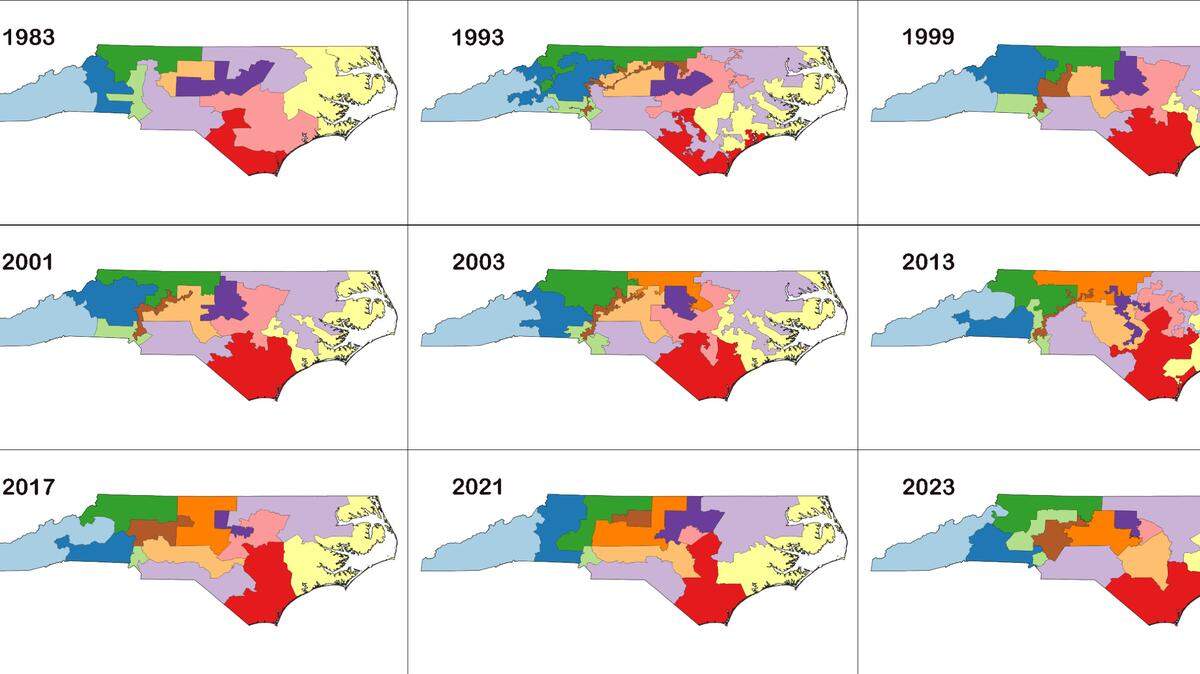
Gerrymandered or no? How will courts judge new North Carolina political maps?
A guide to the three gerrymandering lawsuits challenging NC’s political maps
Meet the judges who could soon rule on North Carolina’s redistricting lawsuits
Podcast: Explore North Carolina’s long history of gerrymandering election maps
Want to design NC redistricting maps? Here’s an app to draw your own political lines.
The trial over whether North Carolina’s new political districts are unconstitutional partisan gerrymanders is happening in early January, but few expect that to be the last word. Rather, it’s the opening salvo of legal arguments.
Most political observers expect the case to eventually be taken up by the North Carolina Supreme Court.
Exactly when that happens, however, is a huge question. It could make a difference in which justices rule on the case or when their ruling might go into effect.
So who are the Supreme Court justices, and what do we know about how and when they could rule on gerrymandering?
Here’s what you need to know.
Partisan control of top court
The court currently has a 4-3 Democratic majority, but two seats are up for election this year, both held by Democrats. So if Republicans flip even one seat, they will gain the majority on the court at least through the 2024 elections, if not longer.
Every judge in North Carolina is elected in partisan elections. And so far, the rulings in these redistricting lawsuits have appeared to more or less reflect the politics of the judges hearing the case.
The Republican-majority N.C. Court of Appeals ruled in favor of Republican lawmakers when they declined to delay the 2022 primaries in December. But then the Democratic-majority state Supreme Court overruled them and did delay the primary, ruling in favor of the liberal challengers.
It’s impossible, however, to say whether the rulings were purely partisan in nature. Both courts have kept the details secret of how each individual judge ruled, The News & Observer reported, despite requests from the media and politicians to make that information public.
When could the justices decide?
The Supreme Court’s decision to delay the primary also came with an order to fast-track the lawsuits. While previous redistricting lawsuits have taken years to reach their final conclusions, the court appears interested in trying to settle this challenge within just a few months, well before the election.
Still, there’s no guarantee the process won’t drag on past the election and end up in the hands of whichever justices sit on the court then.
And even if the justices strike down the maps as unconstitutional before then, it’s possible the 2022 elections might still happen using the old maps. Any ruling would likely have to come at least two months before the primary in order to matter for 2022, although an exact date is impossible to say.
That’s because the map-making process itself can take a week or two, if not longer. Then, politicians would need time to look at the new maps and figure out where, or if, they want to run. Then there would have to be several more weeks for early voting and mail-in voting.
And the 2022 primaries are less than five months away, on May 17.
Who’s on the Supreme Court now?
▪ Paul Newby (R): The longest-serving justice on the court, and the chief justice since 2021, Newby defeated former Chief Justice Cheri Beasley in the 2020 elections when Republicans swept every appellate judicial race in the state.
▪ Phil Berger Jr. (R): The son of N.C. Senate leader Phil Berger Sr., the younger Berger became a judge in 2016 after losing the 2014 GOP primary for a seat in the U.S. House of Representatives to Mark Walker, who went on to serve several terms. He was then elected to the Supreme Court in 2020. It’s likely that the liberal challengers will want Berger to recuse himself since his dad is a defendant — although Berger has resisted doing that in a different high-profile political lawsuit, over voter ID, which caused some controversy earlier in 2021.
▪ Tamara Barringer (R): A former Republican state senator from Cary, Barringer lost her re-election bid to the legislature during the 2018 “Blue Wave” midterm but then won election to the Supreme Court in 2020. It’s unclear whether her recent history as a Republican lawmaker would cause the challengers to ask her to recuse herself from this case.
▪ Anita Earls (D): A Durham civil rights attorney who made a national name for herself in large part by suing North Carolina Republicans over redistricting and voter ID, Earls won election to the court in 2018 and has since been on some progressive shortlists for a potential U.S. Supreme Court opening. It’s likely Republicans will want Earls to recuse herself. In addition to her history suing them over redistricting, she was endorsed in 2018 by former U.S. Attorney General Eric Holder. Holder now leads a group behind one of the redistricting lawsuits — a group that also gave hundreds of thousands of dollars to the N.C. Democratic Party in 2018, when Earls was running for election.
▪ Sam Ervin IV (D): The grandson of the late U.S. Sen. Sam Ervin Jr., a longtime mainstay of Western North Carolina politics, Ervin is finishing his first eight-year term on the court. He’s planning to run for re-election in 2022, and because of that, Republicans have criticized him for not saying which way he ruled on the decision to delay the primaries. It’s unclear if that will cause lawmakers to ask him to recuse himself from the case.
▪ Mike Morgan (D): In 2016, outside groups on both sides of the aisle poured millions of dollars into that year’s Supreme Court race, and Morgan defeated a GOP incumbent. His election flipped the court from a Republican to a Democratic majority, which Republicans hope to reverse in 2022.
▪ Robin Hudson (D): The senior associate justice, Hudson has been on the court since 2007, longer than everyone but Newby. Hers is one of the seats up for election in 2022, but she is not running for re-election. She’s 70 now, and the state’s mandatory retirement age for judges is 72.
For more North Carolina government and politics news, listen to the Under the Dome politics podcast from The News & Observer and the NC Insider. You can find it at link.chtbl.com/underthedomenc or wherever you get your podcasts.