What you should know about Republican NC House Speaker Destin Hall
AI-generated summary reviewed by our newsroom.
- Hall became House speaker Jan. 8, 2025 after GOP caucus selection and Moore’s exit.
- Hall drives redistricting and ICE cooperation policy; budget stalemate shapes 2026 agenda.
- As former Rules chair, Hall controlled bill flow and led Republican redistricting efforts.
The three most powerful politicians in North Carolina are the governor, the speaker of the House of Representatives and the president pro tempore of the Senate.
In 2026, that’s Gov. Josh Stein, Senate leader Phil Berger and House Speaker Destin Hall.
Berger, a Republican, has been in power for decades, and Stein, a Democrat, was attorney general before becoming governor, making the two of them higher-profile figures.
But Hall, a Republican, is just one year into a powerful statewide position as speaker.
Here’s more about who he is.
How Destin Hall became speaker
Hall, 38, was elected as speaker at the start of the legislative long session. His first day on the job was Jan. 8, 2025, when he received the gavel in an opening-day ceremony attended by previous House speakers.
The speaker is always chosen by the party that is in the majority, so Republicans decided among themselves that it would be Hall.
Hall replaced now-U.S. Rep. Tim Moore, who had been the longest-serving House speaker before he ran for Congress. Hall was known as a top lieutenant to Moore.
Hall served most recently as chair of the House Rules Committee. That is a powerful position because the Rules chair decides what legislation comes to the floor, or is sent to the Rules Committee never to be seen again. Rules is the last stop for a bill before it gets a vote.
The most powerful positions in the chamber are the speaker, majority leader and Rules chair. Each is a representative elected by voters in their districts, but they wield considerable influence over millions of North Carolinians because of their roles in the majority party.
Hall’s hometown, education, career
Hall grew up in Lenoir and was raised by his grandparents. He and his wife, Madison, live in Granite Falls, and their son, Henry, was born in 2025.
In a speech after being sworn in a year ago, Hall said that “only in America” could someone who grew up as he did, in rural, small-town North Carolina from a family without college graduates or lawyers, become speaker.
Hall received his bachelor’s of science degree in risk management and finance in 2009 from Appalachian State University and his law degree from Wake Forest University Law School in 2014. He is a general practice attorney with the law firm of Wilson, Lackey, Rohr & Hall.
He has represented Caldwell County and Watauga County in the state House since 2017.
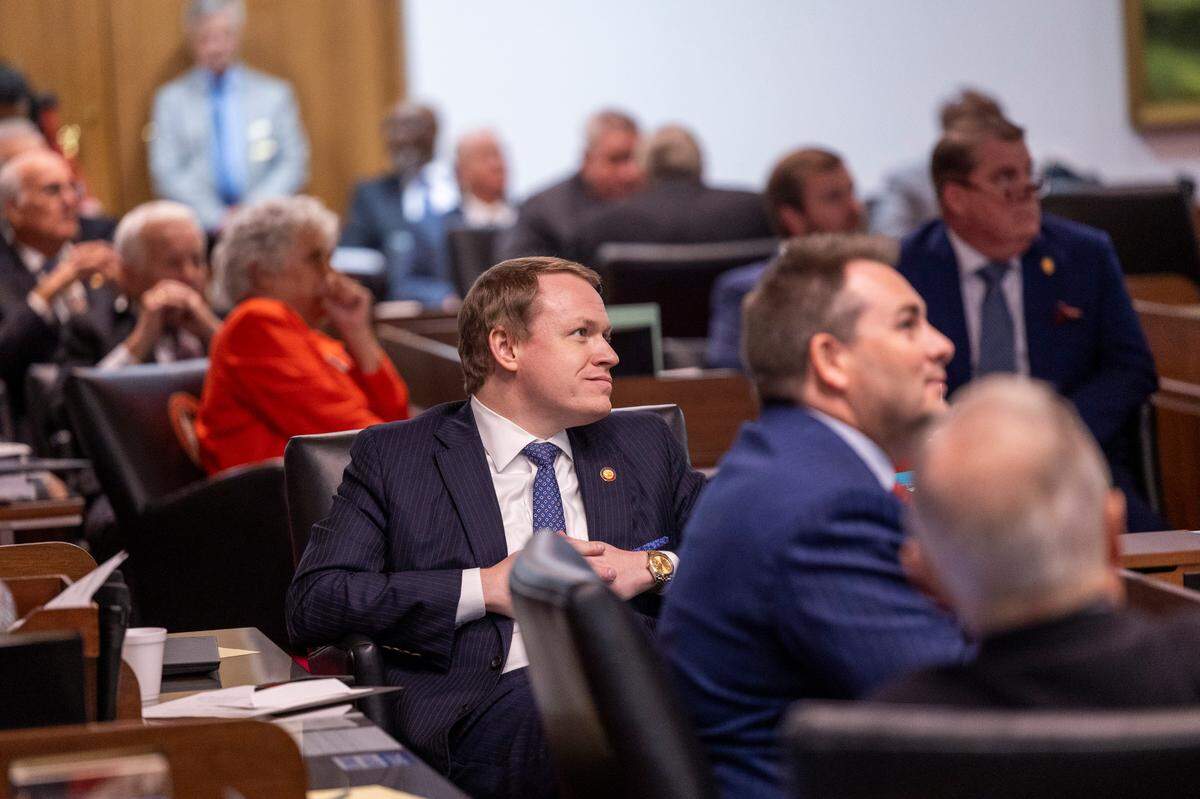
Laws and legislation led by Hall
Hall was Republicans’ top redistricting official for several years, leading to the redrawing of maps that have favored Republicans. That led to lawsuits and a 2022 gerrymandering trial during which Hall testified that he had used “concept maps” to help guide his work, despite previously telling Democrats he had not used any outside materials.
Over the past few years, Hall’s main push has been about making sure sheriffs across the state closely cooperate with U.S. Immigration & Customs Enforcement, known as ICE.
A version of his ICE cooperation bill passed via a veto override in late 2024, before he became speaker. Another bill tightening the law passed in 2025 as Republicans overturned another veto — with help from a Democrat.
In November, as federal immigration agents were detaining people in Charlotte and the Triangle, Hall said it was the “direct result of some sheriffs who have been elected, who decided they were not going to cooperate with ICE anymore.”
Now that the state budget stalemate has dragged on into 2026, that will be the focus of the upcoming legislation session that begins in April.