
Push to move courthouse Confederate monuments snags in Alamance. Legal quest persists.
A trio of lawsuits working their way through North Carolina’s court system were filed to clarify when Confederate monuments can or must be moved from courthouse property.
On the eve of the first trial, set for this week in Alamance County, a Superior Court judge dismissed the case.
“We were mostly disappointed that we weren’t granted a hearing on the facts,” said Barrett Brown, president of the local NAACP branch, which was one of the plaintiffs. Also pressing the case against Alamance County and its board of commissioners were the State Conference of the NAACP, Down Home NC, Engage Alamance and a multi-racial group of individual plaintiffs.
But a decision that favors one county fighting to keep a courthouse monument is unlikely to be the end of the dispute.
Judge Forrest Bridges acknowledged as much in announcing his decision, as did Rik Stevens, the county’s attorney, in comments about the case. In an email to The News & Observer, Stevens said, “we appreciate the judge’s ruling but also understand that the ruling could be appealed.”
Brown said Thursday that the local NAACP organization is keen to keep fighting. “This might be a long trek judicially, but we believe we’re gonna get justice and we’re gonna get that monument removed.”
Attorneys representing the plaintiffs will likely make a decision on how to proceed next week, after the judge has entered his written order, said Gagan Gupta, one of the attorneys involved in the case in Alamance, as well as similar lawsuits in Gaston and Iredell counties.
The NC monuments law
One reason an appeal is likely is that North Carolina’s appellate courts have yet to interpret the statute that is key to Alamance County’s explanation for why it will not move the local monument. It’s the Cultural History Artifact Management and Patriotism Act of 2015, often referred to as the monuments law.
The statute bars moving monuments on public property in most circumstances, but it has an exception for “An object of remembrance for which a building inspector or similar official has determined poses a threat to public safety because of an unsafe or dangerous condition.”
Gov. Roy Cooper invoked that exception when he ordered three Confederate monuments be evicted from State Capitol grounds after protesters pulled two statues down in 2020, The News & Observer previously reported. He cited the physical risk from assaults on the monuments themselves and “the strong potential for violent clashes at the site.”
Two years before that, the State Historical Commission recommended against removing the same monuments. The commissioners said they felt constrained by the 2015 law.
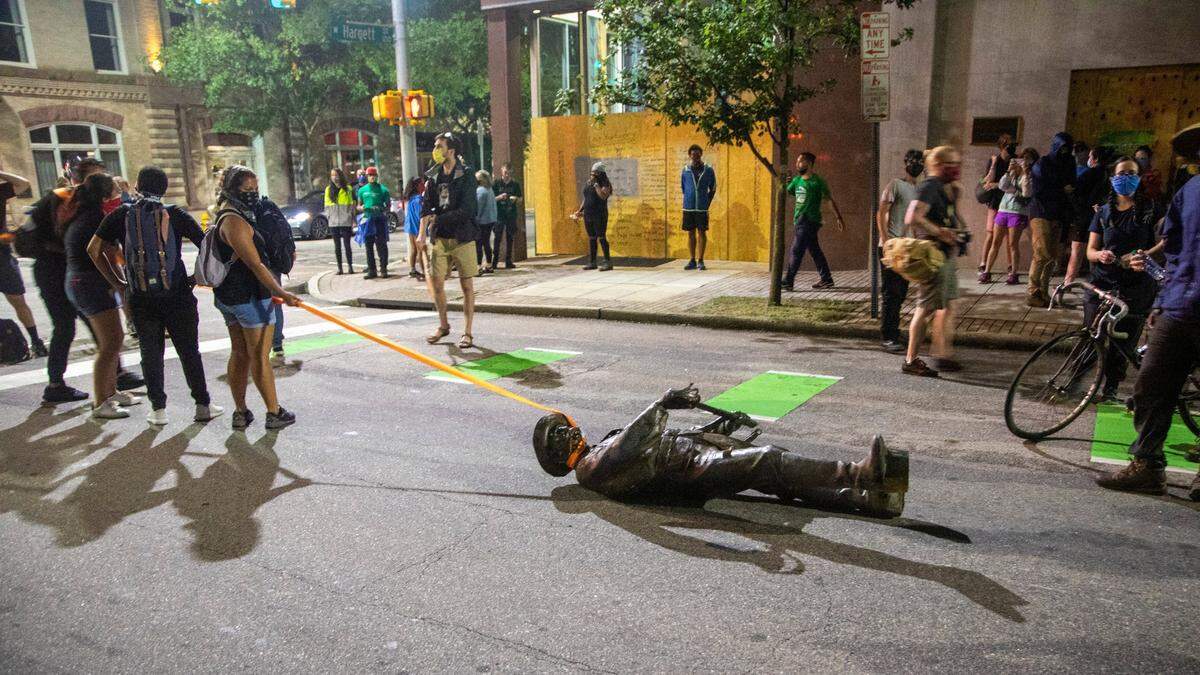
The plaintiffs’ attorneys in the Alamance case made arguments similar to Cooper’s, citing frequent protests and counter-protests, accompanied by guns and death threats, as some of the evidence. They also quoted from a letter that former County Administrator Bryan Hagood wrote to the county commissioners in June 2020.
“I believe this would be a terrible thing for Alamance County to have someone seriously injured or killed by one of our Deputies or a Graham Police Officer in an altercation that began as protecting the memorial,” Hagood wrote.
He also worried about potential violence by self-appointed monument protectors. “I don’t believe it is right for things to come to violence over this issue where law enforcement and/or citizens on any side of the issue are hurt or killed,” he wrote, before recommending that the monument be moved.
The commissioners rebuffed Hagood’s suggestion, writing in a news release that year that he “neglected to obtain information about the legality of his opinion before he offered it.”
County leaders have repeatedly said they do not have the authority to move the monument.
Who’s right? “One of these three cases potentially will set precedent on that question,” Gupta said.
A Court of Appeals or Supreme Court decision will likely influence the future of the roughly 70 monuments that remain standing on public property across the state.
Trial dates have not yet been set in the Gaston or Iredell County cases.
All three lawsuits make additional arguments that the monuments violate the state constitution.
A protest hot spot
Debate over whether to move Confederate monuments from public spaces, particularly near courthouses, has roiled communities for years, but particularly since the death of George Floyd at the hands of a Minneapolis police officer sparked protests across the country.
Since then, leaders in nearly two dozen North Carolina communities have removed or relocated monuments, data from the Southern Poverty Law Center show.
But perhaps no other monument in the state has been the subject of more intense protest than the Confederate soldier that stands atop a granite column about two stories high in downtown Graham, the Alamance County seat.
The News & Observer and ProPublica chronicled the near-daily conflicts in the town’s Court Square in late 2020 and early 2021 in “Sound of Judgment,” a documentary and investigative report that documented the depth of racial discord there.