Tornado watch lifted as strongest Monday storms pass the Triangle
AI-generated summary reviewed by our newsroom.
- Widespread damaging winds and brief tornadoes expected across the Triangle today.
- Some winds may reach 74 mph, risking structural damage and outages.
- Storm line likely noon–evening; fast-moving storms may require quick sheltering.
The strongest bands of storms, with their risk of damaging winds and tornados, have passed the Triangle.
The most concerning band of thunderstorms with the risk for severe weather crossed the Triangle around midday bringing rain, but little else.
Winds reached about 40 miles per hour with gusts topping out at 38 at the Raleigh-Durham International Airport, according to the National Weather Service. Wake County was no longer under a tornado watch as of 4 p.m. Monday.
Weather forecasts predicted widespread damaging winds and some tornados throughout the day and into evening Monday, March 16.
“At a high level, the parameters for tornado development were there and are still there in the eastern part of the state where the tornado watch is, and they still might get tornadoes down there,” said Phil Badgett, lead forecaster for National Weather Service, told The N&O around 2:30 p.m. Monday. “But, at least for us, the threat is over and I guess we can just kind of be thankful for that (and) that nothing really happened.”
Tornado warnings
Those storms, which prompted tornado warnings in some parts of North Carolina, diminished in power as it crossed the state, said Nick Petro, a metrologist with the National Weather Service. But the storms might reintensify as they move toward the eastern North Carolina.
“This event has been a struggle to nail down the exact time, as it is very much more scattered in nature,” he said. “But that’s a good thing. When it’s less organized that means the overall severe threat is less so. I think most people will take that trade off.”
The NWS declared Monday a level 4 out of 5 “moderate risk” of severe storms. The last level 4 day we had in North Carolina was March 18, 2021, and several tornadoes occurred.
Several area schools were closed Monday ahead of concerns about high winds and possible tornadoes.
Severe weather timeline
A tornado watch was in effect until 2 p.m. Monday for multiple North Carolina counties including in Wake, Durham, Orange, Lee and Chatham.
A new tornado watch was issued for 8 p.m. most of eastern North Carolina including Wake and Johnston counties. But several counties, including Wake, Johnston and Cumberland counties, were dropped from the watch before 4 p.m.
Wake County was on the edge of where the atmosphere is “most primed” for severe weather, Petro said.
“We are looking at the energy provided to grow these storms and become severe,” he said. “It is most abundant east of I-95, there is enough on the western edges to potentially become severe.”
People should have multiple ways to get weather alerts and warnings.
A tornado watch comes when severe thunderstorms and tornadoes are possible, while a tornado warning means that a tornado is coming, and people should find a safe place right away.
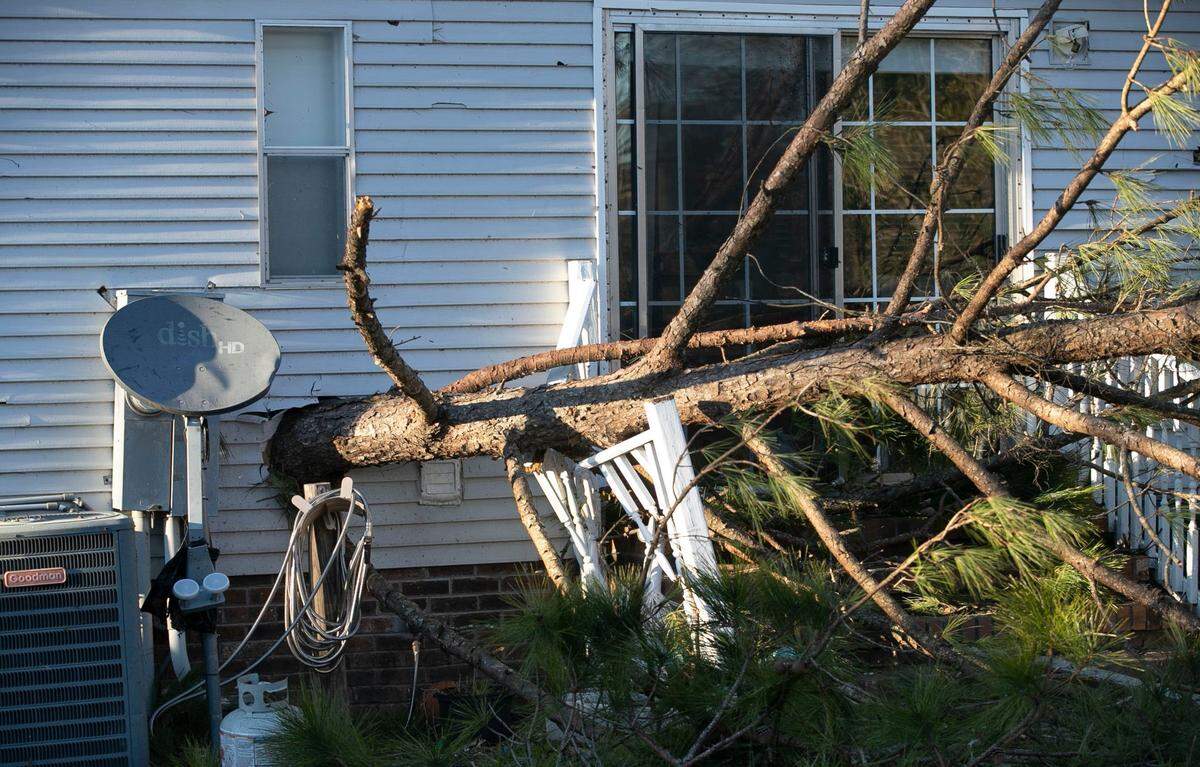
Seeking shelter
Duke Energy warned customers to prepare for damaging winds and possible tornadoes across the area.
“Strong wind gusts can bring down trees and power lines and cause outages, and our line and tree crews will work as quickly and safely as possible to restore service as outages occur,” according to Rick Canavan, Duke Energy storm director in a news release.
Peak tornado season in the state is from March to May, according to ReadyNC.
Most deaths and injuries that occur during a tornado are caused by flying debris, according to National Weather Service. People should seek shelter if a tornado warning has been issued for their area. Good shelter options include:
- The lowest possible floor or in the basement.
- Avoid rooms with windows or taking shelter near heavy objects like a fridge or piano.
- If you live in a mobile home, you want to find a sturdier shelter or go outside and try to find a ditch or low-lying area.
- If your home or office doesn’t have a basement, go to the lowest floor. Hallways, bathrooms and closets are better options.
- If you’re in your car, don’t try and outrun the tornado. Try to get to a public building and seek shelter. Do not seek shelter underneath bridges or overpasses.
- If you’re outside, seek nearby shelter. If there isn’t a shelter, find a ditch or low-lying area.
Rent.com, an apartment search engine, recommends people who live in apartments to also seek shelter in basements and the first floor.
“If there aren’t any options below ground, a neighbor’s ground-floor unit is the safest bet,” according to a Rent.com’s blog post. “Also, if you live in a building with interior stairwells, you can go to the lowest floor and under the stairs to hide in a tornado.”
This article will be updated throughout the day.
Portions of this story were previously published in The News & Observer.
This story was originally published March 16, 2026 at 8:32 AM.