A hoops dream ends in Kinston, but basketball’s place in fighting nightmares persists
READ MORE
Dreams and Nightmares: A Kinston basketball story
North Carolina is home to various basketball cathedrals, places whose history transcend the sport and define the state’s culture. Our four-part series, publishing throughout Winter 2022, explores why Kinston High School rises above the rest of N.C.’s worthy shrines.
Expand All
Inside NC’s poorest community lies its richest basketball where nightmares fight dreams
It started as a basketball game. It ended as a reminder of what Kinston is up against
As teens are gunned down in Kinston, can basketball’s refuge prevent another victim?
A hoops dream ends in Kinston, but basketball’s place in fighting nightmares persists
In this small Eastern North Carolina city down on the Neuse River, where the floodwaters rise while when the hurricanes come, where downtown grows quieter while the mom and pop stores close, a basketball court is not a place for games but a place to escape. To dream.
The Vikings of Kinston High School are nearing the end now, a team of teenagers from one of North Carolina’s most hard-luck cities hoping to turn a dream of their own into reality. This is a school that’s won 11 state championships, more than all but two high schools in state history, one where some of its best over the years have gone onto college cathedrals of the ACC — Reynolds Coliseum and the Smith Center and Cameron Indoor Stadium — and then off to the NBA.
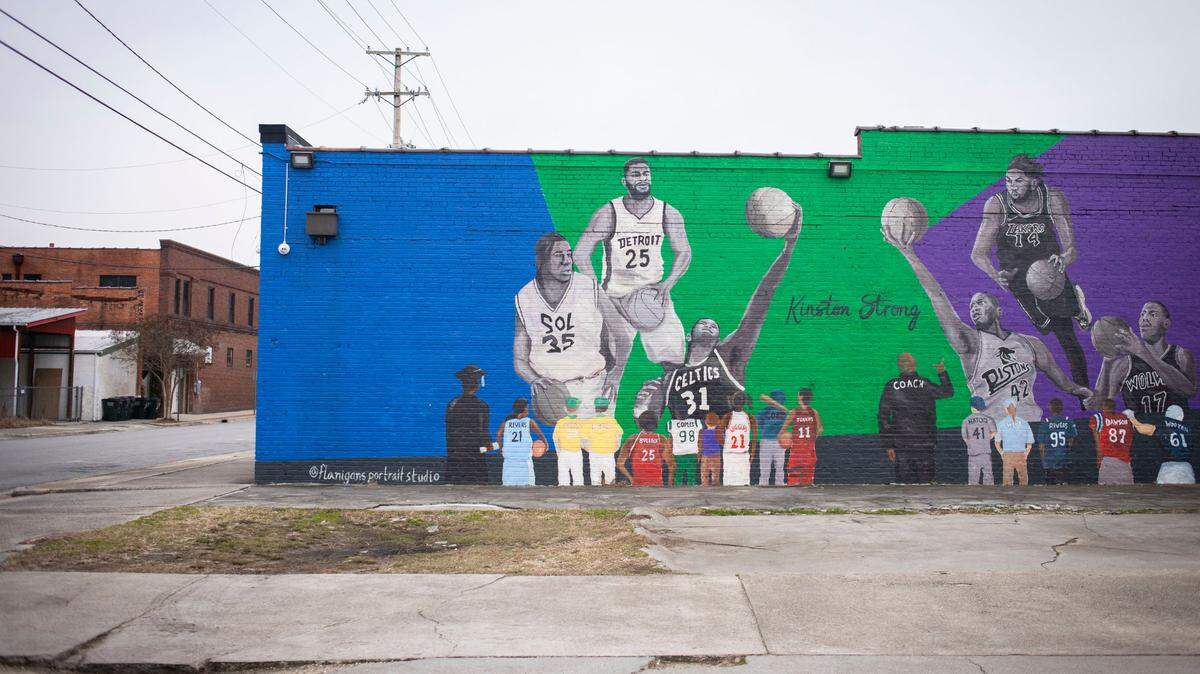
The players here now grew up watching and hearing about Brandon Ingram and Reggie Bullock the way those of an older generation grew up hearing about Jerry Stackhouse, the way that those of his generation grew up hearing about Charles Shackelford and Cedric “Cornbread” Maxwell. All except Maxwell played in Kinston High’s current gym, where little kids walk into games and watch who they wish to become.
To some, just wearing the jersey with KINSTON across the chest is the fulfillment of a long-held desire. Something to treasure on its own, the achievement of becoming a part of something greater.
“It’s something I dreamed about, as a kid,” says Dominic Clark, a junior.
“I always wanted to put on this jersey, ever since I first saw them play,” says Jyrah Canady, a senior.
“It’s always been a dream,” says Jeremy Dixon, another senior.
“Watching Reggie, Brandon — I always wanted to follow in their footsteps,” says Horace Smith, a junior. After a pause he describes another wish, one inspired by the reminders all around him in this old gym: “That’s been the dream of mine, too, to win the state championship.”
It will be a long road to reach that point. There can’t be any slip-ups, or off nights, and even if Kinston goes on a run, Farmville Central looms. Kinston and Farmville are the class of 2-A high school basketball in the eastern half of the state. Kinston has the history and tradition, while Farmville, 25 miles to the north, has emerged as a power that’s won three straight state titles. A second game between the two — Farmville won the first, in mid-January — seems destined.
It’s approaching mid-February now, and the Vikings are closer to reaching their potential than they’ve been at any point since the season began three months earlier. Since consecutive losses in mid-January, Kinston has run off eight straight victories.
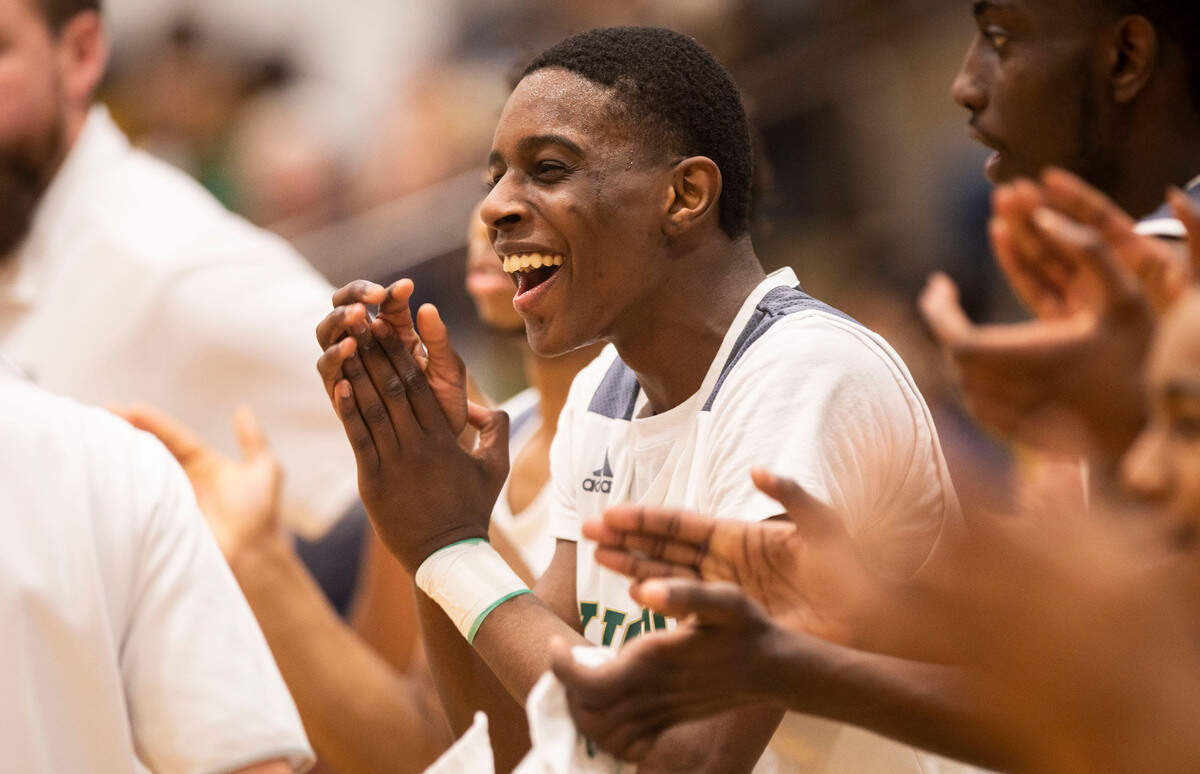
Senior night arrives with celebratory pomp, every Kinston High senior in a winter sport lining up outside a mostly full gym and waiting their turn to be introduced. The seniors on the boys basketball team line up last, shuffling their feet, nervously waiting. They look like they’d rather be playing a game instead of making a big show. Like their classmates, they’re holding gold balloons shaped into their jersey numbers, and banners with their names and a photo of them in action. They’re escorted by their parents or grandparents, or others who’ve come to be like family.
At Kinston High, just reaching this point can be something of a victory. It’s a school with its share of obstacles, from low-performance grades and the poverty students face at home, to the threat of violence that persists outside the school’s walls. Just weeks earlier, a shooting near downtown left one 13-year old dead, and two other teenagers wounded. They were the 37th, 38th and 39th teens to be shot in Kinston since 2016. Weeks before that, a fight erupted in this gym during the Vikings’ loss against Farmville, leading to that game ending with almost five minutes left.
Now, though, it’s time to celebrate. A line of teens nearing the end of their high school journeys files onto the court, one-by-one. When the public address announcer says their names and a bit about their hopes for the future — the colleges they plan to attend, what they’d like to study, who they’d like to become — their classmates cheer. There’s pride in the accomplishments of others here. Their loved ones look proud. Some are wearing shirts with their child’s picture on them.
Others in the crowd wear celebratory shirts of their own.
“Proud bestie of a graduate,” one says.
The women carry flower bouquets. This will be a moment everyone remembers.

Soon the court clears and it’s game time against North Lenoir High, Kinston’s big rival, but not before it’s time to sing the national anthem. Dixon, the Vikings’ best player, does the honors. His teammates give him a hard time as he steps to the microphone near midcourt and begins. His rendition is enough to make people in the crowd smile, or look surprised, or nod slowly as if moved by his voice. He can sing.
By the end of the regular season, Dixon is one of two Vikings seniors who’ve already achieved something of a dream. One of six players in school history to play varsity all four years at Kinston High, Dixon has earned a chance to play at the next level. He has committed to Winston-Salem State University, which he says has long been his dream school. Canady has just received similar news: Admittance to North Carolina A&T, where he’s always wanted to go.
He opened his acceptance email with his guidance counselor.
“My face lit up, man,” Canady says. “I was so happy.”
He’ll become a first-generation college student.
Now the game begins and Kinston wins by 27 to easily advance to the championship game of the conference tournament about a week later. It’s at East Duplin High in Beulaville, a little town with a row of fast food restaurants, two gas stations and one church.
Dixon takes a peek inside the gym before the game begins.
“It’s deep,” he says to no one in particular, about the crowd. “Both sides. That’s what I like.”
Outside, the sun dips over the horizon, leaving a pink sky stretching over an endless landscape of open spaces. In the air is the faint smell of the hog farms somewhere in the distance. Kinston leads Wallace-Rose Hill by four at halftime, by three at the end of the third quarter, by two with less than five minutes left. The Vikings hold on.
It’s their 15th consecutive conference championship. They’ve won one every year since Reggie Bullock was in school, and now he’s been in the NBA for almost 10 years.
It’s the end of one journey and the start of another. The state playoffs are here.
BEHIND THE STORY
MOREWhat is this series?
Kinston High School has long been home to one of the most successful boys basketball teams in the state. The Vikings have won 11 state championships and sent a long line of players onto major college programs over the years. They’ve also thrived in one of the most disadvantaged parts of North Carolina. This story is the final part of a series about a season in the life of Kinston High basketball. Perry Tyndall, the Vikings coach, has allowed reporter Andrew Carter behind-the-scenes access to his team as it navigates challenges on and off the court. The story of the 2021-22 Vikings is also a story about a struggling town and region; it’s a story about Kinston, home to some of the poorest census tracts in North Carolina, told through the lens of a high school basketball team.
**
Anticipation builds slowly, at first. Not among the Vikings themselves, for they understand the stakes, but in the community. The Kinston High gym used to fill up more often than it does now for regular-season games, and certainly those in the playoffs. This year, the Vikings’ first state playoff game begins with little atmosphere, like an early-round NCAA tournament game that isn’t expected to be competitive.
Kinston is the No. 2 seed in the 2-A East, Farmville the No. 1. Thirty-two teams make the state playoffs in the east and west regions, 64 in each of the state’s four classifications — 256 teams in all, from the Outer Banks to the western slopes of the North Carolina mountains, all vying for one of four state championships that will be decided the second weekend of March inside either the Smith Center at the University of North Carolina or N.C. State’s Reynolds Coliseum.
In the moments before Kinston begins the state playoffs against West Bladen, the No. 31 seed, Joann Ingram walks in a back door to work the concession stand down the hall. She’s been doing it for 31 years, since her son played here. Outside the gym, a couple other women are selling Kinston basketball t-shirts for $10. Van Simmons takes the tickets, like he’s done the past three decades.
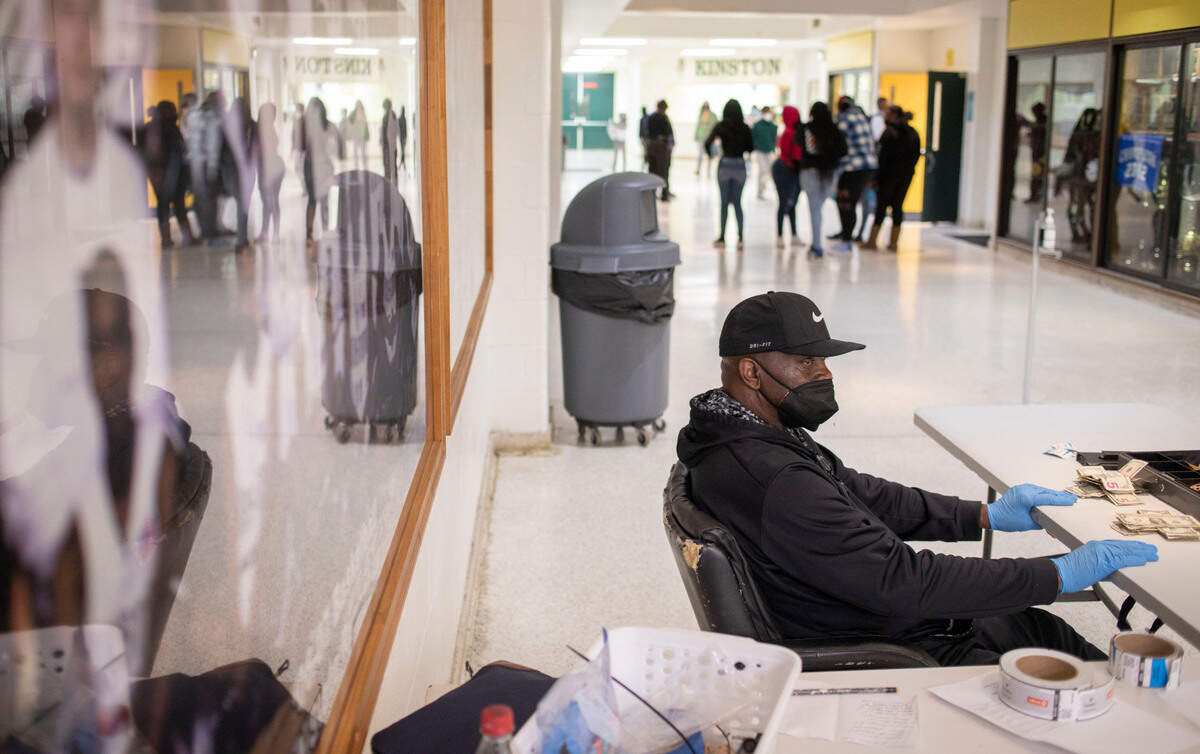
Business is slow. It’s a small crowd, family and friends, to watch the Vikings win easily and it’s a similar scene a couple of nights later during Kinston’s 13-point victory against Washington in the second round. Just like that, Kinston is in the 2-A Sweet 16, and one day toward the end of a practice Tyndall sits his team down and reminds them of the “blood, sweat and tears” that those before them have poured into the program, and what it means to wear this particular jersey.
“You’re forever enshrined into a family of Kinston High basketball players,” he tells them.
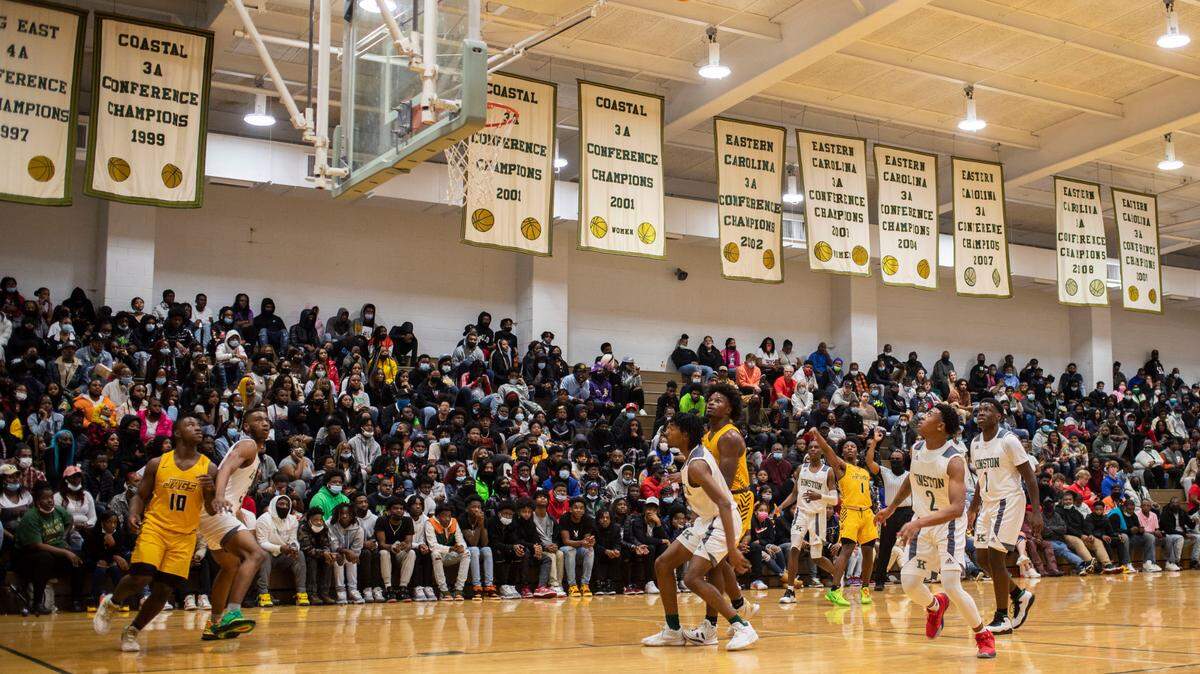
Even during the Vikings’ first two playoff games, both light crowds, there is a poetic rhythm to high school basketball. In the confined space of the Kinston High gym, the noises sound louder. They blend together to create a melodic soundtrack: The sneaker squeaks and the chants of the cheerleaders; the coaches shouting from their benches, while players call out screens and directions on the court; the swoosh of the net after a true make and even the clang of the rim after a miss.
The small-town high school basketball gym remains one of the purest stages in American sport; a respite from the cynicism and commercialism baked into major college athletics and the pros, even if the walls in Kinston’s gym, like those in little gyms like it everywhere, include ads for small-town businesses. There are slices of Americana everywhere: The old banners hanging from the ceiling; the pair of local radio announcers sitting in the last row, headsets on; the ads on the wall for Kings BBQ and a local church and Lovick’s Cafe. The place smells like old popcorn and stale sweat, and it probably smelled like that when Jerry Stackhouse played here 30 years ago, and most definitely did when Reggie Bullock and Brandon Ingram came through in more recent times.
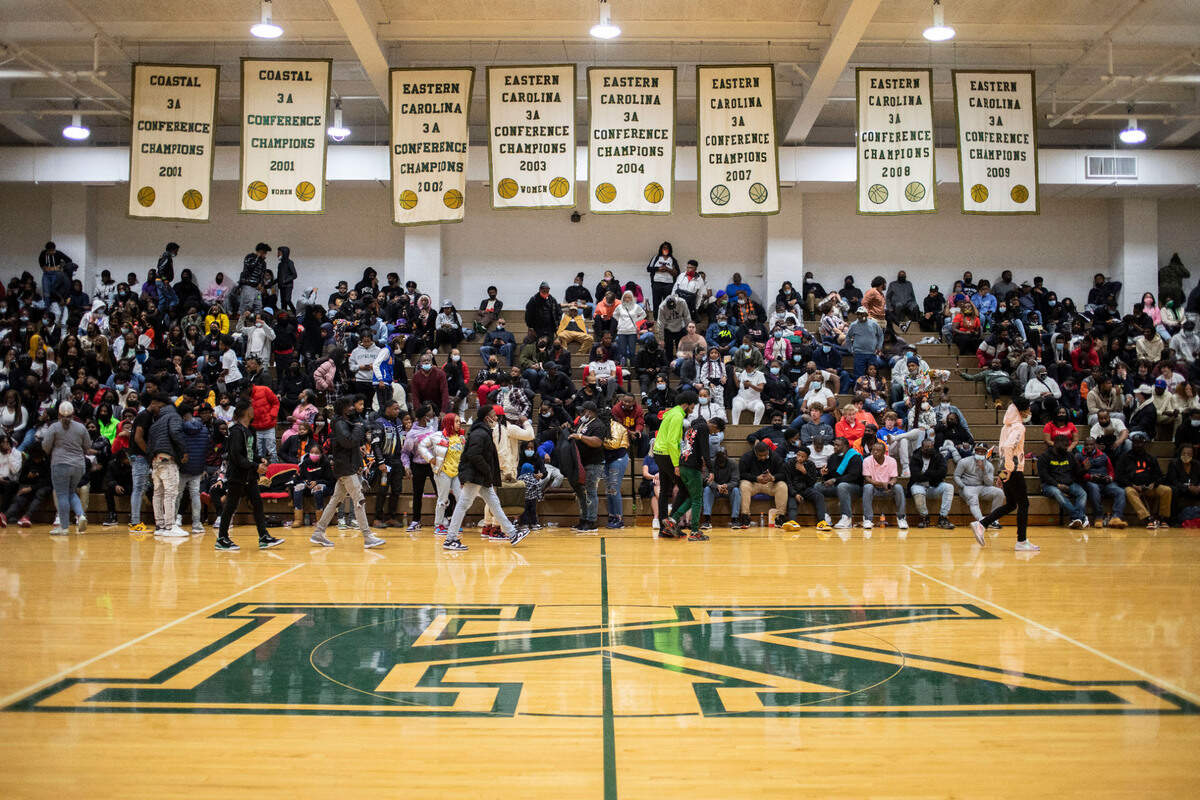
It was a smell of Kellan Bryant’s childhood, when she attended games with her father, then the Kinston High principal and an assistant basketball coach. Now it’s the scent of home, comfort.
“When you walk into the gym, it smells the same way it did for 30 or 40 years,” says Bryant who, like her father before, is now the Kinston High principal.
Like the vast majority of her students, Bryant grew up in Kinston. She graduated from Kinston High in 2001, then went onto UNC-Chapel Hill. Education wasn’t necessarily her original plan, though she comes from a family of educators — both of her parents were, and so is a sister. When life circumstances brought Bryant back home, she entered teaching and her first job was in what’s known as a “self-contained behavior classroom.” There, she taught the most challenged of students.
“Within two weeks,” she says, “I knew that I was right where I was supposed to be.”
That set her career path, and she became the principal at Kinston High in 2017. She took over a school where the majority of students are classified by the state as “economically disadvantaged,” and one where almost every student qualifies for free and reduced lunch. For a long time, more than 50 years ago, there was an extended fight to integrate the white and Black high schools in Kinston, and Kinston High opened in 1971, the product of integration.
These days, white students have all but disappeared. The enrollment is more than 95 percent Black.
There’s a lot of data that tells a certain kind of story about Kinston High, and it is a story of struggle and despair, at times, but also one of overcoming. It is a “D” school, according to the most recent data from the North Carolina Department of Instruction, which did not give performance grades during the 2020-21 academic year because of the pandemic.
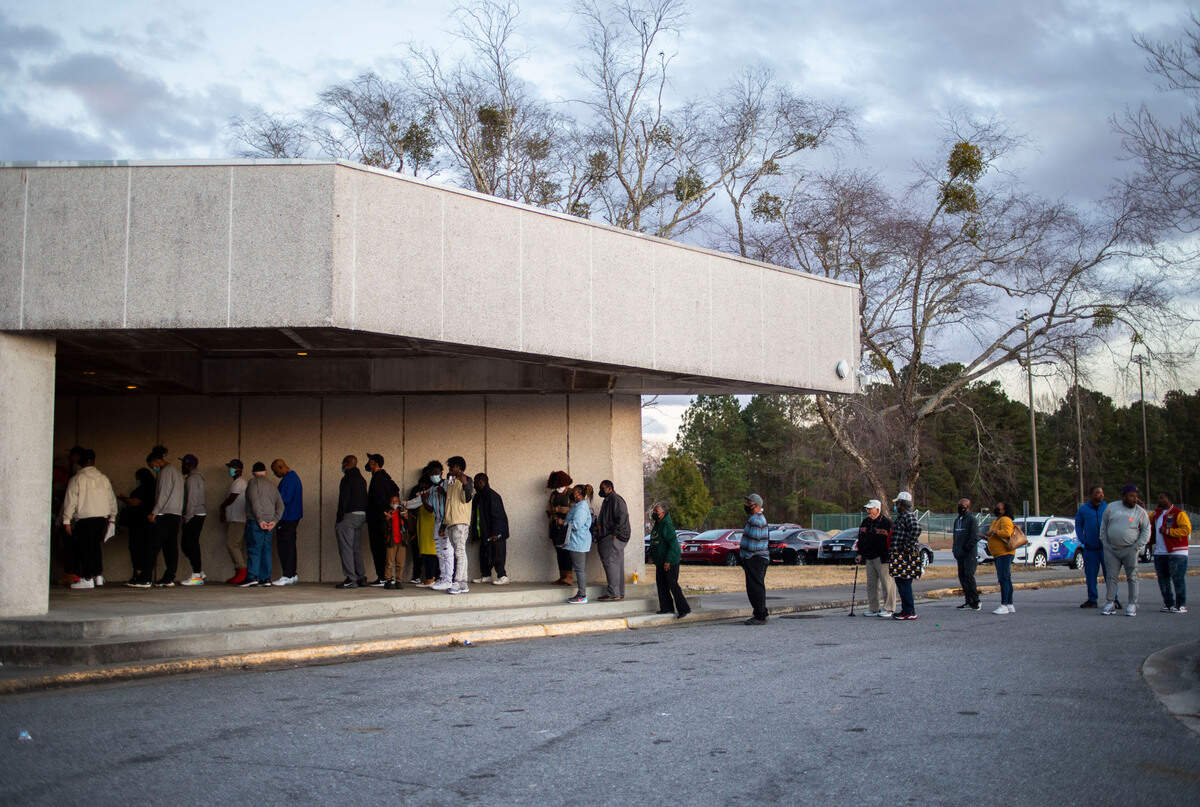
In the years for which grades are available, though, Kinston has been a D school for six years running. It failed to meet its academic growth goals during each of those years. Almost 64 percent of the students are considered economically disadvantaged, well above the state average of 38.9 percent. Across four core subjects — Biology, English II, Math 1 and 3 — students at Kinston High score worse than the state average. According to state data, more than 70,000 North Carolina high school students are enrolled in Advanced Placement classes. None of them are from Kinston High.
To Bryant, the data doesn’t necessarily tell the full story. It doesn’t account for the backgrounds of a lot of Kinston students, what they might be facing in their lives. In Kinston High, she sees a place of opportunity, one that is not failing students but one that is instead offering them a chance to rise above their circumstances, perhaps to break a cycle.
“Our graduation rate for our five-year and our four-year cohort is the highest it’s been in 20-plus years, which is fantastic,” she says. “I think we have found over the past three or four years, even through COVID, a lot of different strategies to use with our kids who we would consider at-risk and I think that’s important, because no kid follows that same trajectory. Every kid is different.”
She pauses for a moment, considering the fairness of some of the metrics that paint a picture.
“Fair is not a word that anybody likes to hear,” she says, “but I think sometimes we need to recognize that what’s fair for one (student) may not necessarily be what’s fair for another. And we have to not only take into account their educational abilities in regards to cognitive abilities, but we also have to take into account their social aspect and their history, and what they are going through at home or different pieces of that puzzle.”
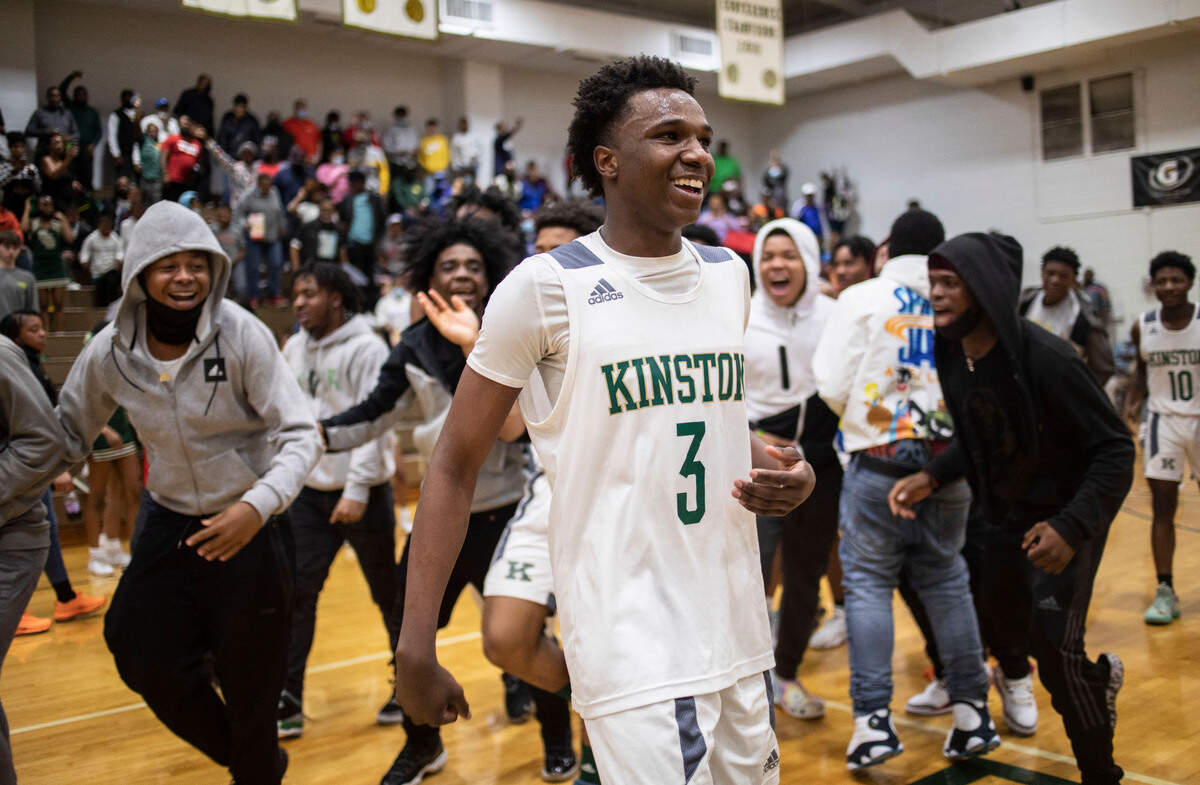
During her days as a student at Kinston a little more than 20 years ago, Bryant played soccer and softball and ran cross country. She was a cheerleader. She came back to Kinston when a lot of people who go off to college don’t return. This is a place that means something to her, and she’s protective of her students and the way they might be judged because of their school’s reputation.
“I have a heart for Kinston,” Bryant says. “And I have an even bigger heart for Kinston High School itself. I think it means something when you’re a Viking.”
Bryant is a regular presence at Kinston basketball games, often walking the hall outside and talking with students or leaning against the wall near the baseline and taking in the scene. Little by little, throughout the playoffs, the atmosphere inside the Kinston High gym transforms into what it used to be, the crowds going larger. The Vikings roll past South Granville in the Sweet 16 and then hang on against undefeated Burlington Cummings in front of a packed gym.
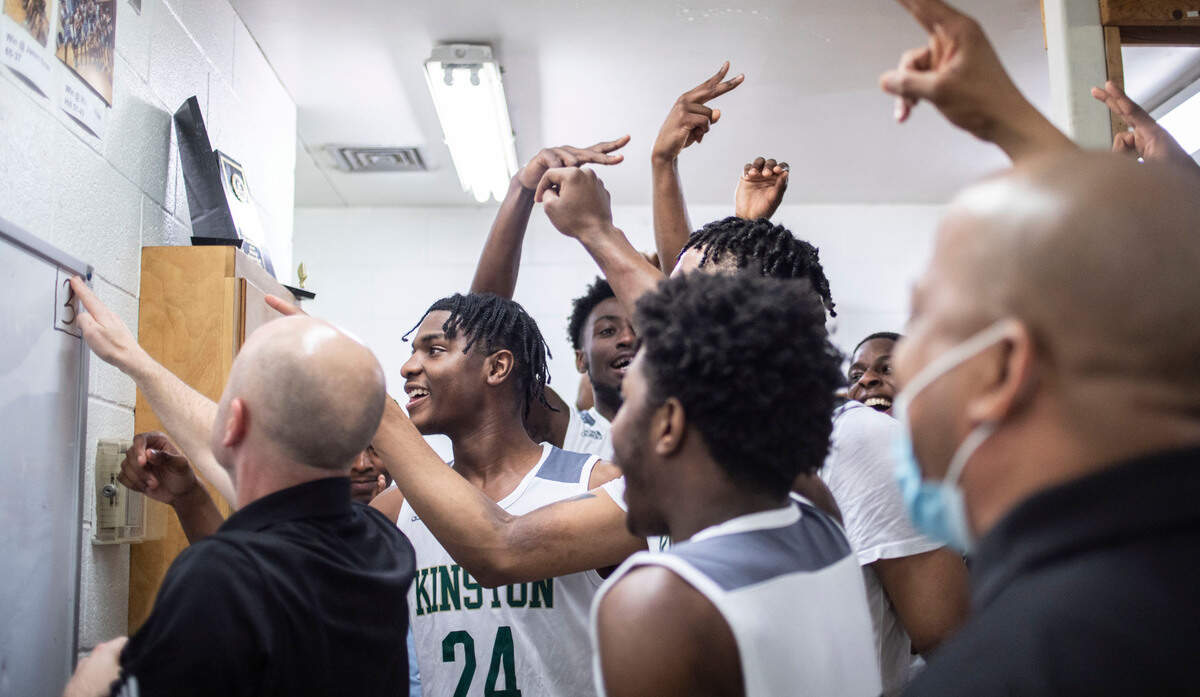
Afterward, Skeet Davis, a community luminary and mentor to hundreds of kids over the years, slowly makes his way out of the gym. He has watched every playoff game from the corner near the Kinston bench, sitting in a walker. He’s a little slower now, what with dialysis three times a week, and who knows how many seasons he has left. Each one is a treasure. He gives Tyndall, the Vikings’ coach, an embrace.
Kinston is back in the state final four.
**
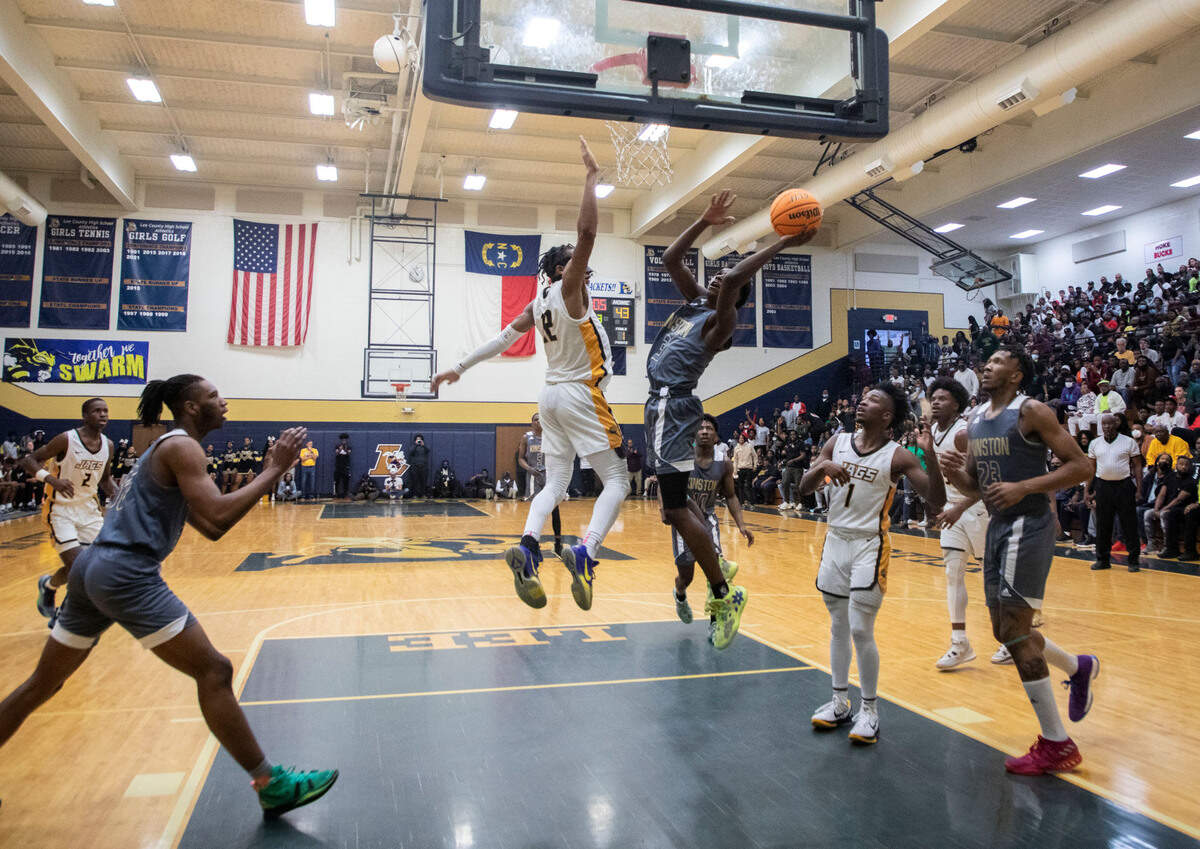
It’s four days later now, a Saturday, and the moment is growing closer. The Vikings eat a pregame breakfast at Lovick’s Cafe, a Kinston favorite, before making their way to Lee County High in Sanford, which is hosting the 2-A East Regional championship game. The opponent is familiar, and expected. It’s Kinston’s nemesis. It’s Farmville Central.
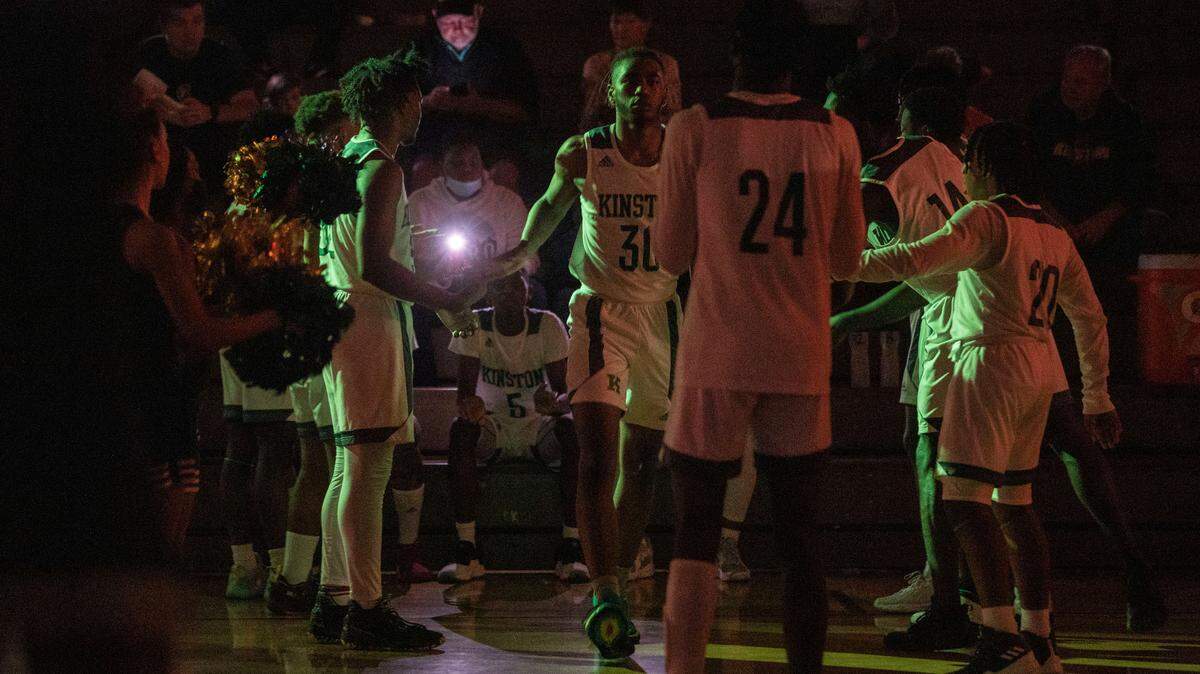
About 90 minutes before tip-off, the place is packed, supporters from both Kinston and Farmville wearing shirts with faces of some of the players; others with sayings like STRAIGHT OUTTA KINSTON. The Vikings warm up to “Dreams and Nightmares,” the Meek Mill song that plays when they run onto the court at home games.
For them, the nightmare can be their surroundings. The things they might see or endure outside of school, in their neighborhoods, or the invisible forces that make it difficult to break cycles that have a way of ensnaring young people in Kinston. Even the ones who make it out, and are successful at the highest level, can tell plenty of stories about the other side.
“You know, there’s not a lot of money in Kinston,” says Brandon Ingram, speaking by phone in the days before his old high school team’s game against Farmville. “There’s not a lot of jobs in Kinston. I think at some point, those shootings and killings and murders and all that stuff became normal and numb, being around it for my 16, 17 years.
“I had friends, family killed in Kinston. The gym was a safe haven for us. The gym was a safe haven to get away, and try to be leaders for kids. Kids started kind of early, getting into the bad stuff. It was a decision — you could get into sports, or it was so easy to get into all the violence and all that that was going on. And of course, some of those people were my friends. It’s kind of hard to navigate it, but at the same time, you have to have a strong mind throughout Kinston.”
The dream, meanwhile, is this moment. It’s a deep playoff run, a chance to win states. Kinston is known for basketball, and for those like Ingram and Bullock who’ve reached the NBA, but here especially the sport is a teacher. It has taught each of the Vikings things they might not yet fully understand, lessons about perseverance and the fleeting nature of opportunity.
“Cherish the moments I have right here,” Horace Smith, the junior forward, says when he considers what he’s learned. “Because it can go by very fast.”
“Don’t back down,” Canady says of his main Kinston basketball takeaway. “If you want it, you’ve got to go get it. They’re not going to give it to you.”
“Nobody’s giving you anything,” Dixon says, in the same vein. “If you’re not going to go get it, you just won’t get it.”
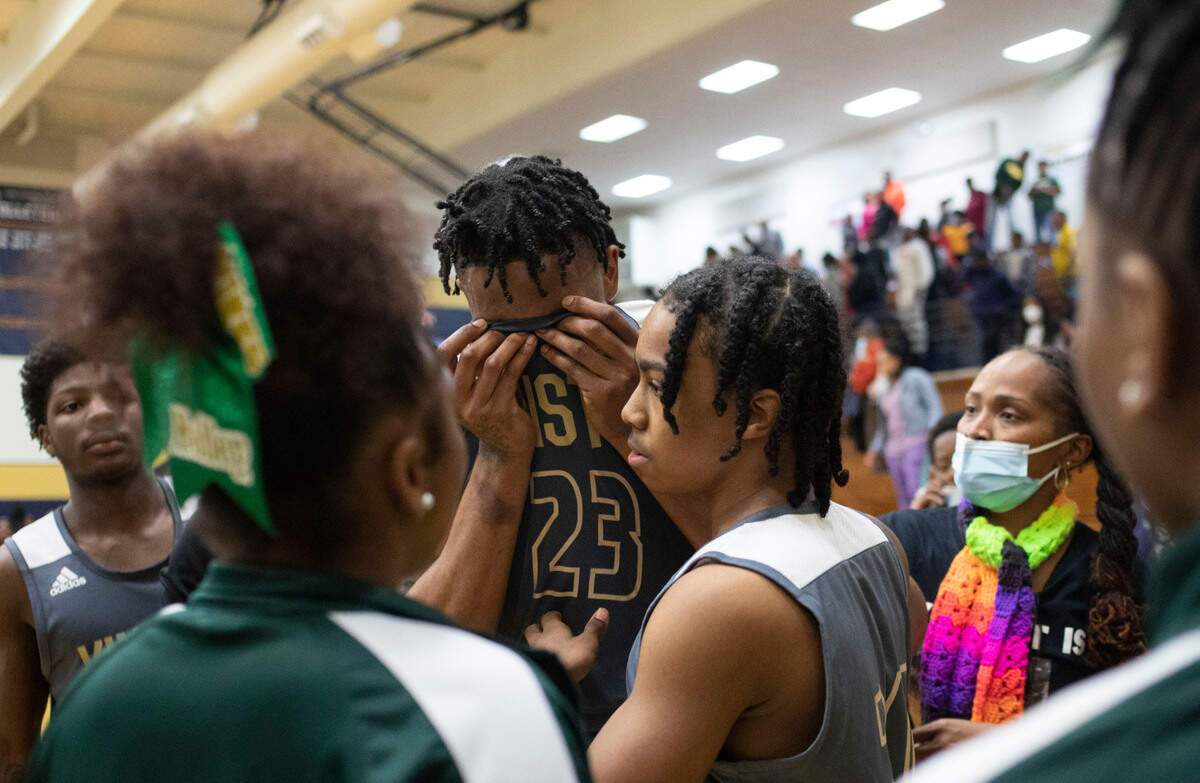
The Vikings trail Farmville by 12 points at the end of the first quarter. By the second it’s growing more and more out of reach — a 22-point deficit at halftime. There’s a late flurry, Dixon leading a fourth-quarter charge, and the Vikings make it an eight-point game with about 90 seconds left.
There’s hope, but not enough time.
**
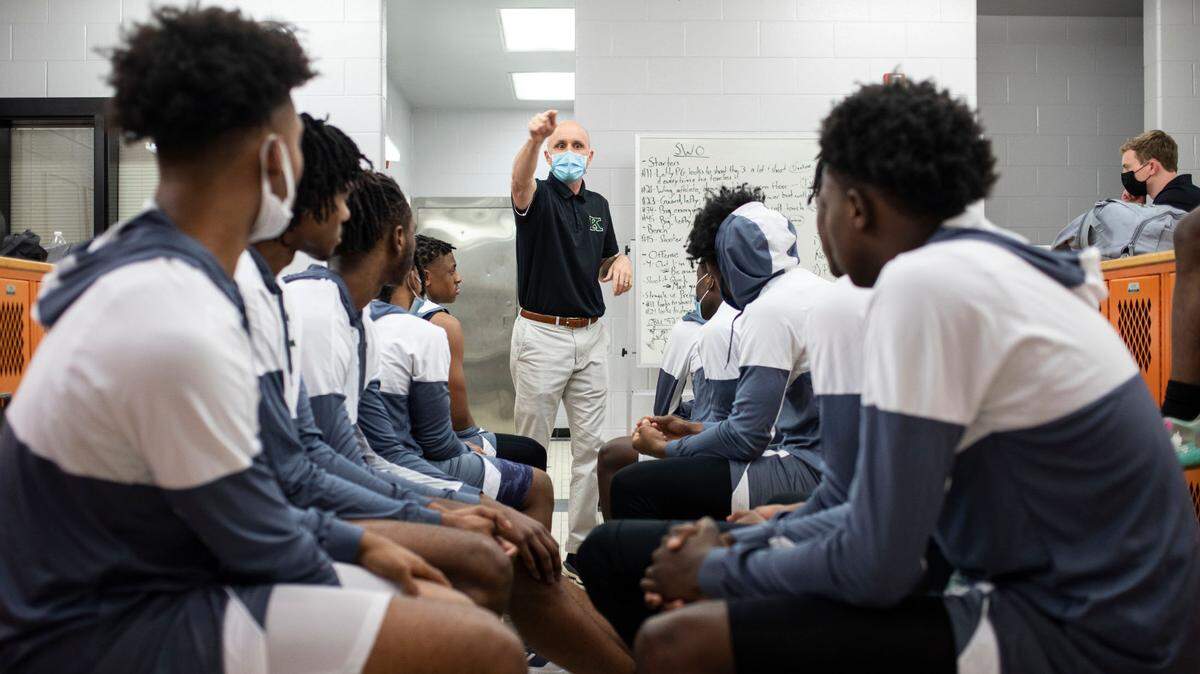
This is Perry Tyndall now, in his 10th season as Kinston’s head coach, in the locker room after:
“There’s nothing, really, that anybody can say in here that’s going to make this moment feel any better. It’s not. It’s just not. OK? But I need you to listen. I need you to listen to all of this. You’ve got to learn from this moment today.”
He’s proud of the perseverance, the comeback.
“That’s Kinston,” he says.
After the last game he addresses the team as a basketball coach first. Then as something like a life coach. He plays both roles, a mentor on and off the court, and it’s outside the gym where his players often need the most.
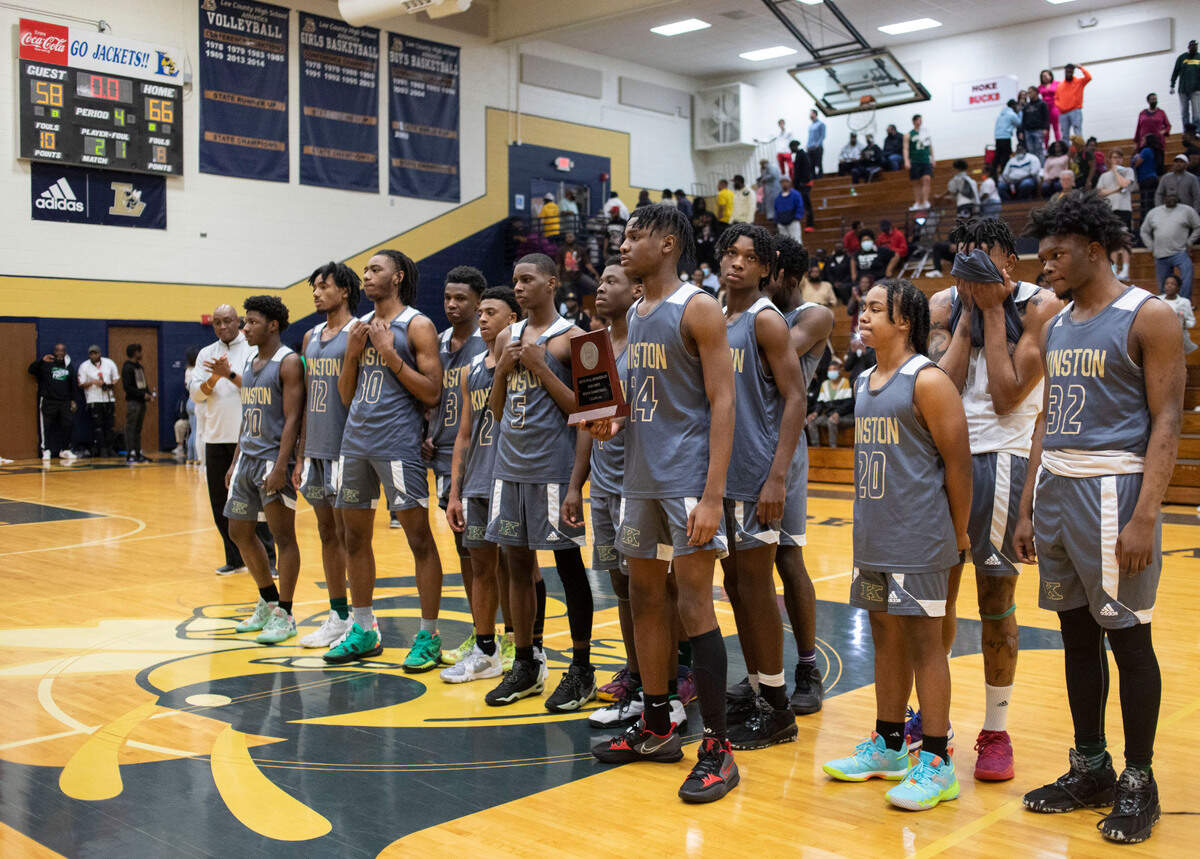
A season has ended and one day his players’ basketball pursuits will, too. Some of them have just ended moments earlier, with the loss. Others will end next season, or the one after that.
“And then what are you going to be?” Tyndall asks his team. “Great friends, great leaders, in the jobs you pursue. You’re going to be great fathers one day. You may be great coaches. You may be whatever great it is — but pursue greatness and don’t settle for average.
“Don’t settle for average. The world will tell you average is all right. Don’t settle for average. Look at me please. Everybody look at me one more time, please. Just eyes, on me. One time. One time. I love you more than you’ll ever know,” and soon his postgame talk has ended, too.
“Family on three,” Tyndall says. “One, two three — ”
“Family,” his players say softly.
**
They walk out of the locker room. Some of the Vikings ride back with the parents. Some board the team bus. It’s more than a 100-mile ride back to Kinston, east through country highways and roads south of Raleigh, through parts of North Carolina that often seem forgotten or left behind.
A lot of Eastern North Carolina feels that way, places shrinking along with the opportunities they used to provide, small towns and cities holding on to what they still have. Kinston has lost a lot over the years, with jobs and people moving out, and Kinston High reflects its broader environment.
It reflects the grit, too, that’s come to define this place; the strength to keep rebuilding, at least attempting to. The season-ending loss spoke to some of that, how Kinston didn’t surrender despite the long odds.
“The kids are going to fight,” Tyndall says a couple days after the season ends. “And it goes back to that Kinston pride and Kinston toughness. ... Some of those kids have fought all kinds of different dynamics growing up. And they just are resilient.
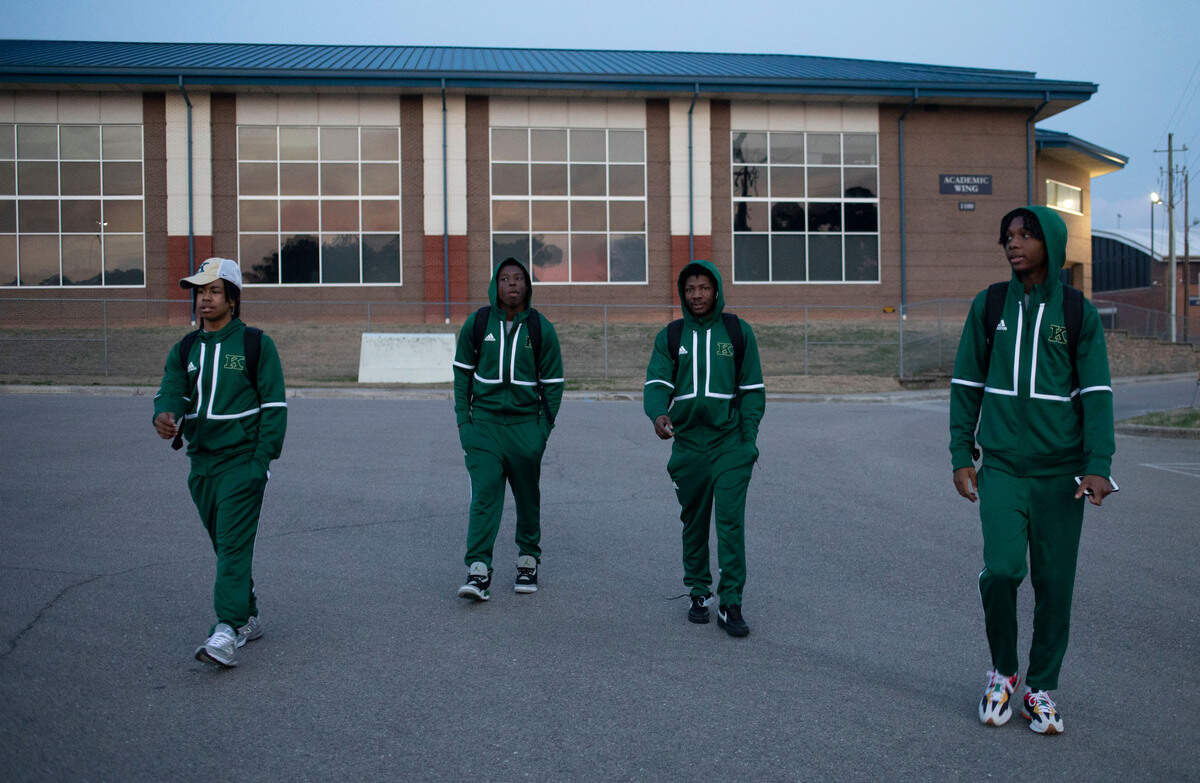
It’s the first day in a while without practice, or an upcoming game. Tyndall, as the caretaker of a program, is already thinking toward the future. Most of his seven seniors, though, have likely played their final organized basketball game.
A few of those seniors have figured out their post-graduation plans. Some are deciding between the military and college. Others don’t know. To varying degrees, basketball has given them hope, opportunity and direction. Tyndall has guided some of them as far the sport will take them. They’ll be on their own now, left with the lessons from the court or the locker room.
Throughout town, a cycle will begin anew, Holloway and Woodman and other local gyms offering the usual respite from the forces Tyndall and other mentors often fight against. The past connects to the future on the basketball courts in those places, the legacy of those who came before passed down to the younger generation.
The dreams, and the nightmares, start over again.
Staff photojournalist Julia Wall contributed to this story.
This story was originally published March 14, 2022 at 6:00 AM.