Part 2: Five years on, Fortnite’s future still was uncertain. Then Epic Games made a crucial, timely, contentious pivot.

A glimpse at Fortnite’s future
Nearly three years had passed since designer Cliff Bleszinski introduced Fortnite at the 2011 Video Game Awards, and the product Epic Games teased that night still hadn’t materialized. Much of the original Fortnite development team was gone, and Bleszinski himself exited the North Carolina company in 2013, as did former Epic president Mike Capps.
Uncertainty continued to tail Fortnite, much as it had in the game’s initial months. At one point in late 2012, Epic invited employees at the Cary headquarters to play the latest prototype and vote on whether it would remain in production. Staff gave it a reprieve, but the project still wanted for structure. Would it be free to play or sold in units? Was it catering to a mass market or pitched as an alternative oddity? And when would it be released?
“There was a lot of ambiguity,” said Carlos Cuello, who joined the Fortnite project as a lead programmer in 2015. “Certainly, some aimlessness. Some of it was coming from the top, just not knowing the direction that we wanted to try to go in.”
“There was no clear end in sight,” programmer Nick Cooper said, “and it felt like the project was struggling to find an identity.”
“The gameplay wasn’t as sticky as what people were kind of hoping for, in my opinion,” said Chris Wells, a senior character artist.
Yet for a fleeting moment in 2014, the fort defense game Wells thought of as “good” transformed into something thrilling. Wells believes he glimpsed Fortnite’s future before the world and even Epic Games recognized what it could be. The spark came when a colleague suggested they design the next Fortnite playtest differently — instead of fighting creatures, players would fight each other in a standard video game format known as “capture the flag.”
“Let’s just try it and see what it’s like,” Wells recalled. “So we had this playtest, and I’ve never seen gameplay like that before. It took the competitiveness to a whole new territory because it added another dimension of creativity. It was brilliant. People were making stairs that went up into the sky, boxing each other in, almost like Roadrunner moments. All the things that they were constructing in the single player (version) were now used in this fresh way.”
This was not, however, the breakthrough moment. When the player-versus-player playtest concluded, Epic reverted to making monsters the chief opponents. Wells left Epic shortly after, but a decade later, he still remembered the rush of this portentous Fortnite battle.
‘Is this ever going to come out?’
Through the mid-2010s, Fortnite progressed in fits and starts. Some at Epic questioned why the meandering project had not been canceled.
In 2015, Epic released a beta version to a closed group of players to garner feedback.
“We’re doing releases, we’re looking at data, we’re working on the technology, we’re building out the tech, building the gameplay,” Cuello said. “The gameplay was pretty hardcore and fairly niche.”
“I think there was a big mismatch in terms of the company’s values and the game we were making, but it wasn’t for lack of aim,” he added. “We just went in the wrong direction and kept going.”
Entering 2017, two questions lingered.
“Is this ever going to come out?” wondered Charlie Hall, a writer at the gaming outlet Polygon. “And when it does come out, what’s it going to look like? Because it had been several things.”
More than five years had passed since Epic aired its Fortnite trailer, and the project remained in development. Its setting was real-world suburban with certain twists. Players shot both practical weapons and firearms inspired by ‘80s sci-fi movies. They could collect guns, shields and ammo by picking them off the ground or by smashing loot boxes shaped like llama piñatas.
It was creative but also complicated. Hall recalled traveling in 2017 to Cary where Epic put on a big Fortnite presentation, using a theater stage to showcase its intricacies. Though impressed with the display, Hall had “some choice words” after he actually played the game.
“I called it the Willy Wonka three-course dinner of video games,” he said. “It was the first time that I ever suffered from what I consider to be a repetitive stress injury from the work that I was doing. I was clicking the mouse so much that I hurt myself after trying to review this game for a week.”
On July 21, 2017, Epic Games released Fortnite. Today, this version of the game is known as Fortnite: Save the World, and many have relegated it as an afterthought to the triumph that was to come. But Save the World has its defenders.
“I see a lot of people in the press saying, ‘Oh, the original game failed or flopped,’” said Ed Zobrist, the head of publishing at Epic from 2016 to 2021. “That’s actually not true. It did not. It just wasn’t a big hit. It was a solid performer as (a role-playing game), but it wasn’t setting the world on fire.”
“It didn’t appeal to the mass market as I think Epic was hoping for, and maybe what we wanted, but it was enough to make the development budget back and then some,” Cuello said.
“You can’t put your finger on it, but you just knew there was something there,” said Bradford Smith, a material artist at Epic. “It gave players a lot of agency and autonomy, and there’s exploration.”
In his review, Hall described the game as “sloppy, but with flashes of brilliance.”
While still at the Fornite press junket in North Carolina, Hall heard an interesting piece of news that became more significant in hindsight. It was the summer of 2017, the last few months before Epic would change forever.
“I remember someone from Epic saying that there was another game mode that they were working on,” he said. “There was talk of a battle royale version of Fortnite.”
Last player standing
The battle royale concept is simple. Players enter a shared world and eliminate each other until there’s one individual or team left. The format gained popularity after the 2000 Japanese film “Battle Royale” became a cult favorite. “The Hunger Games” later replicated this last-person-standing structure across best-selling books and a movie franchise.
In video games, the first major battle royale hit came in early 2015 when the California studio Daybreak Game Company released H1Z1. Two years later, in March 2017, the South Korean publisher Krafton debuted PlayerUnknown’s Battlegrounds, a gritty, realistic battle royale shooter that became one of the world’s most-played PC games.
Observing this trend from North Carolina was Lowell Vaughen, Epic’s director of product strategy.
Former employees say Vaughen advocated for the company to tackle battle royale, pitching the concept to other executives in a few presentation slides. Nothing more was needed. Epic’s underlying culture in the 2010s, dictated by Sweeney, disdained bureaucratic formalities like superfluous meetings or reports.
But Epic didn’t just want to build a battle royale game. It wanted to build one fast. PlayerUnknown’s Battlegrounds, better known as PUBG, wasn’t yet on consoles like Xbox and PlayStation. Epic executives believed beating PUBG to these devices was vital.
“There was data that says if you’re the second to come out on a console, it doesn’t matter how big you are, you’re likely never going to take over that market share,” Cuello said.
Racing against a rival
Heading into the summer of 2017, PUBG existed while Epic’s game did not. To surpass their rival, Epic executives chose to create a battle royale format within the Fortnite project.
In early July, Epic shifted a team of developers from a game called Unreal Tournament to Fortnite. Many who had led the legacy Fortnite project didn’t transition to the battle royale effort.
Having spent six years on the first version of Fortnite, Epic now raced to create a second game mode in weeks. The company set the former Unreal Tournament developers in a small office known as a “war room.”
“It just felt like a quick experiment,” Bradford Smith said. “It felt like something a responsible business would do, where if it fails, it fails quick.”
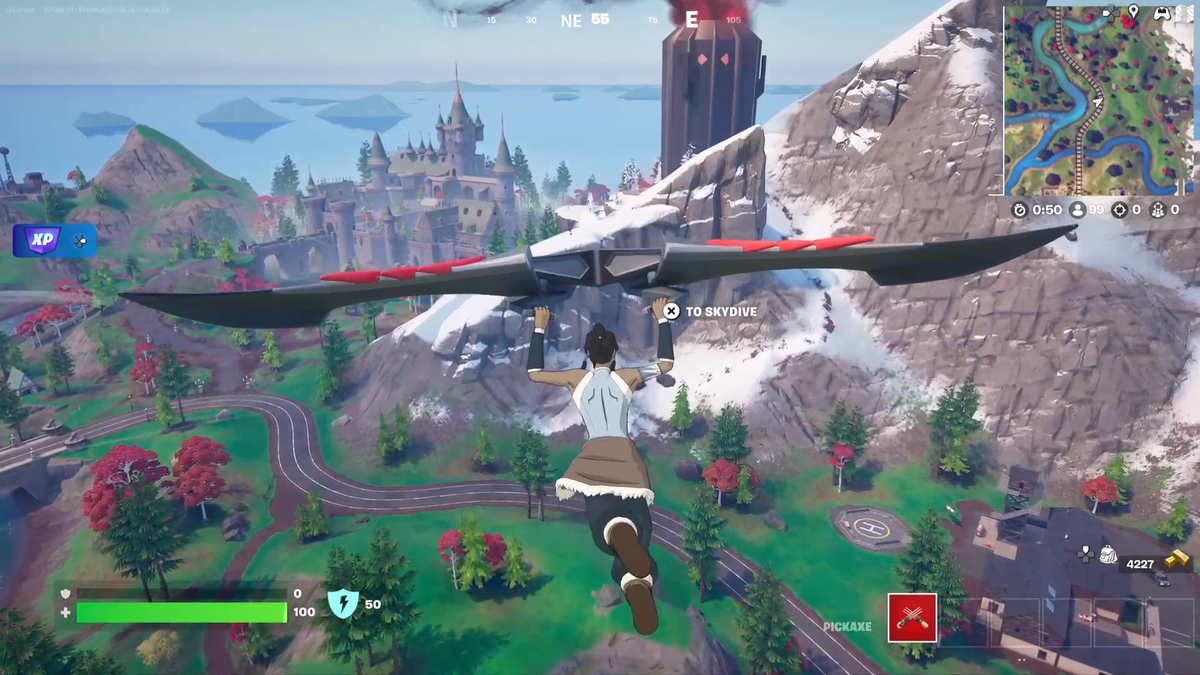
Epic had two advantages to launching Battle Royale rapidly. First, the company possessed six years’ worth of Fortnite content. For weeks, staff cut and slashed the original game, pulling buildings, landscapes, weapons and characters into the new version. Needing an aircraft players would jump from to begin each round, developers found a blue school bus in the archives and affixed balloons from a Save the World mission to its top. What was intended as a whimsical placeholder ended up being the battle bus that opens each battle royale.
Staff also drew inspiration from the game they were chasing. For elements like health bars, weapon tuning, gameplay and storm cycles, Fornite mimicked PUBG.
Many expressed unease with how much of the game’s structure mimicked PUBG, a game created on Epic’s Unreal Engine. (Epic makes its Unreal Engine available to game developers, then charges 5% royalties on products that earn revenues of more than $1 million.)
“There were a lot of decisions made because of what PUBG did,” one former employee said.
Like Fortnite’s incoming project, PUBG also begins when 100 players fall from the sky. The game maps in both universes also shrink over time (through a mechanism known as storms) to ensure player proximity. In 2018, PUBG Corp. sued Epic Games in a South Korean court for copyright infringement over Battle Royale, but dropped the case after a few weeks.
“PUBG was an Unreal Engine customer,” said Ellen Liew, who worked as Epic’s director of experientials from 2014 to 2023. “But I don’t think anyone can take credit for the genre. Like any other industry, you get inspired.”
And what Epic was making inside a war room in Cary was inspiring.
“When PUBG became big, like all the executives were playing almost every day,” Cuello said. “And when we started building Battle Royale, all the executives, key stakeholders of the company were playing every day.”
“If I remember, there was like a daily playtest at noon every day at the headquarters,” Liew said. “My office was really close to the war room that housed all the Battle Royale team, and you could just tell there was an excitement.”
“There’s something about human nature that loves to battle and conquer,” Smith said. “There’s just something miswired about the human brain that seems to draw us to conflict. But that level of self-expression Fortnite had, I think, is absolutely critical.”
In mid-September 2017, Epic Games announced a battle royale mode of Fortnite would be available to play — on consoles and computers — in two weeks. As the company’s head of publishing, Zobrist noted this new format still had no cover art, marketing materials or evident way to make money.
“We had this mad scramble to put everything together, and Tim (Sweeney) really didn’t want to delay the launch of this new mode,” Zobrist said. “Tim has more of the philosophy that, ‘We don’t need perfection. Let’s put it out there, iterate on it, and get it going.”
Former employees spoke of 14-hour days stacked together to make 80-plus-hour weeks. “It was very intense,” one former manager said.
Epic released Fortnite Battle Royale on Sept. 26, 2017. It had beaten PUBG to consoles by more than two months. When PUBG reached Xbox that December, Fortnite was already on its way to becoming a global phenomenon.
Next: “Nothing prepares you for that kind of success.” Inside Epic as Fortnite takes over the world.
This story was originally published October 16, 2024 at 5:00 AM.