
SAS walks back pledge to go public, creates space for Goodnight succession options
READ MORE
The State of SAS
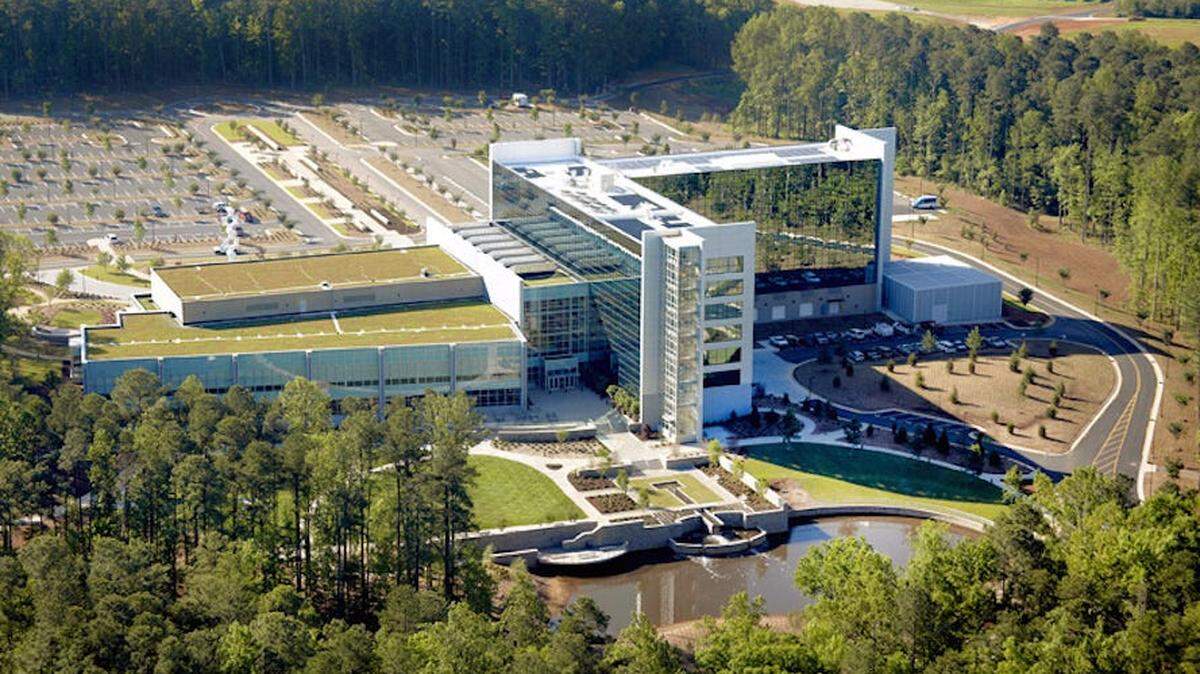
SAS Institute is one of the world’s most valuable private software companies and a major economic and cultural force in Cary, North Carolina, which is home to its headquarters. One of its co-founders, Jim Goodnight, is ranked by Forbes as the No. 72 wealthiest American, with a net worth of $15.3 billion. As the company turns 50 this year, here’s a look at the company’s origin story and its future.
Expand All
Despite some signals to the contrary, SAS Institute’s 83-year-old CEO and majority owner Jim Goodnight has never seemed very keen on reaching the stock market. “Personally, I don’t want the hassle of running a public company,” he told The News & Observer in 1995. “It would ruin my life.”
Goodnight has promised a SAS initial public offering at times since. In 2000, he predicted his large Cary analytics software company would go public within 12 to 18 months. Then in 2021, he announced an IPO was anticipated within three years.
Rather than insist it will still go public, the company told The N&O it now strives to achieve “public readiness” in order to give its billionaire CEO multiple succession options.
“We know that we will be an attractive investment for investors when the timing is right,” spokesperson Shannon Heath wrote in a Feb. 9 email. “And we want the company to be in a strong position that would give Dr. Goodnight options to decide what is best for our future.”
Current market conditions would make an imminent SAS IPO a surprise. Software as a service (SaaS) stocks have plunged in 2026 as investors worry advanced artificial intelligence tools will crater revenues. After posting 8% sales growth in 2023, the company didn’t include this metric in its most recent annual report.
Postponed IPO timelines and current Wall Street dynamics have some doubting whether Goodnight, one of SAS’ two shareholders alongside co-founder John Sall, counts the stock market among his realistic succession options.
“He’s missed the window,” said Andre Boisvert, a former Oracle executive whom Goodnight hired in 2000 to take SAS public during the dot-com boom. At that time, SAS was the world’s most valuable private software company. Boisvert abruptly resigned as president and chief operating officer once Goodnight’s interest in an IPO waned. In 2004, Goodnight told USA Today “we were never really close” to going public.
If SAS stays private, what is it most likely to do? And what would each post-Goodnight route mean for this major Triangle employer and its workers?
SAS succession option: private equity
Given SAS’ reported annual revenue of more than $3 billion, industry experts say a short list of tech sector-focused private equity firms — Silver Lake, Vista, Francisco Partners and Thoma Bravo among them — have the capacity to buy it in full.
“A private equity exit would make a lot of sense for a company like SAS,” said David Robinson, a finance professor at Duke University’s Fuqua School of Business. “It’s demonstrated a proclivity to remain private. If SAS was going to go public, they probably would have done it years ago.”
Private equity firms often purchase companies through leveraged buyouts, meaning they borrow to cover the acquisition cost. Firms once shied away from taking on debt to buy tech companies, New York University finance professor Gustavo Schwed said, but as the sector has matured, investors began competing for assets — and taking on more debt to win.
“Most of the deals are sold through competitive options,” he said. “And that forces all bidders to bid the highest price they could possibly be willing to pay. And that forces them to stretch in every regard, including how much money they’re willing to borrow.”
A critique of private equity is that firms divert revenue to pay off acquisition debt rather than reinvest it in the company. “Private equity firms own companies for an average of seven years; they’re trying to sell for a profit, not grow the business over the course of decades,” journalist Megan Greenwell wrote in her 2025 book “Bad Company: Private Equity and the Death of the American Dream.”
Having any debt would be foreign to SAS, which was profitable from its first day in 1976 and says it has never borrowed. The Cary analytics giant has also been known for putting money back into research and development; in 1998, it reported applying 31% of its revenue to R&D, almost double what Microsoft spent at the time.
For SAS employees who feared going public would disrupt their company’s culture of 35-hour workweeks, on-site child care, campus artwork and generous retirement contributions, a private equity buyout could portend steeper cutbacks. “They would bring a playbook to change operations in an attempt to substantially increase sales and profitability,” UNC finance professor Gregory Brown wrote in an email.
For its part, SAS says it isn’t communicating with private equity investors. “SAS is not having any discussions regarding investment or an acquisition from a PE firm, or anyone else,” Heath wrote in February.
Robinson said any hypothetical buyer would be wise to see the value in what SAS has been for half a century. “They might pare back some of the benefits that people receive,” he said. “But I can easily see that they might not if they understood the importance of those benefits for attracting and retaining talented programmers.”
Strategic acquisition
If not through IPO or private equity, Goodnight and Sall could sell SAS to another company. They have entertained this path before.
In July 2021, The Wall Street Journal reported SAS was in talks to sell to the California semiconductor supplier Broadcom for between $15 billion and $20 billion. Goodnight denied the deal within days, however, and by the end of that month, the company had renewed its pledge to go public.
The short-lived prospect of Broadcom taking over sparked concerns among the approximately 5,000 workers who at the time reported to SAS’ main Cary campus. Some thought the worry was justified. “A sale to Broadcom could be a big shock to the insular culture of SAS,” the tech news outlet SiliconANGLE wrote at the time, citing sector analysts.
Strategic acquisitions differ from private equity, says Srini Krishnamurthy, a professor of finance at NC State’s Poole College of Management. “Private equity is much more sharply focused on making money,” he said. “An operating company is more interested in making sure that they have access to the product and its users.”

Job risks remain. Redundant positions are targets post-merger, Krishnamurthy said, as are employees whose work isn’t tied to what the new owners value. Steven Kaplan of the University of Chicago’s Booth School of Business said a corporate acquirer “is likely to make lots of cuts,” if the purchased company is not growing and overly bureaucratic.
But compared to private equity, a corporate purchase is a longer-term play.
The Triangle is no stranger to major software buys; in 2019, IBM purchased Raleigh’s open source software giant Red Hat for $34 billion. That move has been seen as a win for IBM, with Red Hat driving its parent company’s shift toward software with consistent double-digit revenue returns.
Pass SAS on in a trust
Professional sports teams do it. Fictional media moguls, too, like Logan Roy on the HBO show “Succession.” Plus, plenty of real-life billionaires. Is a trust how Jim Goodnight and John Sall pass along SAS?
A trust is a legal contract between its creator and an appointed trustee (or trustees) who manage it for the benefit of others. Beneficiaries could be family, philanthropy, the owner who created the trust, the trustee, you, me, or really anyone. Beneficiaries don’t necessarily have power to run what’s in the trust, however. An outside board (or individual) could be tasked with running SAS — or at least charged with picking software industry veterans to run the Cary company.
“The fundamental questions are, Whose hands are on the steering wheel?” said Patricia Annino, a partner at Rimon’s Trust and Estates Group in Boston. “Does he want family’s hands on the steering wheel? Does he want outsiders’ hands on the steering wheel? Where is that balance of power?”
A corporate succession-via-trust can go in varied directions — including an eventual sale or IPO. The creator of the trust sets its path. The appointed trustees then execute it.
The creator can set ground rules. For example, the octogenarian CEO of another large private software company, Epic Systems’ Judy Faulkner, is adamant that her multibillion-dollar Wisconsin firm never go public or get bought. So she has selected a trio of health system executives to sue anyone who doesn’t adhere to her wishes.
Goodnight and Sall have not publicized such specific long-term desires. The company did not answer whether the two men have considered passing on SAS through a trust. Both have children, none of whom are known to be active in top management.
Sell it to employees
Rather than sell to private equity, another business or public investors — Goodnight and Sall could sell their company shares to SAS workers through what’s called an employee stock ownership plan, or ESOP. By far the largest ESOP in the United States is the grocery chain Publix, which is majority owned by its 260,000 employees and has 61 stores in North Carolina.
SAS would be an outlier among its peers if it went this route. “I’ve never heard of a big company that’s a software-based company, doing something like that,” Paul Lachance, of the industry advisory firm Software Equity Group, said.
ESOPs function as worker retirement plans, according to the Rutgers University School of Management and Labor Relations, and they offer selling owners “unique tax advantages.” Minimizing tax payments is something Goodnight has previously stated as a goal.
The company declined to say whether Goodnight has considered an ESOP as part of his succession. Selling shares internally would be a departure for SAS, which over its first 50 years has never given employees an opportunity to buy into the company.
This story was originally published April 22, 2026 at 5:30 AM.



.jpg)