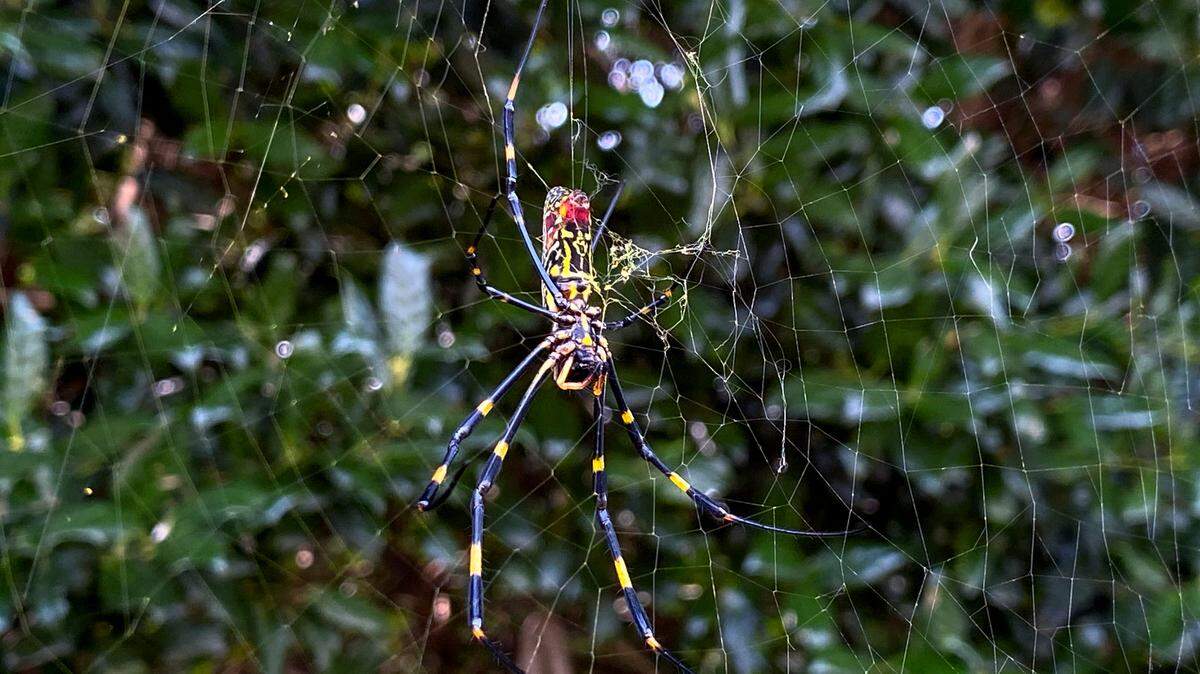
Yes, the Joro spider is coming to NC. But here’s why it’s not as bad as you think.
READ MORE
Flying and crawling pests in NC
More stories about creepy-crawly (or buzzing) pests and what to do about them.
Expand All
We have so many questions about that Joro spider.
How big is it? Is it really coming to North Carolina? Is it really going to parachute down from the sky? Will it hurt me?
The yellow and black arachnid, which originated from Asia, is getting a lot of press lately, so it’s natural to have questions.
We talked with Kelly Oten, an NC State Extension specialist for forest health, to learn more about the infamous eight-legged creature.
Bottom line: In all likelihood, yes, we should expect to see many of these spiders in North Carolina, and we can expect them to stay. But that’s not necessarily a bad thing, Oten said.
Here’s more about what you should know about the Joro.
Are Joro spiders already in NC?
Although most of the talk has been about Joro spiders coming to North Carolina, we should note that a few Joro spiders have already been found and recorded here.
Donald Zepp, an entomologist and researcher with the North Carolina Biodiversity Project, told The N&O that five Joro spiders were recorded in the western part of NC in fall 2021.
They were spotted in Buncombe, Jackson, Rutherford and Transylvania counties, and one was in the Nantahala National Forest (which occupies parts of seven counties), he said.
The Joro spider doesn’t care about humans
Even though we should expect to see many more Joros in North Carolina soon, have no fear.
The spiders are here to do spider-y things, like eat bugs and make cool webs. They’re not here for humans, Oten assures us. In fact, they don’t want anything to do with us.
Joro spiders make webs to try capture flying insects, which they won’t find inside a house, Oten said. They’re interested in staying outside where they can find ample breakfast, lunch and dinner.
“I haven’t heard reports of them invading people’s homes,” Oten said. “If anything, they’ll be on your front deck or in your garden, where we’d actually love for them to be.”
“If a Joro spider is in your house, it got mixed up and didn’t mean to be there,” she said. “Just direct it out, or you can kill it. I’d never call someone a terrible person for killing a spider.”
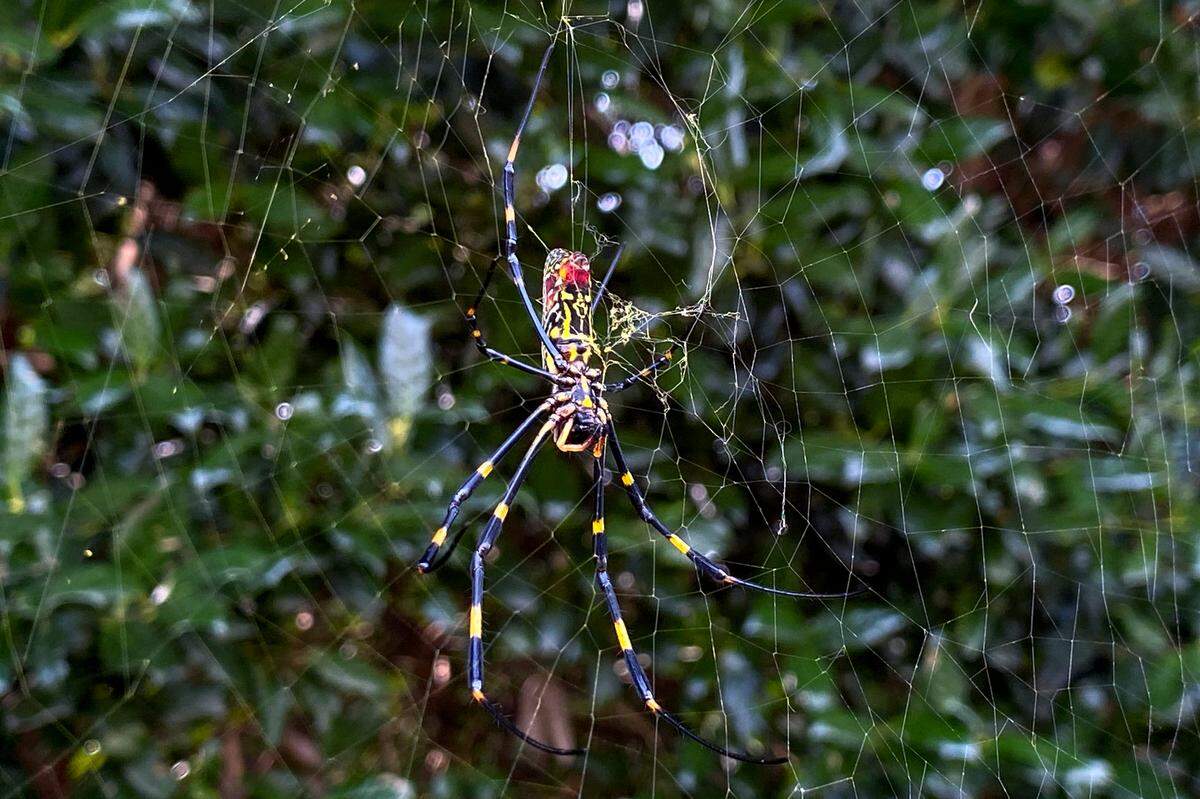
How big is the Joro spider?
Honestly, it’s pretty big.
But if a big one stops you in your tracks, it’s likely a female. The males are pretty small.
“Adult females will have legs around three inches long, so if you flatten them out, their leg span is around 6-to-8 inches, the average size of an adult human palm,” USA Today reported.
The female’s abdomen is usually full of eggs, and that measures to about the size of your thumb, William Hudson, entomologist at the University of Georgia, told USA Today.
Is the Joro spider poisonous?
Joro spiders aren’t venomous to humans, and they don’t even want to bite you, Oten said.
They’ll only bite if provoked, and their fangs often aren’t large enough to pierce human skin, according to a recent report by the University of Georgia’s UGA Today.
We know that brightly colored creatures are often bad news: if they don’t care about blending into their environment, they’re a predator. In the Joro’s case, its bright yellow marks across its body and legs are warning signs to other bugs, not to humans.
“It’s like the monarch butterfly, which is bright orange, but humans don’t care about that,” Oten said, noting that humans will pay to go inside an enclosed space with monarch butterflies (i.e. a butterfly house) — something most of us can’t imagine doing with a Joro spider, but it’s the same concept.
“Joros are poisonous to insects, just like monarchs are poisonous to birds,” she said.
Will Joro spiders be bad for North Carolina’s ecosystem?
Research has shown that Joros have had little to no effect on ecosystems.
In fact, they can even be seen as beneficial, as they provide pest control and serve as snacks to birds and other predators, Oten wrote in a recent article for NC State Extension Forestry.
The Joro spider was first found in the United States in 2013 in Georgia, and it has since spread to South Carolina.
The Joro, compared to similar kinds of spiders in these southern, warm-weather environments, seems to be acclimating well. This means that if Joros come to North Carolina and are here to stay, they’re more a nuisance than a negative thing, Oten said.
So if you see a Joro outside doing Joro things, do your best to leave it, Oten said. It’s getting rid of bad bugs and keeping the birds chirping, not plotting to kill you.
Will the Joro spider drop out of the sky?
You have probably heard this terrifying detail. It’s in headlines and discussed across social media.
It’s not a myth — but it’s also not a trait specific to the Joro.
“There are articles saying they will parachute out of the sky, but lots of spiders technically do that,” Oten said.
That’s because spiders can ride on electrical currents.
“Spiders have no wings, but they can take to the air nonetheless,” Ed Yong wrote in a 2018 article in The Atlantic about the electric flight of spiders. “They’ll climb to an exposed point, raise their abdomens to the sky, extrude strands of silk, and float away. This behavior is called ballooning.”
In fact, spiders of different kinds have been found over two miles in the air, and 1,000 miles out at sea, Yong wrote.
We’re not sure if that’s supposed to make us feel better, but yes, the Joro spider can be in the sky and drop out of it — just like many other spiders can also do.
This story was originally published March 16, 2022 at 11:49 AM.