Are Raleigh’s trees protected from developers? What to know about the rules.
READ MORE
Read more Triangle Asked & Answered stories
This series from The News & Observer’s Service Journalism team answers questions from readers about the Triangle region (and North Carolina). Here are some of the questions we have answered so far.
Expand All
The latest in our Asked & Answered series, in which we answer questions from the community, dives deeper into tree protection in Raleigh.
Last month, a Raleigh resident asked us how the city was keeping up with its “City of Oaks” nickname, as she felt “Raleigh’s old oaks are stressed and dying.” We learned how Raleigh replaces the oak trees that die of old age or heavy hurricane winds.
Since publishing this story, we heard from more readers wondering if trees have any protections during development projects.
We spoke again with Zach Manor, an urban forester for the city of Raleigh, to learn how trees are protected during the large-scale development projects that take over sprawling acres of land.
“This issue is pretty complicated, even in the best of situations, and every development proposal and review process looks so different,” Manor said.
“And you have to remember, while developers are sorting out tree conservation, they’re also looking at numerous other city and state requirements. … It’s a big jigsaw puzzle, and all these things have to get sorted out to let the project move forward,” Manor said.
Here’s what to know about Raleigh’s tree protection during development projects:
Does Raleigh have rules to protect trees against development projects?
In short, yes.
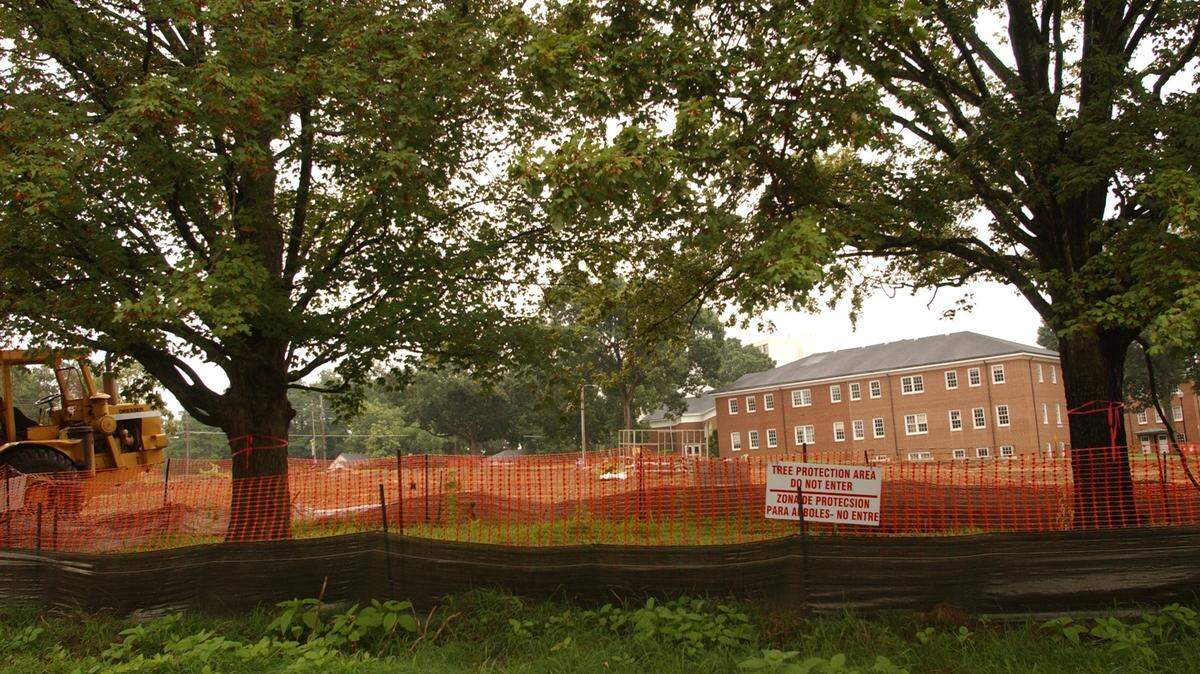
Tree conservation requirements during development apply to properties two acres and larger.
When a property owner wants to develop, they need to submit a plan to the city of Raleigh for review, ensuring all regulatory requirements are met, Manor said.
When applicable, Urban Forestry will review the private property for tree conservation requirements. Until all requirements are met, including tree conservation ones, permits can’t be issued and plans can’t be approved.
Which trees are protected in Raleigh during development?
Tree conservation areas (and occasionally individual trees) must be up to certain standards in order to be conserved during these two-plus acre development projects. Some of these standards include:
- Tree health (as hazardous and unhealthy trees wouldn’t best be preserved)
- The size of the area
- The density and size of the trees
- The species of trees and
The presence of easements, utilities or infrastructure
“For example, invasive tree species don’t count toward these requirements,” Manor said.
If areas or individual trees don’t meet these requirements, they don’t qualify as tree conservation areas, meaning they aren’t required to be protected under tree conservation regulations.
“It’s also important to mention the city’s authority to regulate trees on private property comes from the state, and that any requirements must be specifically granted through enabling legislation,” he said.
How many trees are preserved during development projects?
A 10% minimum of qualifying trees must be preserved.
But Raleigh’s tree conservation ordinance prioritizes groups of trees over individual trees, Manor said.
“It’s easier to think about it in areas of trees as opposed to a specific number of trees. On a three-acre property, three-tenths of an acre generally must be preserved in trees.”
If this three-acre parcel of land is completely wooded, the developer can ensure one area of the land — measuring three-tenths of an acre, equaling 10% — remains untouched, Manor said.
But if the area doesn’t have qualifying tree-studded patches to preserve, then Urban Forestry starts looking at individual trees to keep around, which must be 10-inches wide in diameter or greater. As long as developers follow proper prioritization rules and code requirements, they have some flexibility with the location of tree conservation areas.
“On a three-acre parcel that’s completely wooded, you can do one large area, or you can do three medium-sized areas, one small area and two individual trees to meet the requirements. You can get creative with it,” Manor said.
It’s easier to make these decisions when looking at a parcel of wooded land that’s crowded with trees, Manor said. When a five-acre parcel of land is only 11% populated by trees, the freedom to decide which trees to keep and which trees to remove gets more difficult.
“And if only 6% of the land is made up of trees, you have to keep it all, if the trees qualify,” Manor said. “There’s no requirement to plant additional trees to equal 10% — it’s only saving existing trees.
“Some areas in Raleigh are completely wooded and need to be torn down in order to develop, but most of Raleigh now is only experiencing re-development,” he said.
Are trees planted elsewhere to offset development projects?
No, Urban Forestry does not require any offset planting to make up for torn-down trees.
But Raleigh’s Department of Planning and Development has a lot of planting requirements, Manor said.
“If we’re talking about the number of trees planted, it doesn’t always come down to conservation or protecting trees in right of way areas,” he said.
When constructing a new (or improving a current) parking lot, for example, a 300-square foot interior island for a “shade tree” must be provided every 10 parking spaces, according to the city’s Unified Development Ordinance.
Street trees are sometimes required to be installed, depending on the type of development. And when trees in the public right of way — also known as “City trees,” which are planted in those squares of grass between the street and sidewalk — can’t be protected during small-scale developments, they need to be replaced.
Read more about protecting street trees in our previous Asked & Answered story: newsobserver.com/news/local/ask-and-answered.
This story was originally published March 8, 2023 at 8:00 AM with the headline "Are Raleigh’s trees protected from developers? What to know about the rules.."